Museum of Theatrical and Musical Arts St Petersburg Russia
i. AES+F group

Considered i of the most successful and famous art groups today, AES+F has exhibitions all over the world. The multimedia installations and projects by Tatyana Arzamasova, Lev Yevzovich, Yevgeny Svyatsky and Vladimir Fridkes are devoted, primarily, to global culture and an assay of modern values.
'Inverso Mundus', 2015
Their installation film "Inverso Mundus" (Latin for "inverted world") was shown at the Venice Biennale and is however touring museums around the world.
2. Ivan Aivazovsky

Ivan Aivazovsky / Uffizi Gallery
No-i paints the sea like Ivan could! Painter Aivazovsky was revered every bit one of the about prolific artists, creating over 6,000 seascapes. Art historians and art critics consider 'The Blackness Bounding main' artwork to be his magnum opus, the result of the artist'south rethinking of his life and career.
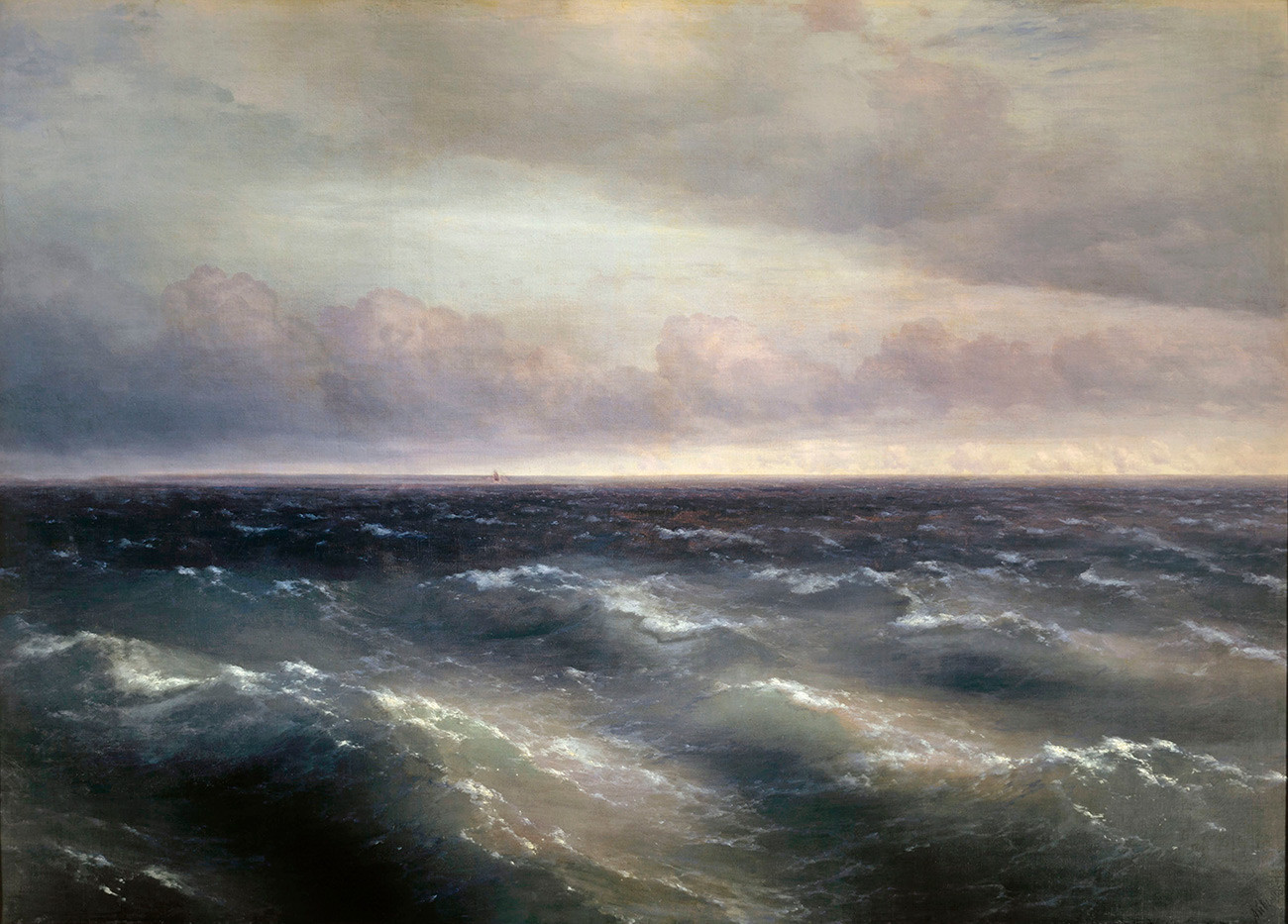
'The Black Ocean', 1881
Ivan Aivazovsky / Tretyakov gallery
3. Yuri Albert

Albert'south famous artworks with text frequently go Cyberspace memes, while his retrospective exhibition, "What did the artist mean by that?" at the Moscow Museum of Modernistic Art, remained in a land of permanent alter throughout its duration. This is what Yuri Albert is all nearly. At the historic period of 15, this conceptualist artist institute himself in the workshop of Komar and Melamid, under whose influence he began creating works that rethink the essence of modern art.
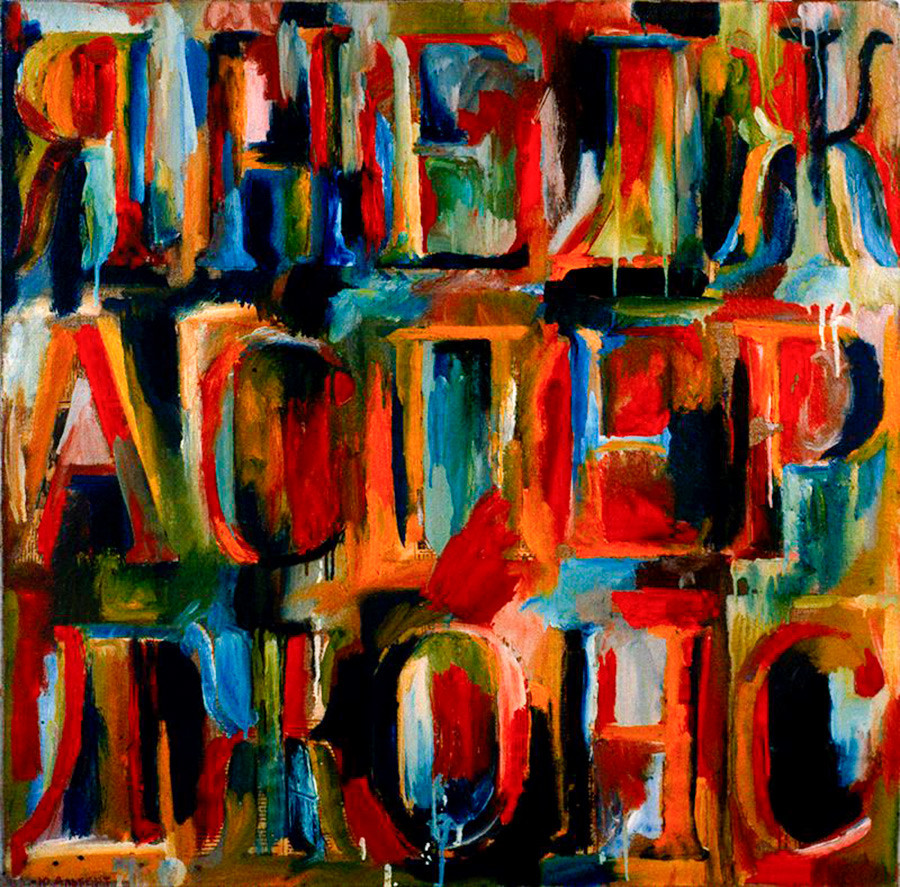
Albert's favorite trick is to take a well-known piece of work, change it and turn it into his ain, at the same fourth dimension engaging in a polemic with the original. Take, for example, his landmark series of works in which the artist ironically compares himself with international fine art stars.
4. Leon Bakst

The European success of Sergei Diaghilev's famous Russian Seasons in Paris was largely due to Bakst. His sets and costume sketches for Ballets Russes productions became a sensation in their own right: they were even exhibited in the Louvre, while Bakst's Orientalist mode ready a fashion in Paris for turbans, wide trousers and colored wigs.
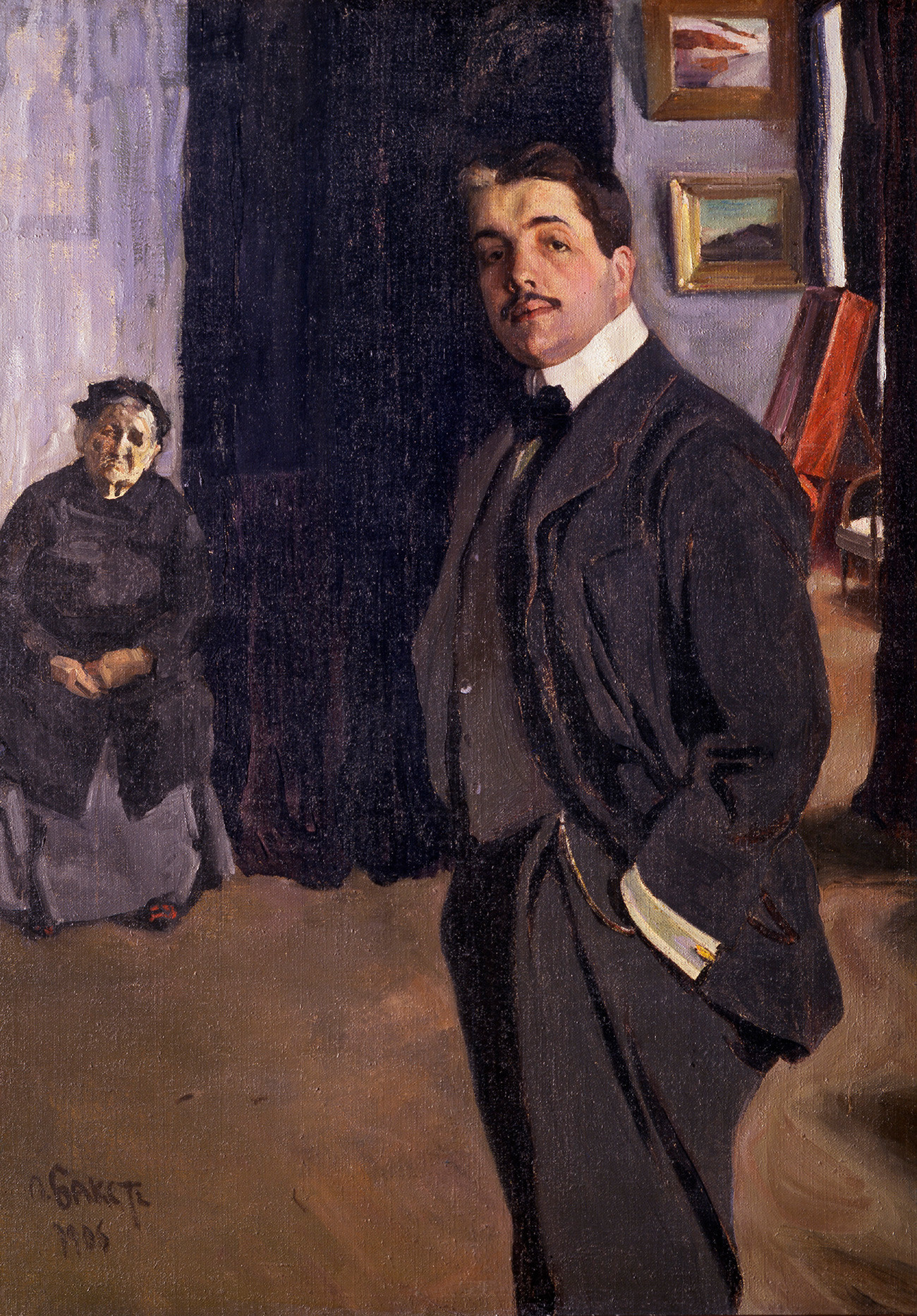
'Portrait of Sergei Diaghilev and his Nanny', 1906
Global Look Printing
v. Andrey Bartenev

Anatoly Lomokhov/Global Look Press
The eccentric Bartenev made a name for himself in the 1990s: his costumes made of whatsoever bachelor materials, equally well as performances and installations, became a symbol of the time.
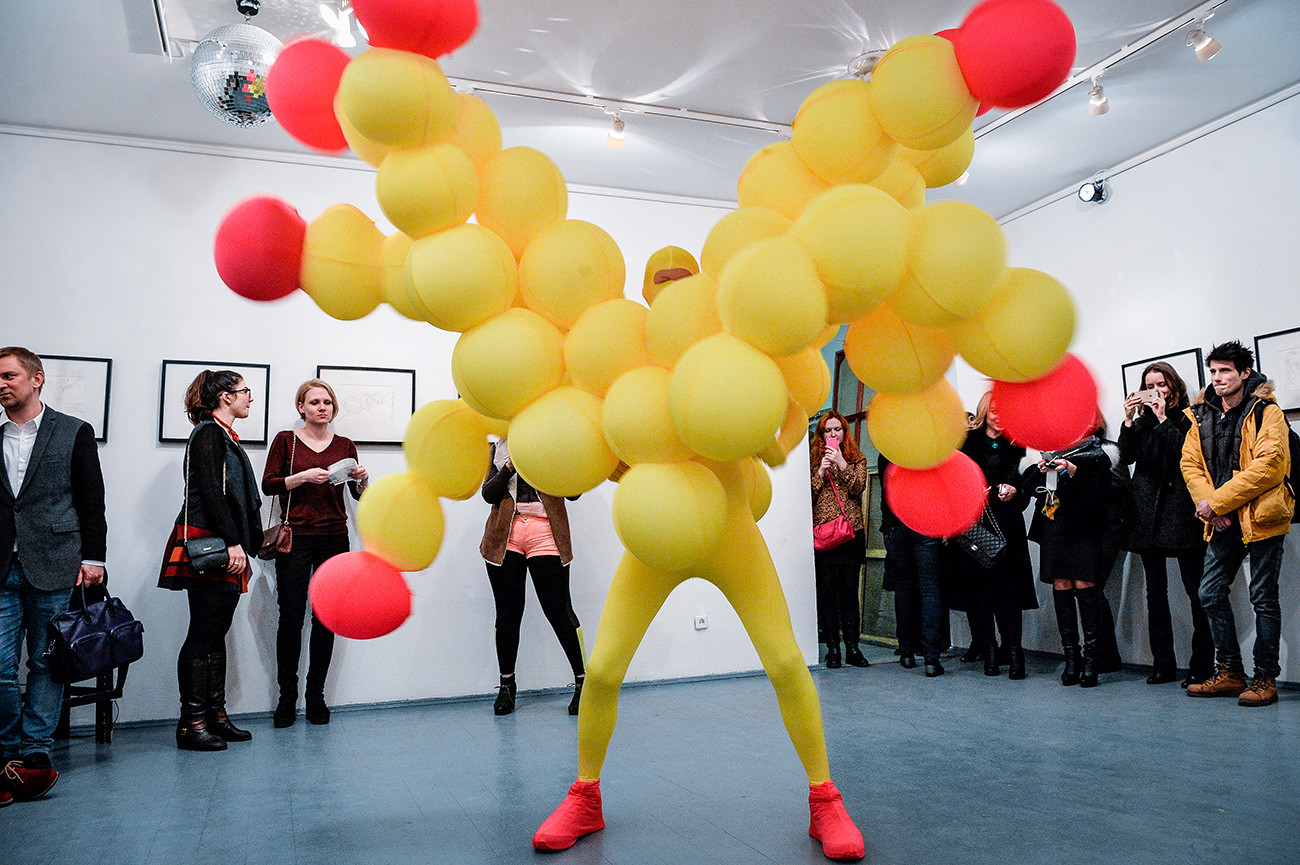
'Bubbles of Hope' performance, 2013
Evgeny Odinokov/Sputnik
Since then, he has become known every bit "a master of the outrageous", a one-homo festivity and a walking performance: Bartenev stands out in a crowd thanks to his bright freakish costumes. They continue to be his way of exploring the globe or rethinking familiar plots.
6. Ely Bielutin

Avant-garde creative person Bielutin had a reputation for experimentation and mystification. He set up a studio in Moscow and a kind of a school called New Reality, which united more than 3,000 artists. In 1962, works by his studio's abstract artists were exhibited at the Manezh exhibition hall in Moscow.
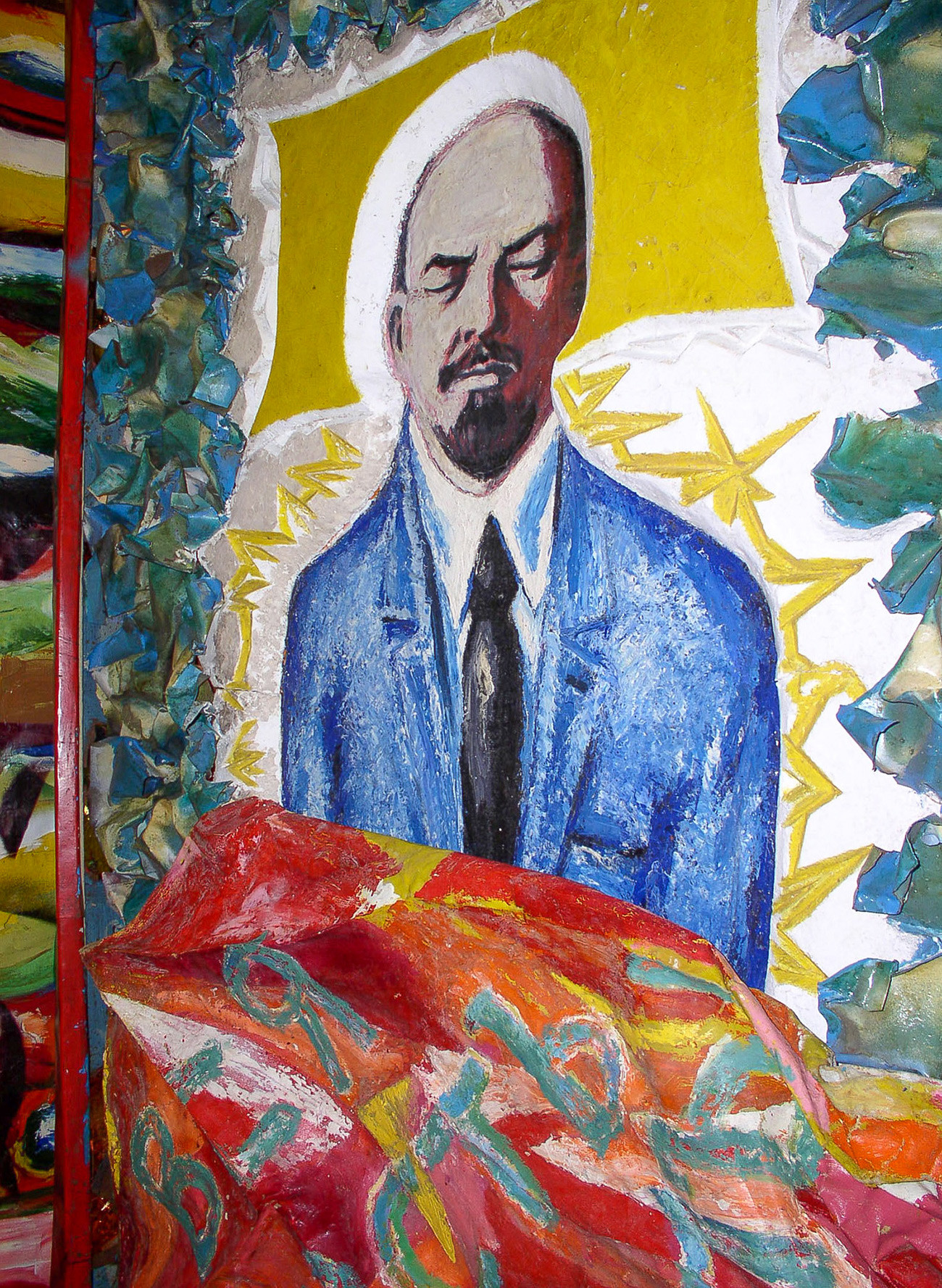
'Lenin's Funeral', 1962
Lyubov Chilikova/Sputnik
The exhibition was visited past Communist Party Secretary-General Nikita Khrushchev, who hated what he saw, describing it "a mess". After that, New Reality was near banned, with Bielutin condign a recluse and not displaying his works almost until perestroika.
7. Victor Borisov-Musatov

Borisov-Musatov was a symbolist, who specialized in painting dilapidated sometime manors, garden tea parties and members of the Russian dignity at the plow of last century. They say that as a representative of the Silver Historic period, he tried to capture "the vanishing world" and the last echoes of an outgoing era.
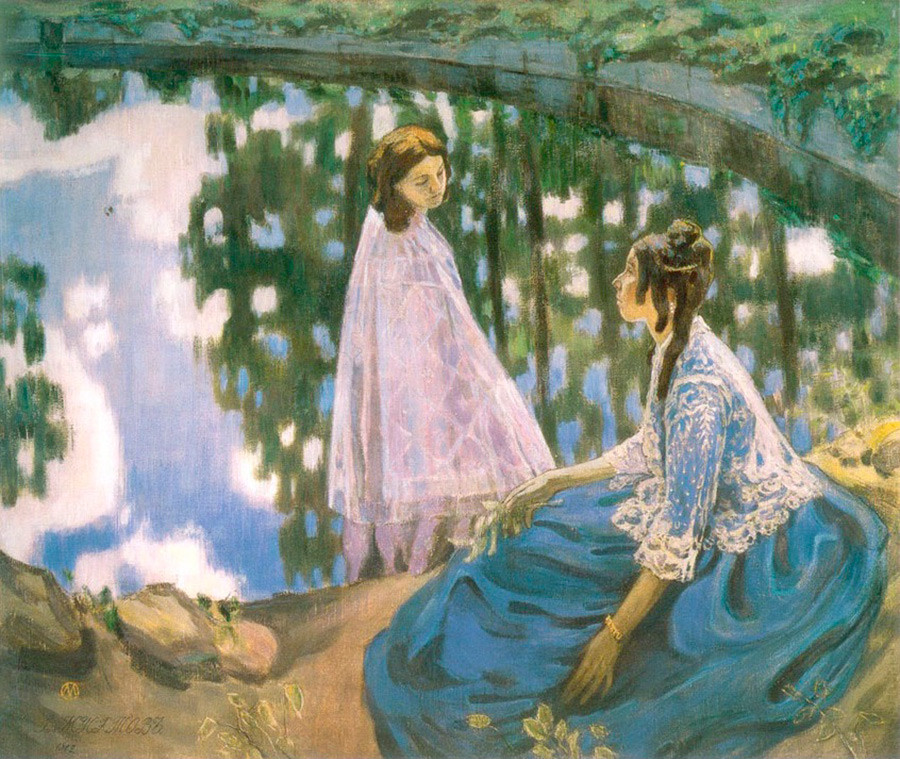
'The Pool', 1902
Victor Borisov-Musatov / Tretyakov Gallery
'The Puddle' was the starting signal of his recognition as a symbolist artist: the painting depicts his sister and bride sitting by a country house swimming. The film became his wedding gift to his wife and his showtime significant success.
8. Karl Bryullov

Bryullov was one of the best portrait painters of his time. He painted official and individual portraits of the Russian aristocracy, attended purple receptions and knew Alexander Pushkin.
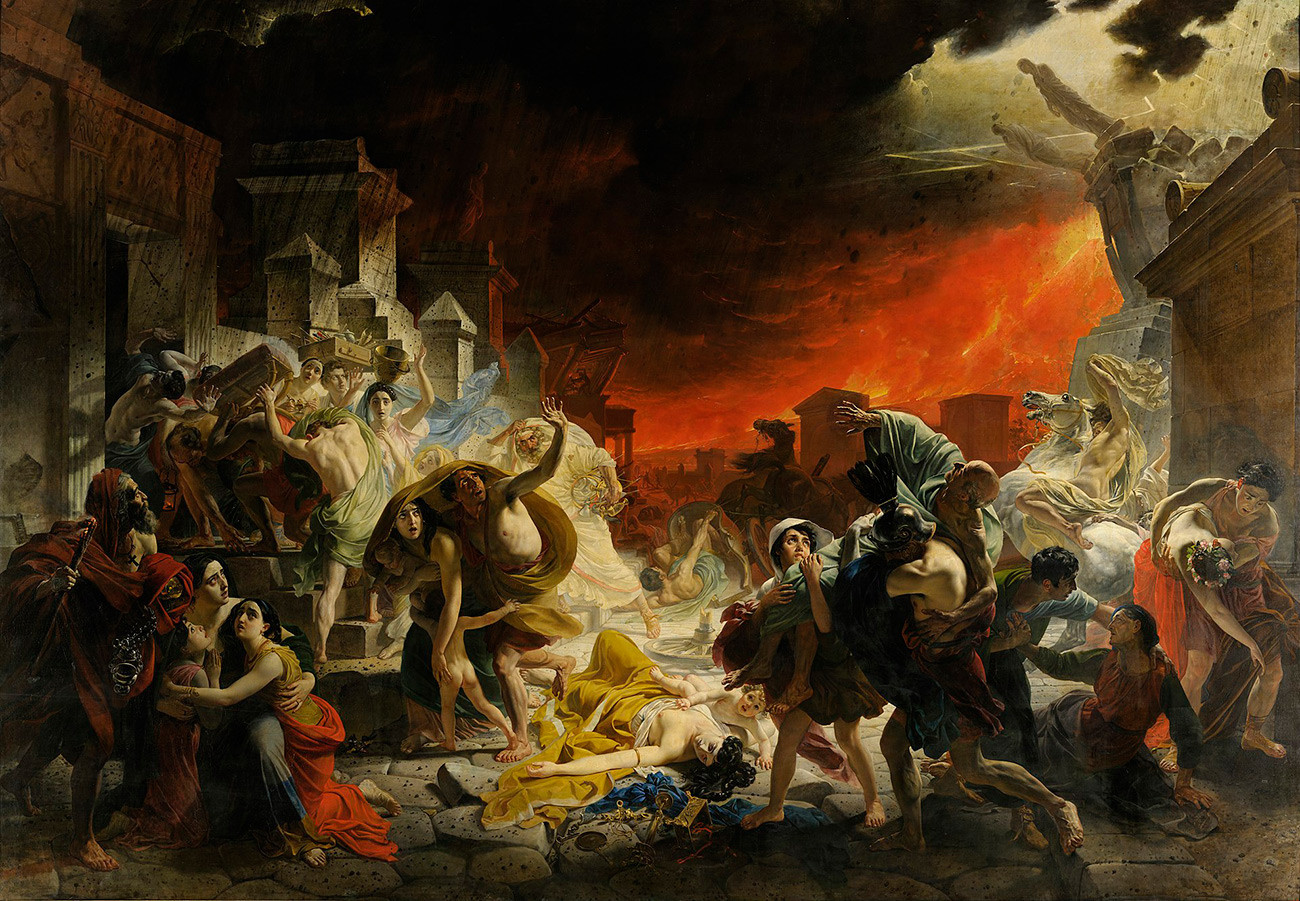
'The Last Day of Pompeii', 1833
Karl Bryullov / The State Russian Museum
But all that came after 12 years living in Italian republic, six of which Bryullov had spent working on his awe-inspiring piece of work 'The Final Day of Pompeii'. For information technology, the artist received the Thousand Prix at the Paris Exhibition and recognition in Europe and Russian federation.
9. Vladimir Borovikovsky

Ivan Bugaevskiy-Blagodarniy / Kaluga Museum of Fine Arts
He painted the Russian aristocracy, including the emperor, but is amend known for his portraits of immature ladies, which are displayed not only in the Tretyakov Gallery in Moscow only also at the Louvre in Paris. Borovikovsky'due south trademark accomplishment was his ability to express the distinct sensuality of his models.
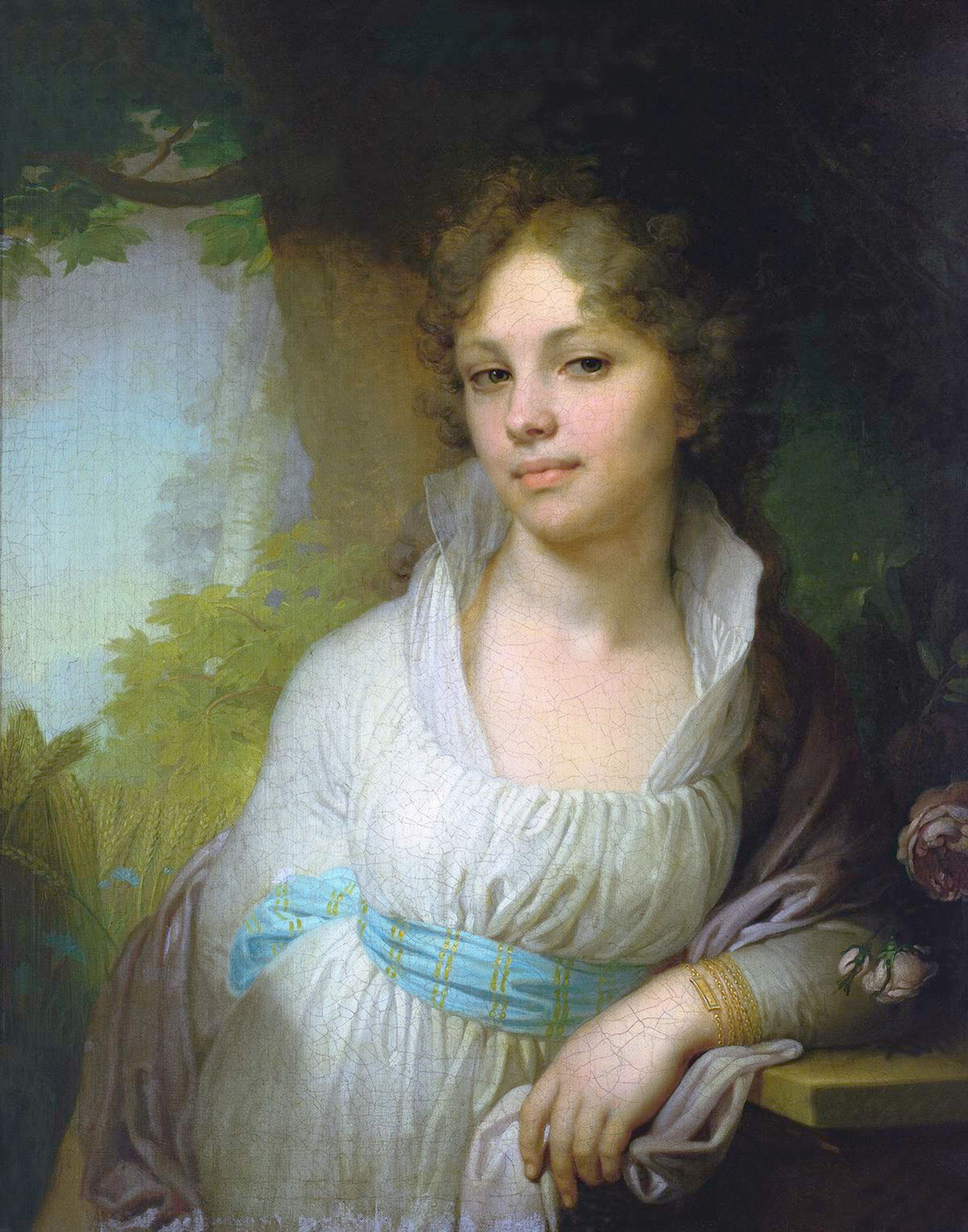
'Portrait of Maria Lopukhina', 1797
Vladimir Borovikovsky / Tretyakov Gallery
10. Grisha Bruskin

In the Soviet Union, his works were rejected, and he institute recognition only with the offset of perestroika. In 1988, at Sotheby's first and only auction in the USSR, his "Fundamental Dictionary" was sold to a Western collector for a (then) tape-breaking $416,000 (following an interrogation by the KGB, the predecessor to the FSB). A couple of weeks later, Bruskin was in America, and his work has since been exhibited in the world's most famous museums.
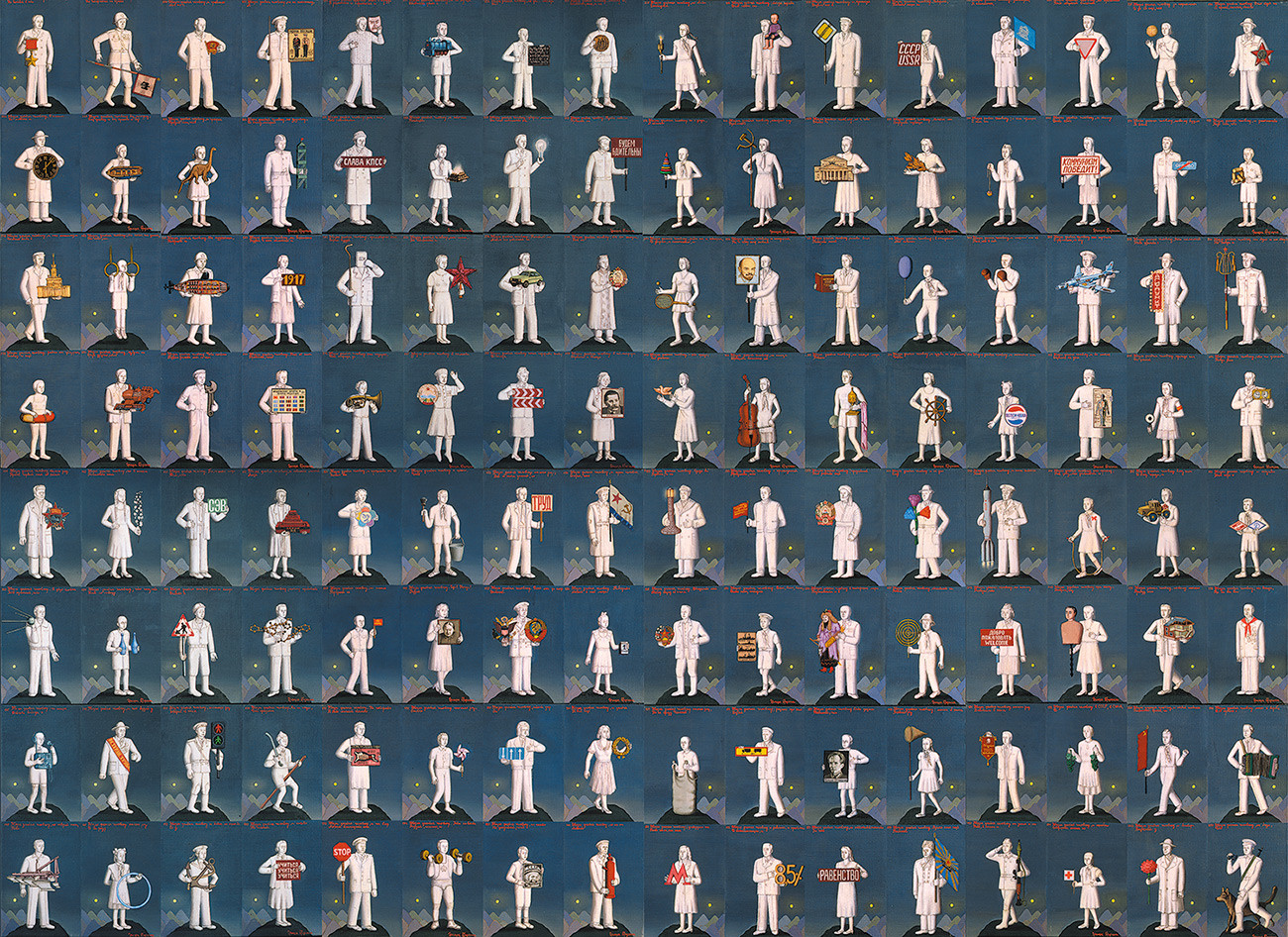
'Primal Lexicon', 1986
Press Photograph
'Fundamental Lexicon' is a series of canvases in which numerous plaster figurines - pioneers, athletes, proletarians, Komsomol members – are carrying the emblems of official Soviet culture, the visual code of Soviet mass agitation and propaganda.
xi. David Burliuk

Burliuk gained recognition as "the begetter of Russian futurism" both in Russia and away, in item, in New York, where he settled in 1922 and was agile in pro-Soviet circles. Burliuk promoted futurism and cubism past all ways bachelor to him: he published a mag, printed brochures, wrote poems and reviews, and painted.
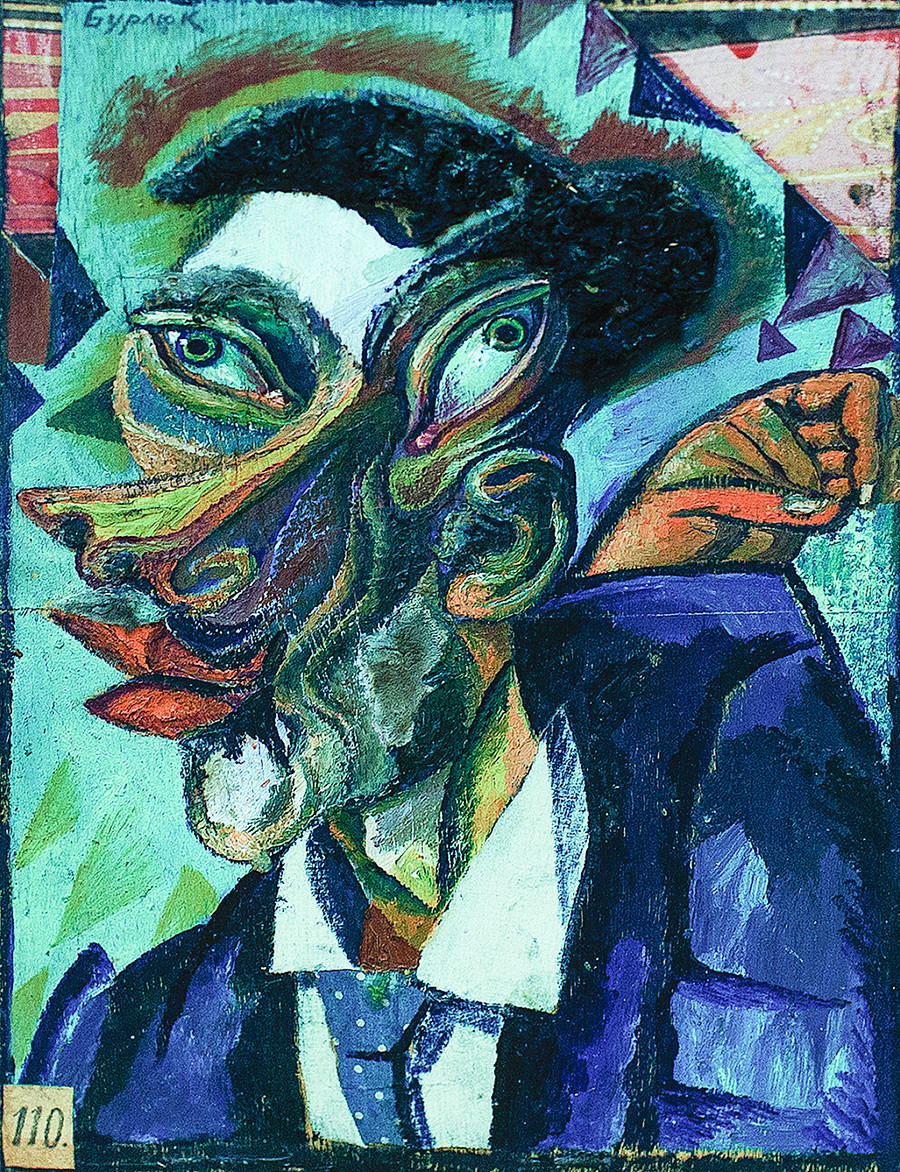
'Portrait of My Uncle', the 1910s
David Burliuk / Irkutsk Regional Art Museum afterwards the name of V.P. Sukachev
Genuine success came to him with his 'Portrait of My Uncle', Burliuk'south merely painting that he managed to find a buyer for in near every city. It became his manifesto of cubo-futurism. "The artist created [the portrait] chop-chop in a hotel, by gluing newspaper clippings into an angle-torn face, which had three optics, 2 noses and then on," his friend and fellow creative person Yevgeny Spassky recalled.
12. Erik Bulatov

Bulatov was one of the founders of Sots Art, along with Komar and Melamid. His solo exhibitions are held in leading museums and galleries around the earth.
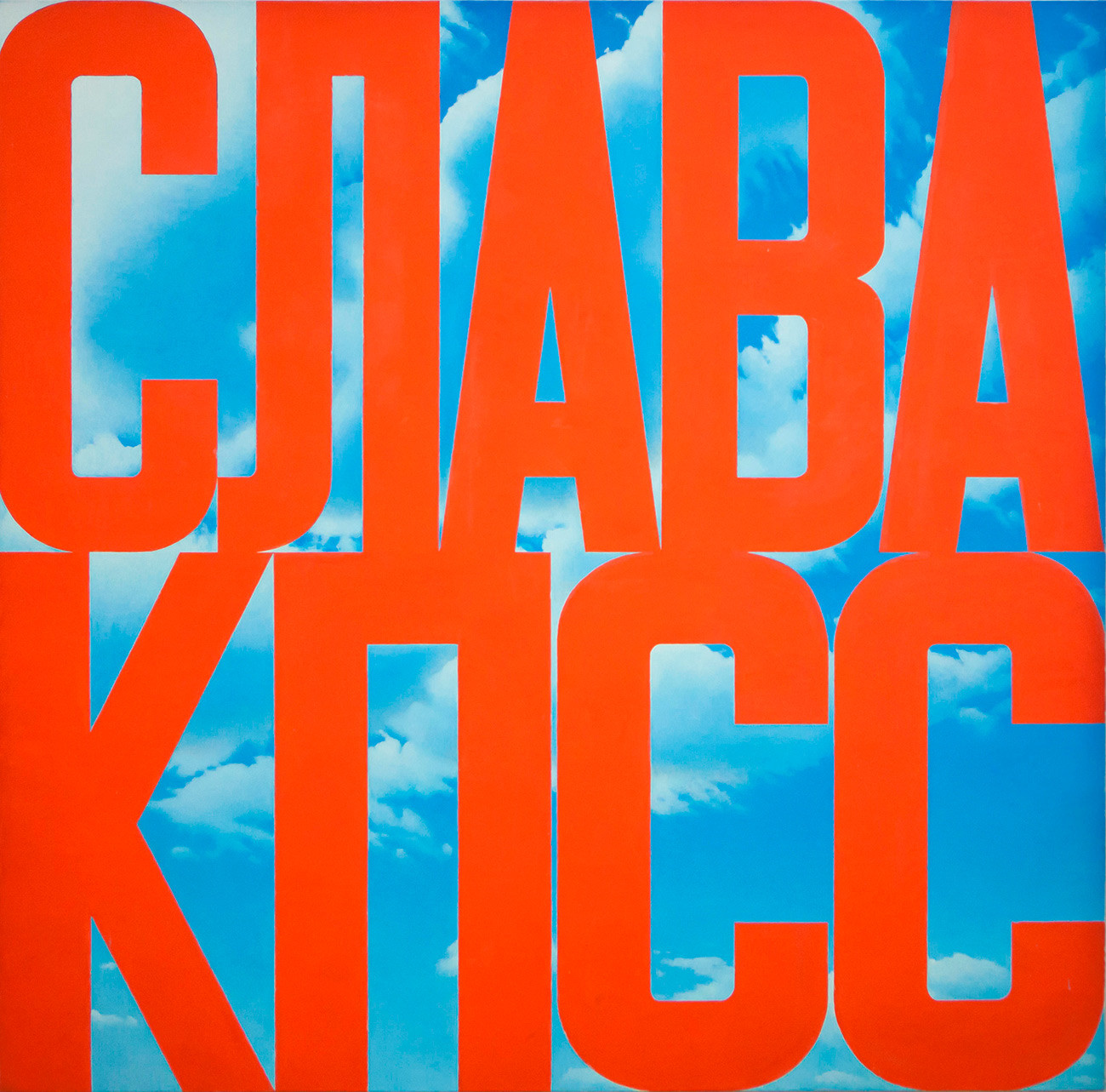
'Celebrity to CPSU Two', 2002-2005
Legion Media
"Space is liberty," Bulatov used to say. Literally, 'Glory to the CPSU' is a Soviet slogan set up against the background of a blueish heaven. Metaphorically, it is freedom that is seeping even through the grid of communist credo.
13. Marc Chagall

One of the leaders of the Russian avant-garde, Marc Chagall created his unique, inimitable style. His almost famous work depicts everything that the artist had at that moment in his life: himself, his wife and everlasting muse Bella and the houses of his native Vitebsk.
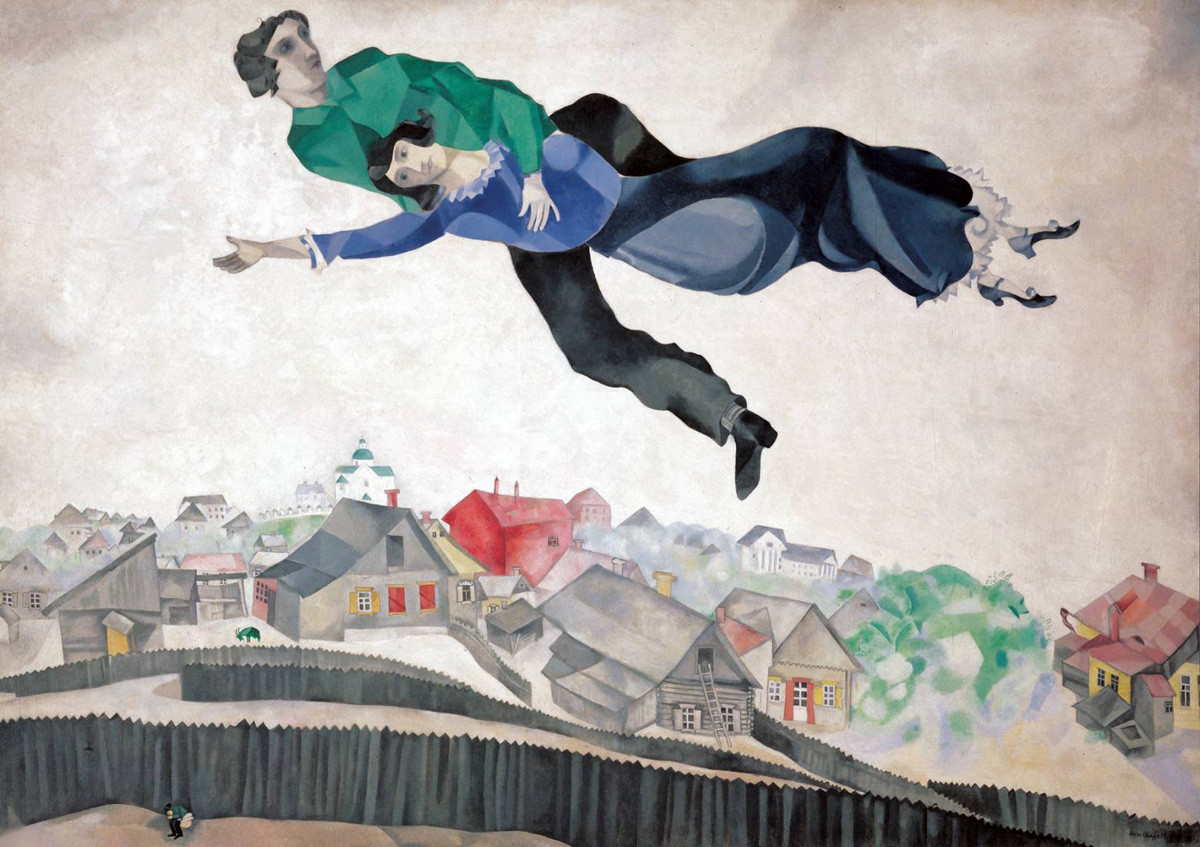
'Over the Town', 1918
Tretyakov Gallery
This composition stayed with Chagall in emigration in France likewise, except that he replaced himself and his wife with a newlywed couple, and Vitebsk with Paris.
14. Olga Chernysheva

Garage Museum of Contemporary Fine art
Chernysheva is 1 of the nigh internationally sought-after Russian artists of today. Her paintings, videos, graphics and photographs were presented at several Venice Biennales and are exhibited in museums from Vienna to New York.
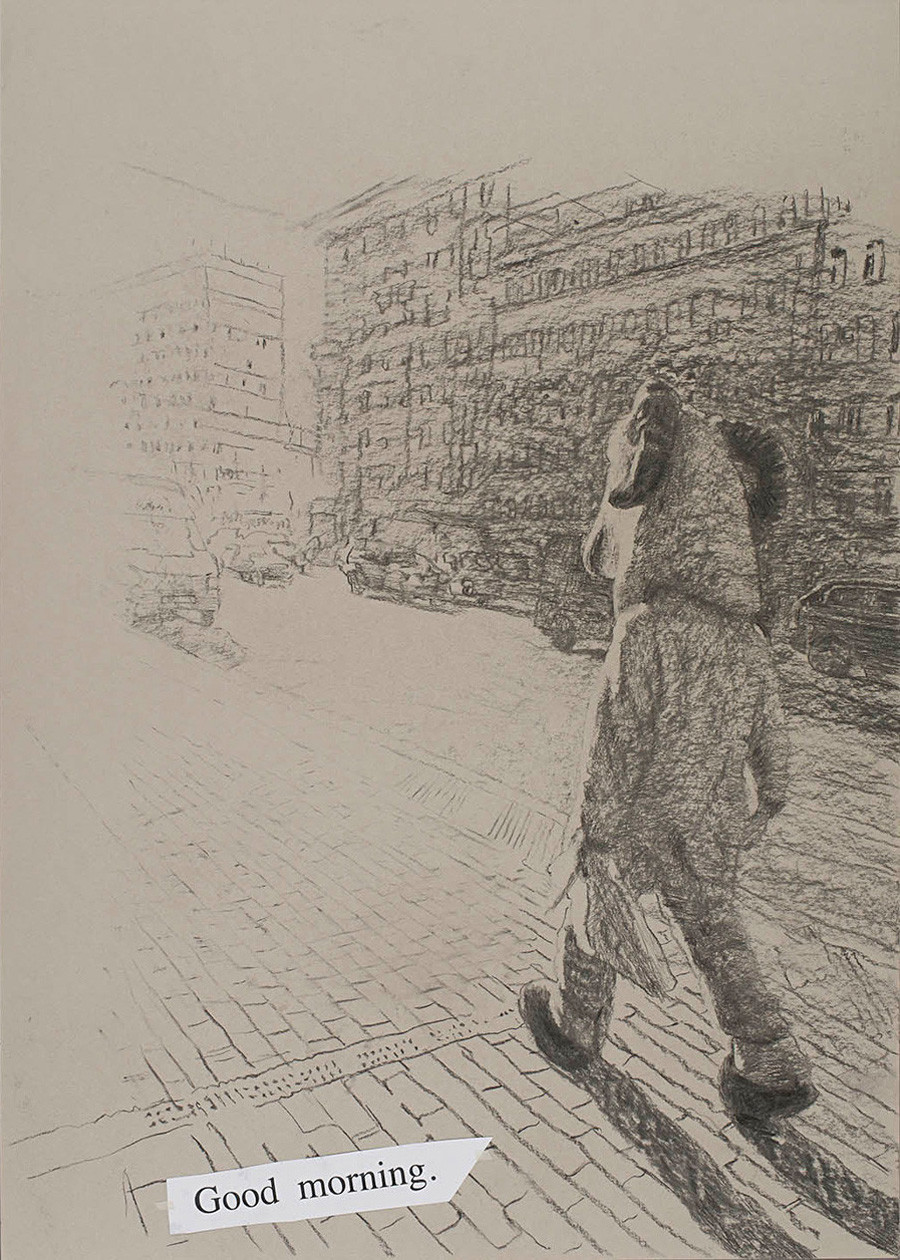
'Untitled. Good Morning', 2014
Olga Chernysheva
She is a stranger to monumentality, and is inspired past the small artifacts of life: mundane occurrences, like a song on the subway or homeless people sleeping on a bench. She uses these everyday scenes to create an image (and a very intimate i) of modern Russia.
xv. Ivan Chuikov

Another hero of the Soviet artistic underground, Chuikov is fascinated by the idea of combining illusion and reality, different styles and languages. This is how his 'Windows…' series came almost. For example, in his "Roman" profile, one can decipher Piero della Francesca's famous portrait of Federico da Montefeltro. But for Chuikov, it is merely a silhouette and a red dot. What is it really? The lord's day? Or a red dot light amplification by stimulated emission of radiation sight pointing at the temple of a classic being ridiculed by postmodernism?
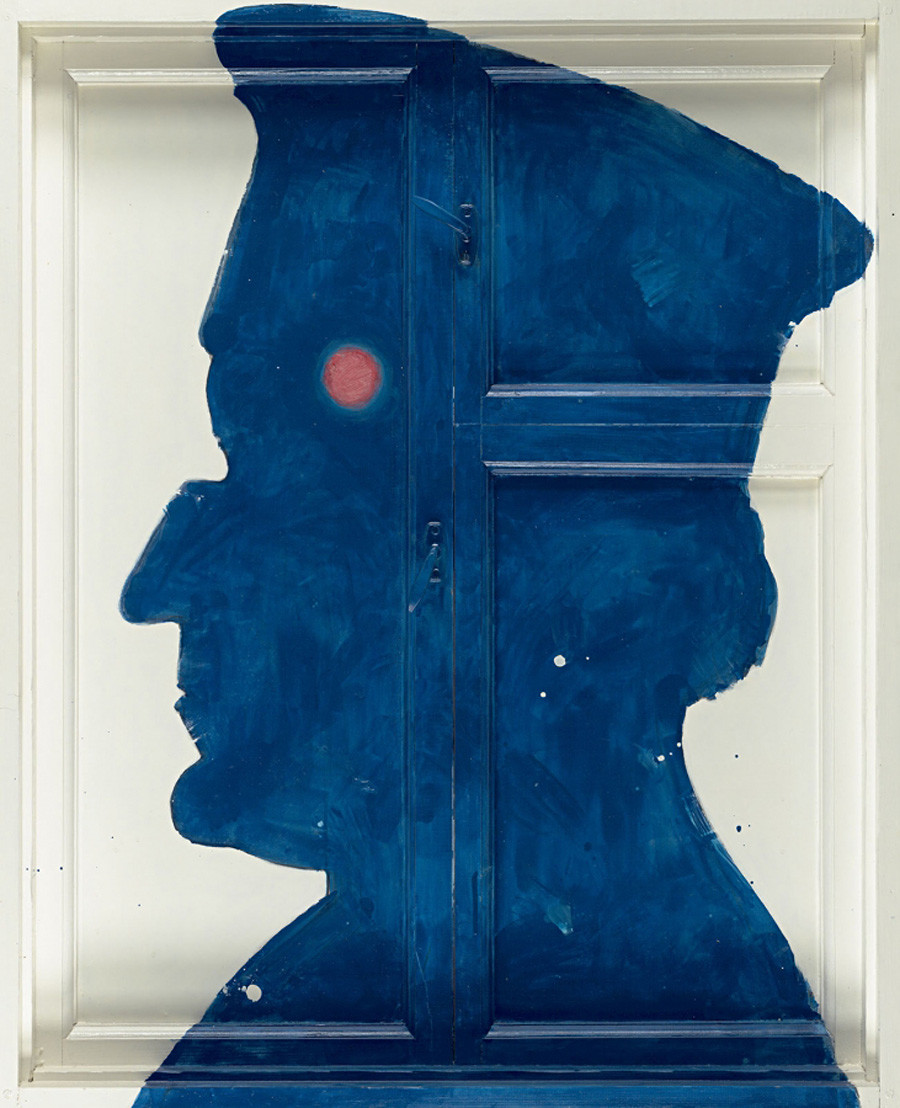
'Window LXIV', 2002
Moscow Museum of Modernistic Art
Chuikov's works can exist found at the Centre Pompidou, the Zimmerli Art Museum, the Russian Museum, and the Tretyakov Gallery.
16. Aleksandr Deyneka

This major figure in Soviet official fine art was one of the pillars of socialist realism, celebrating good health, sports, labor, and the new, Soviet, way of life. He polished this style to perfection: his strong, pumped-upwards men and women tirelessly, and with a smile on their faces, defend cities, piece of work in factories and glorify the party.
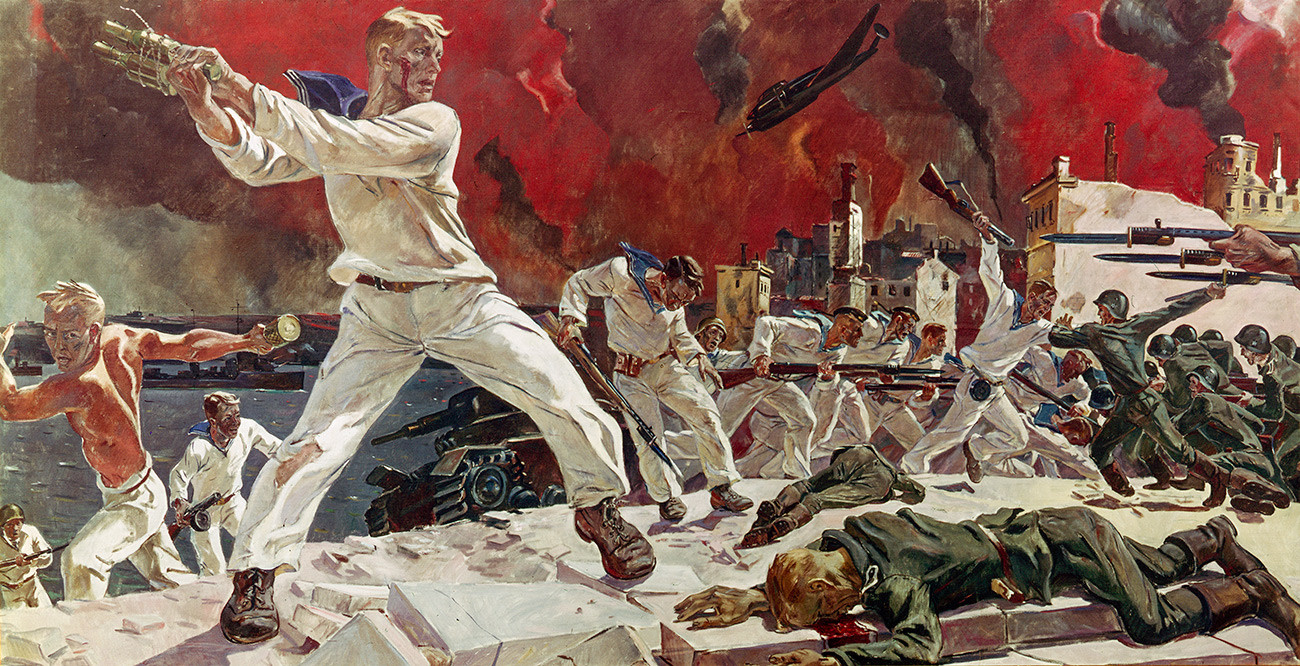
'The Defence force of Sevastopol', 1942
I. Kogan/Sputnik
Deyneka's contemporaries either idolized or hated him: where he depicted heroism in the name of communism, others saw deprivation and lack of pick. After all, his utopian projects were created against the backdrop of mass poverty and reprisals.
17. Elena Elagina and Igor Makarevich

This duo of Moscow Conceptualists, already considered living legends of contemporary art, experiment with the cosmos of social utopias with the assistance of fictional characters.
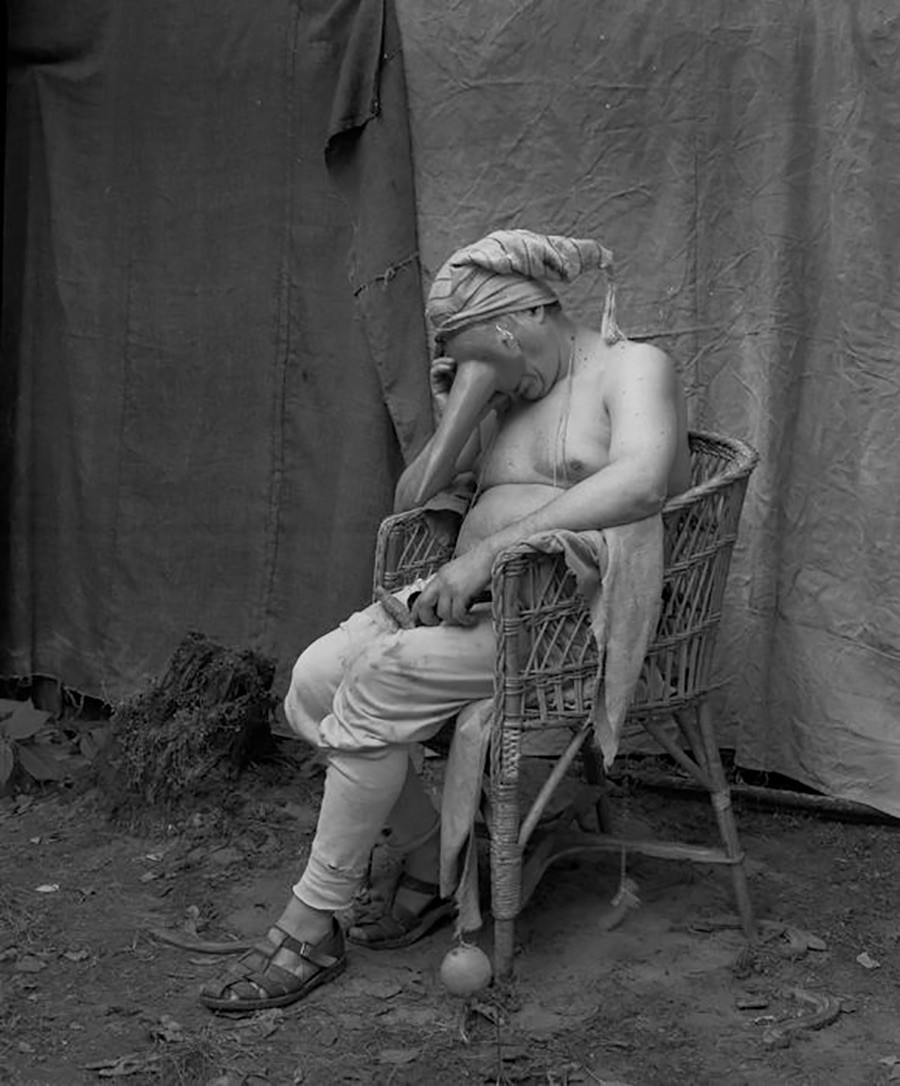
'Homo Lignum', 1996 - …
Igor Makarevich
1 of the most complex and longest of them, the 'Homo Lignum' project, is still ongoing. It tells the story of a humble auditor, Nikolai Ivanovich Borisov, who has a manic desire to go a tree.
18. Aleksandra Ekster

Ekster was one of the "Amazons of the avant-garde" and a fixture at all major exhibitions of the new art of the early 20th century. In 1907, she left for Paris for a while, where she fabricated friends with Pablo Picasso, Fernand Leger, Guillaume Apollinaire and many others, after which she began promoting their works dorsum domicile, helping Russian avant-garde artists to conform their techniques to their piece of work.
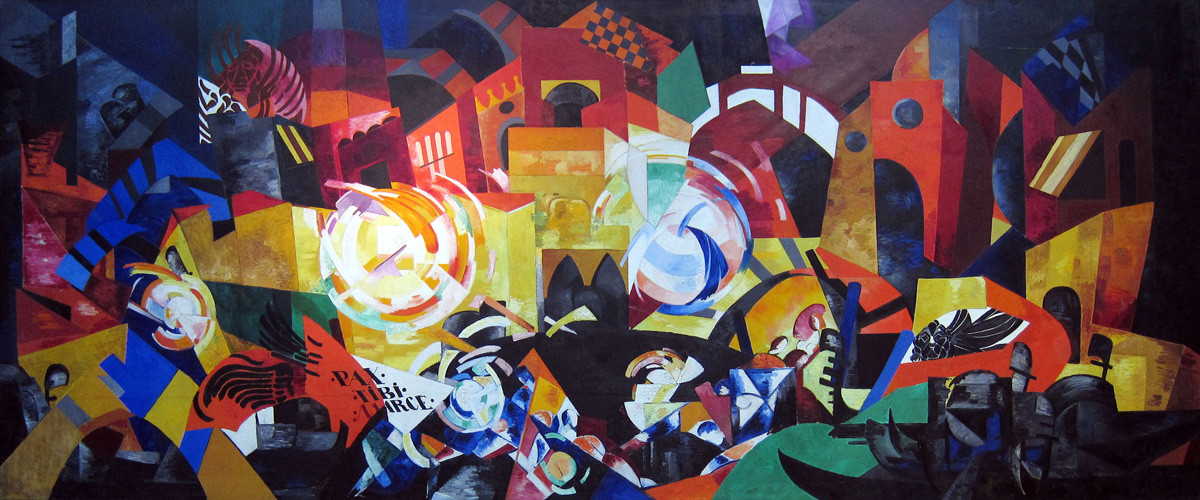
Venice, 1918.
Tretyakov Gallery
Ekster herself was a follower of futurism and, more specifically, of its peculiar Russian form, cubo-futurism. She illustrated futurist magazines, designed theater sets, costumes, pillows and fifty-fifty a uniform for the Red Regular army. But in 1924, she went to the Venice Biennale and never returned to Russia.
19. Semen Faibisovich

A master of photo-realism, Faibisovich paints mainly Moscow. Furthermore, as his subject thing he chooses the city's less attractive features: shabby courtyards, wastelands, kiosks, devious dogs, guest workers, homeless people, ordinary passersby. Yet, information technology is exactly for this reason that Faibisovich's works are believed to be capturing the elusive nature of time. And they are sold at over $400,000 past the world's leading sale houses.
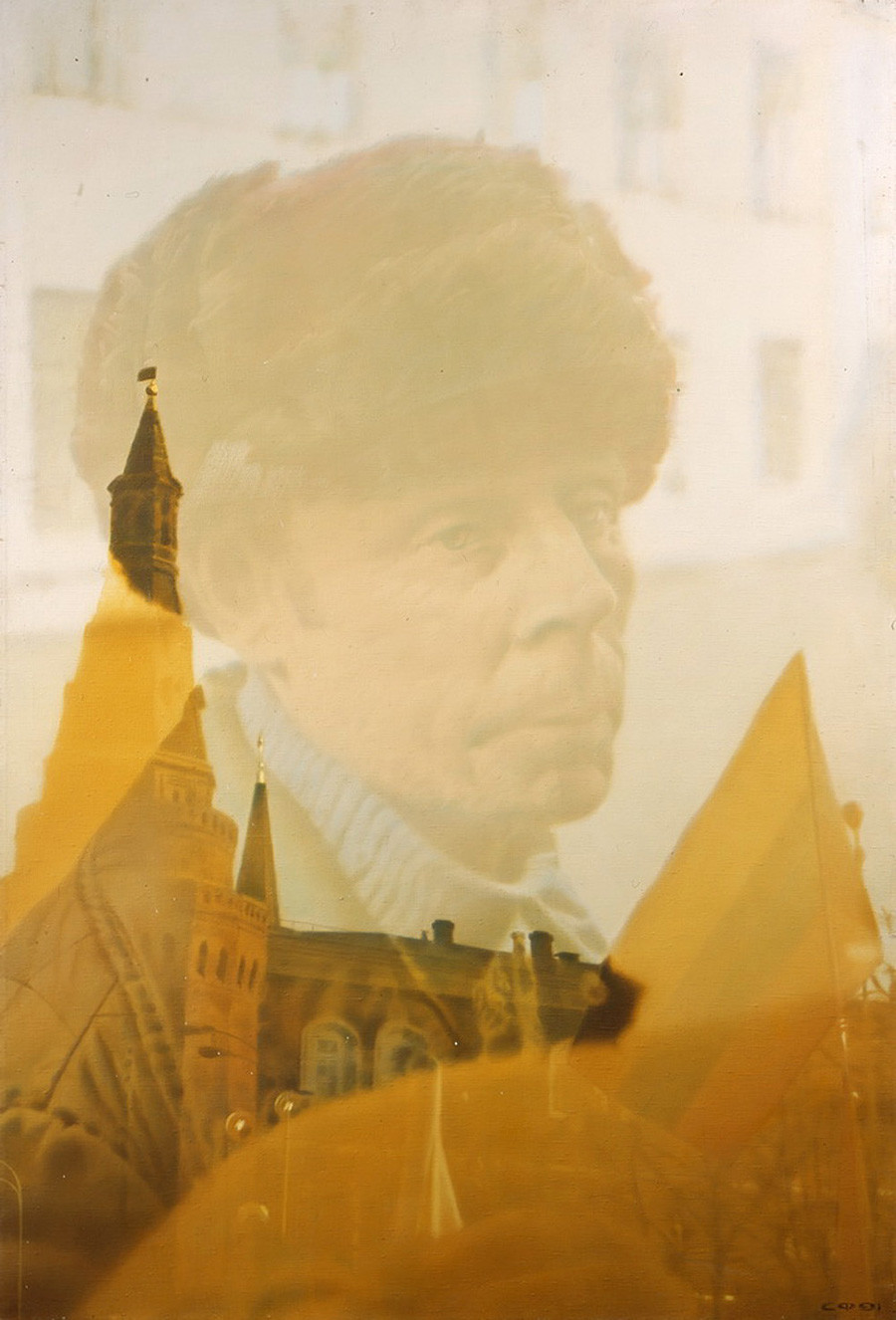
'Russian', 1991
Tretyakov gallery
20. Nicolai Fechin

Having rejected the Revolution, Fechin emigrated to the USA in 1923, where he lived happily for thirty years. That is why there are so many of his works in American museums and private collections away.
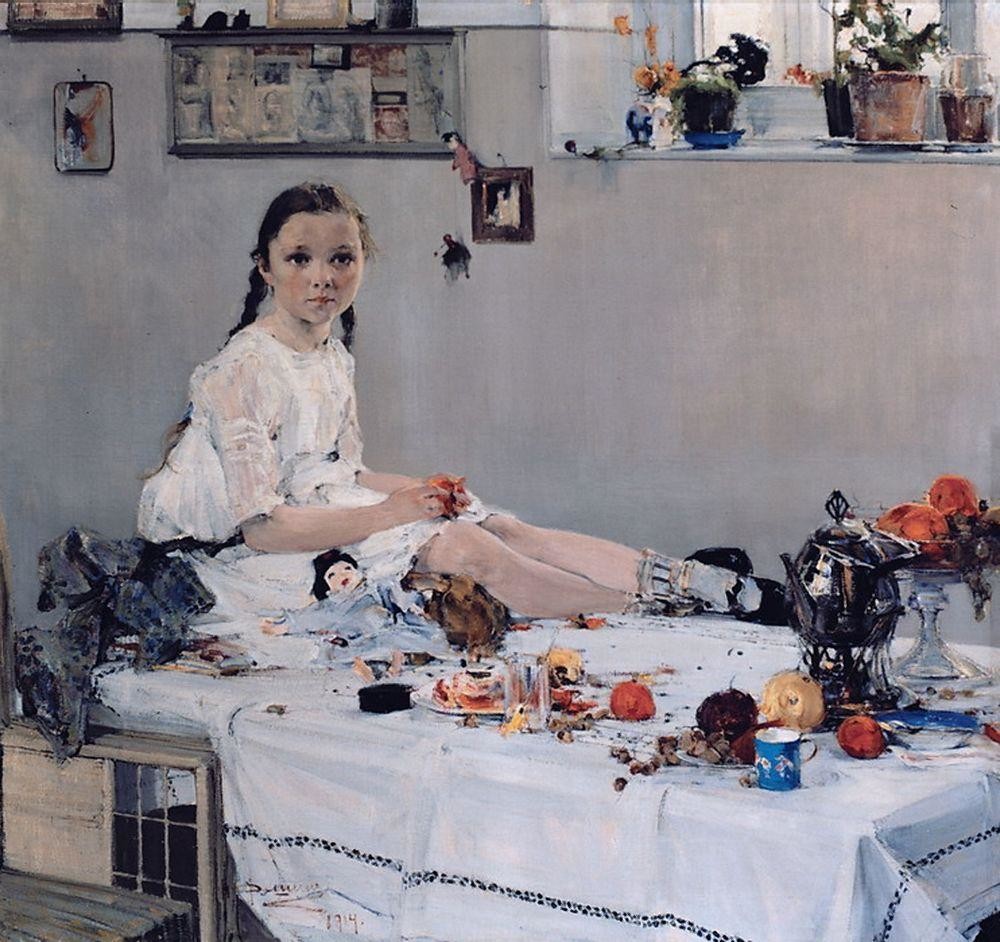
'Portrait of Varya Adoratskaya', 1914
Tatarstan Country Museum of Fine Arts
However, earlier he left Russia, he managed to create ane of his most significant paintings, the portrait of a immature Varya Adoratskaya, which is frequently compared to Serov's 'Girl with Peaches'.
These days, Fechin is amongst the most expensive Russian artists: in 2010, his canvas was sold for $11 million at a MacDougall's auction.
21. Pavel Fedotov

In the Russian Empire, marriage was often not for dear. Society did not await favourably on unequal marriages, but many people in the mid-19th century still considered it a great way of improving one'due south financial situation and social status. This is what i of the most famous paintings by a leading genre artist, Fedotov, is well-nigh.
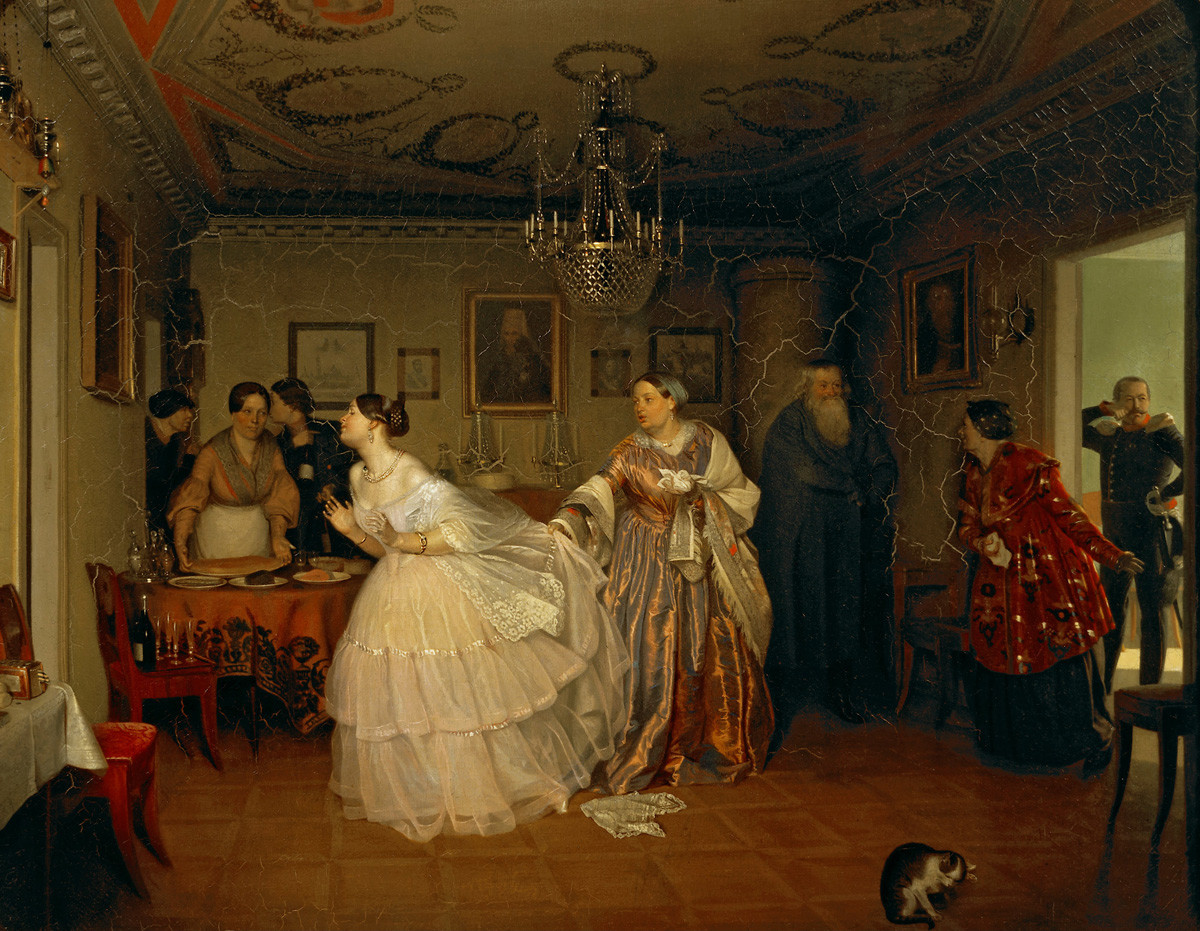
'Major'due south Matrimony Proposal', 1848
Tretyakov gallery
In its time, the moving picture acquired quite a stir: a merchant marries a daughter off to a bankrupt officer; the bridegroom will receive a dowry, while the merchant will become related to dignity.
22. Konstantin Flavitsky

Like many 19th century artists, Flavitsky spent time studying in Italian republic and is remembered for a unmarried masterpiece.
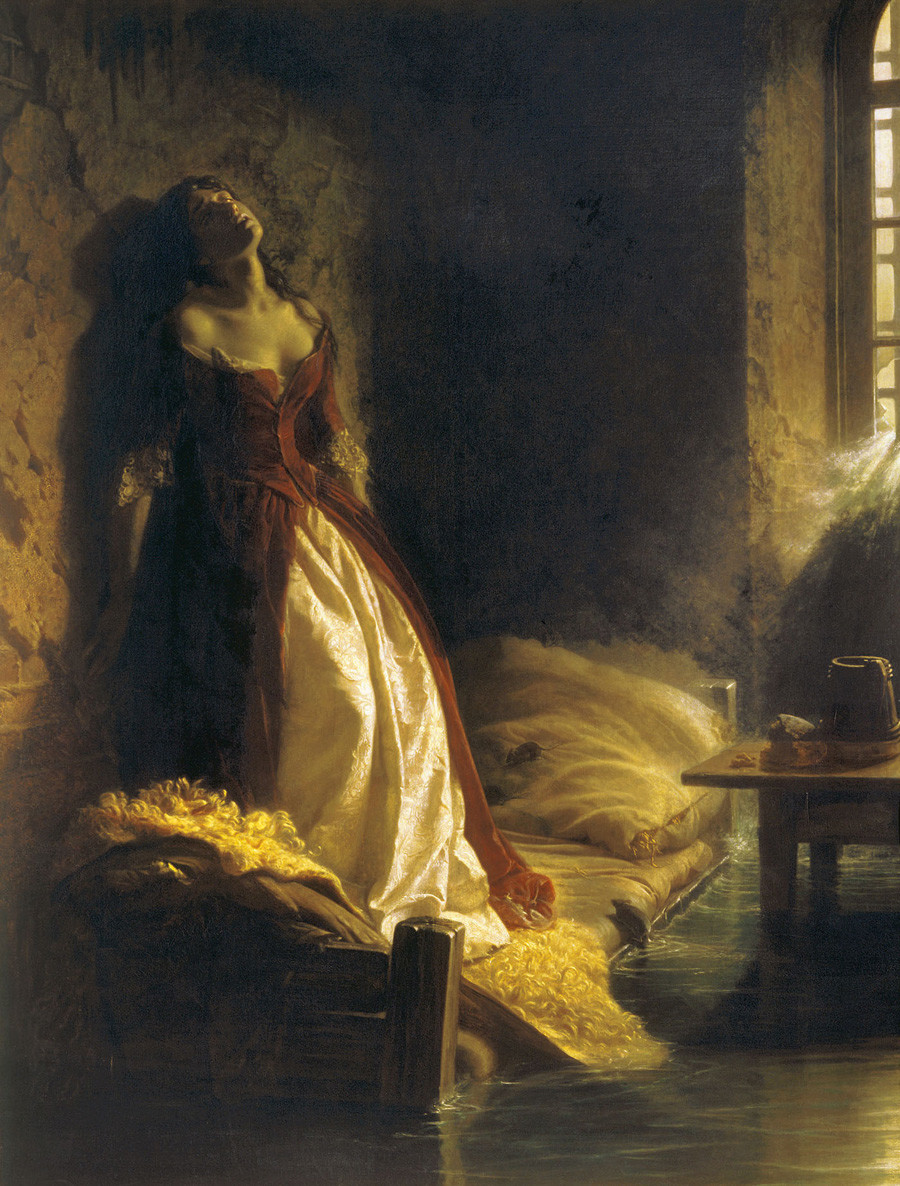
'Princess Tarakanova', 1864
Tretyakov gallery
His earlier paintings were dismissed by critics equally "an false of Bryullov", merely the creative person nevertheless managed to leave a trace in history. The bodily death of Princess Tarakanova (her existent name remains unknown), who claimed to be the girl of Empress Elizabeth, was not exactly as depicted - she died a political prisoner, except non in a flood, but of tuberculosis. Not that it mattered peculiarly: 'Princess Tarakanova' became Flavitsky'south triumph. Notwithstanding, shortly after creating the painting, he died of consumption, which he had contracted in Italian republic.
23. Pavel Filonov

Avant-garde artist Filonov considered himself a Communist through and through and believed that the people needed his fine art. He used the term "belittling art" to depict his multi-dimensional images and refused to sell his works to anyone. This was what killed him in the end: during the Siege of Petrograd, he sat in an ice-common cold attic guarding his paintings and adult pneumonia, which killed him.
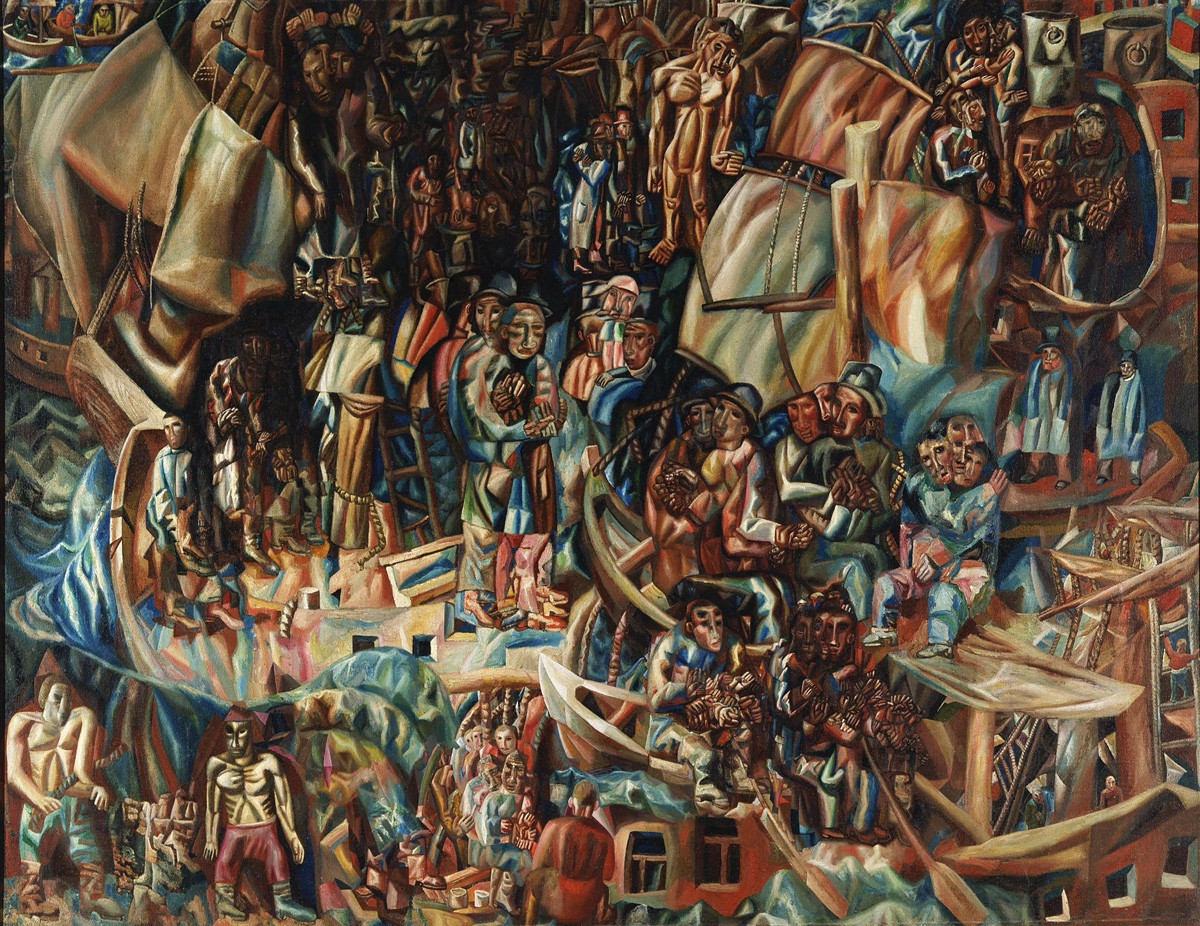
'Ships', 1913-1915
Tretyakov gallery
24. Nikolai Ge

Ge offered an interpretation of religious storylines that ran counter to the established canon, for which he ofttimes savage foul of church censors. Nevertheless, he was convinced that this was the manner to find true emotions and meanings in well-known plots.
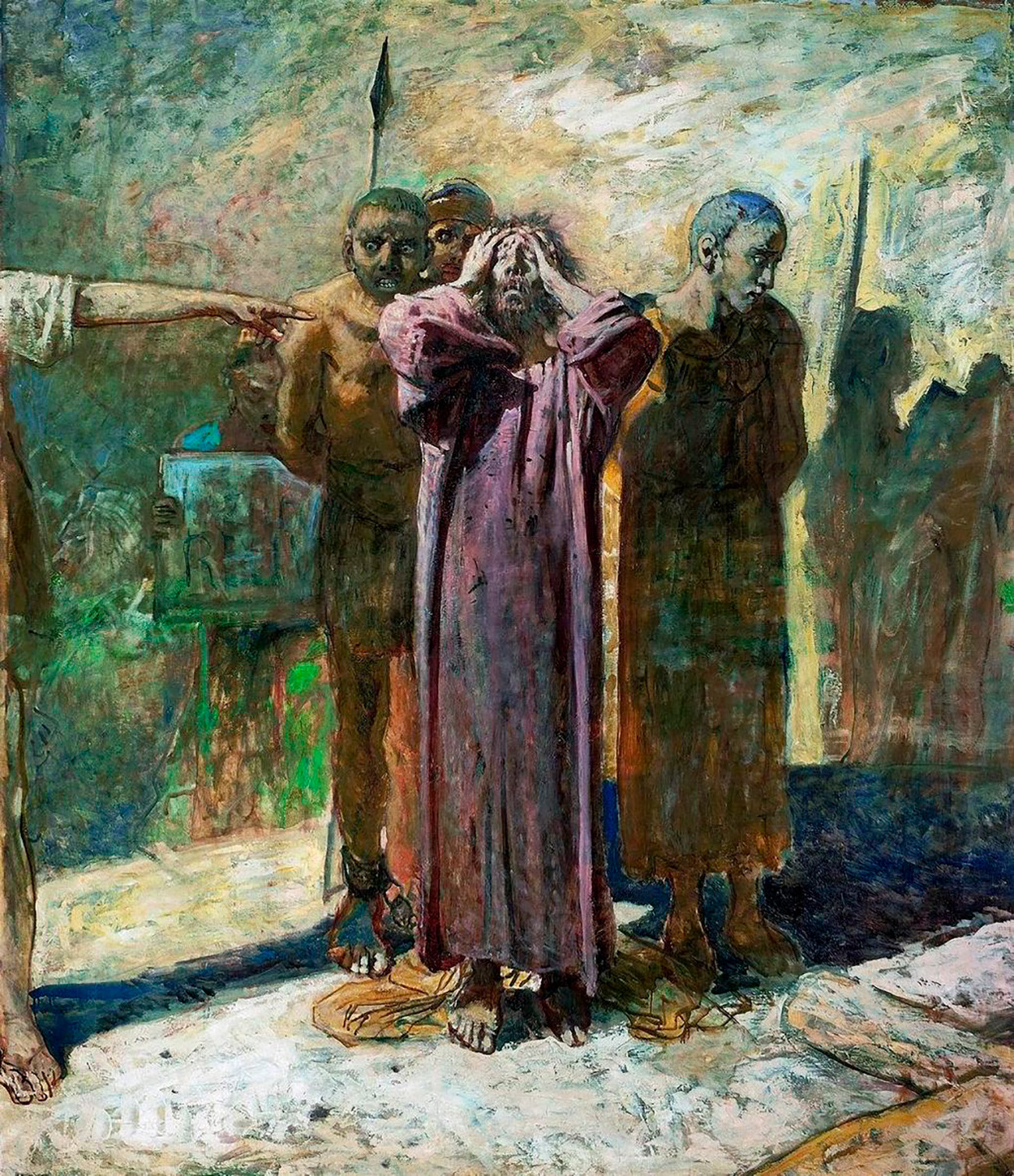
'Golgotha', 1893
Nikolai Ge / Tretyakov Gallery
Ge painted his famous 'Golgotha' a year before his death. "Yes, this painting tormented me terribly," he wrote to his friend Leo Tolstoy. "Yesterday, I plant the concluding affair that I need, a form that is quite live. I establish a way to depict Christ and the two thieves together on Golgotha, without the crosses... In a word... iii souls alive on the canvas. I myself am crying when I look at this picture."
25. Natalia Goncharova

Goncharova, together with her husband Mikhail Larionov, was among the pioneers of the Russian avant-garde. From 1914, she worked on Diaghilev's Russian Seasons in Paris, where she remained until her death in 1962.
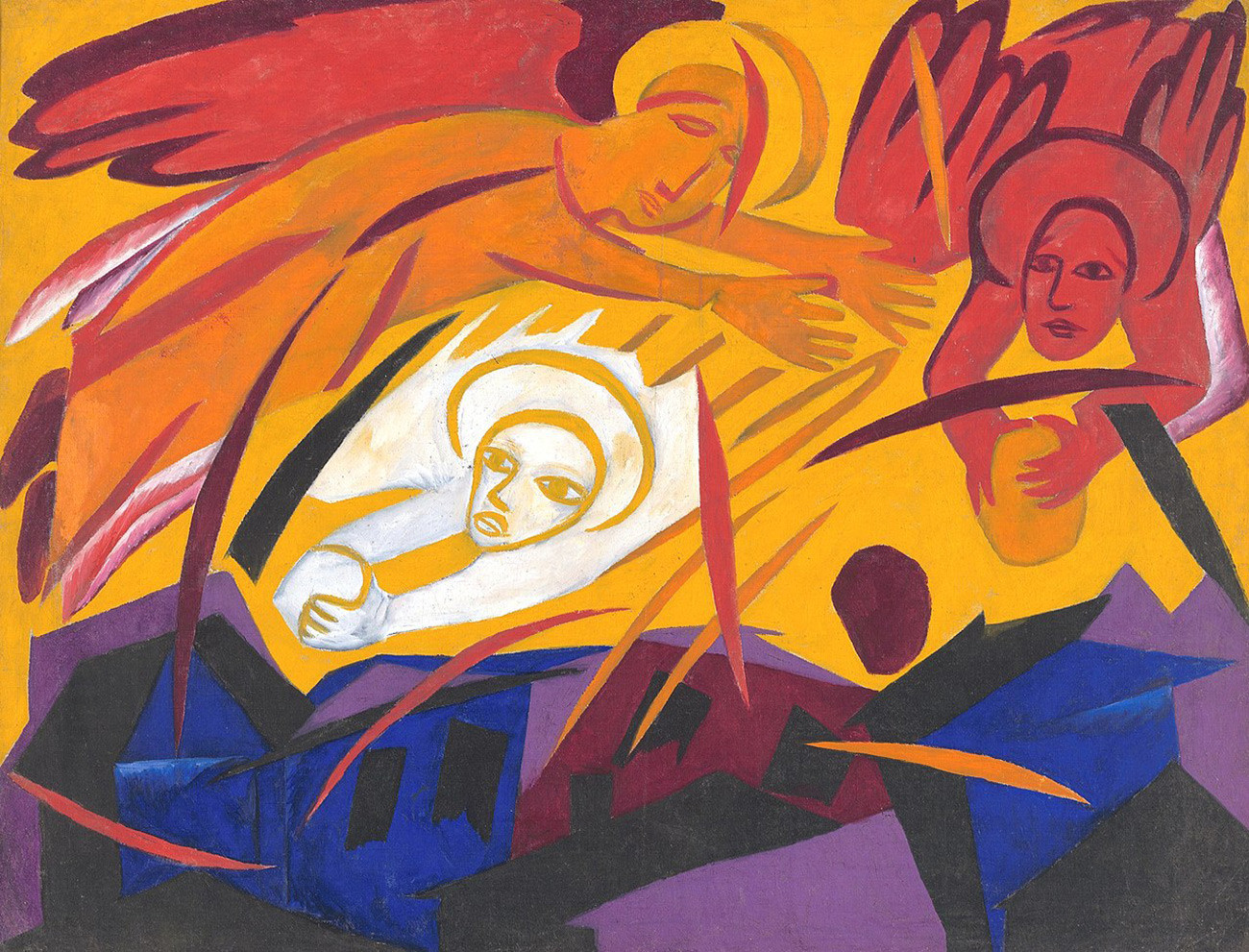
'Angels Throwing Stones on the City', 1911
Natalia Goncharova / Tretyakov Gallery
Today, her works can be found in the world'due south leading art collections, including the Tate Modern in London and the Centre Pompidou in Paris. In 2010, Christie'south sold a painting of hers for $ix million, making her the near expensive (at the time) female artist in history.
26. Theophanes the Greek

A leading Old Rus' painter, Theophanes the Greek, is the creator of ane of the holiest objects in Russian Orthodox Christianity. His Icon of the Virgin with the babe Christ in her arms is considered to be miraculous: according to legend, it oft helped in battles.
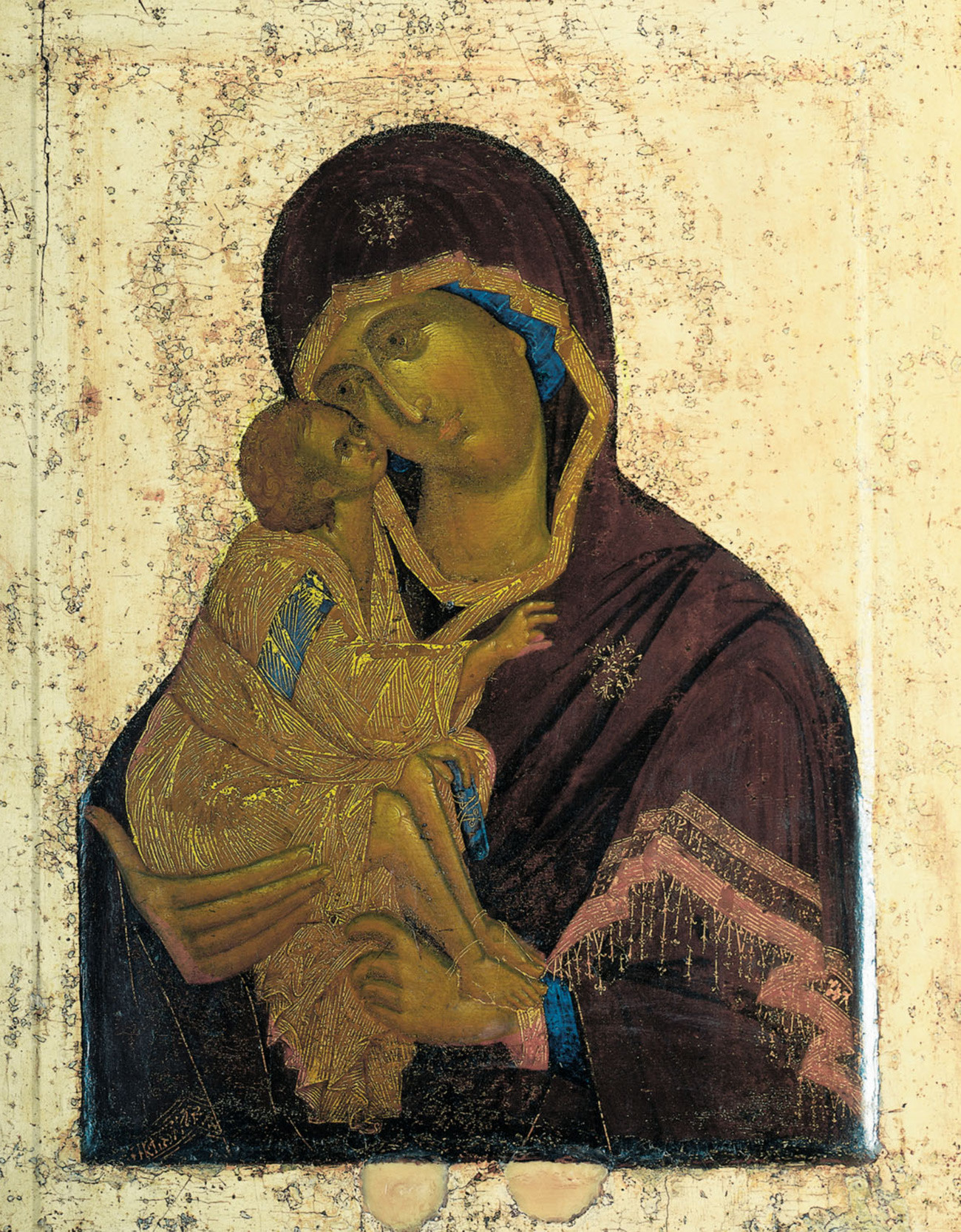
'Our Lady of the Don', 1380
Tretyakov Gallery / Theophanes the Greek
This image, like Andrei Rublev's 'Trinity', has become part of the Russian cultural code.
27. Dmitri Gutov

Gutov belongs to the generation of artists who came into their own in the early 1990s. He creates new readings of canonical objects in culture, the Russian language, Russian icons and classical art in the conventionalities that their essence can be conveyed in a matter of minutes. His most recognizable art objects are metallic panels with a version of Rembrandt and old Russian icons. In one case the viewer moves a picayune to the side, the image is distorted. The idea is that this distortion goes through all stages in the development of the 20th century, from cubism to expressionism to abstraction.
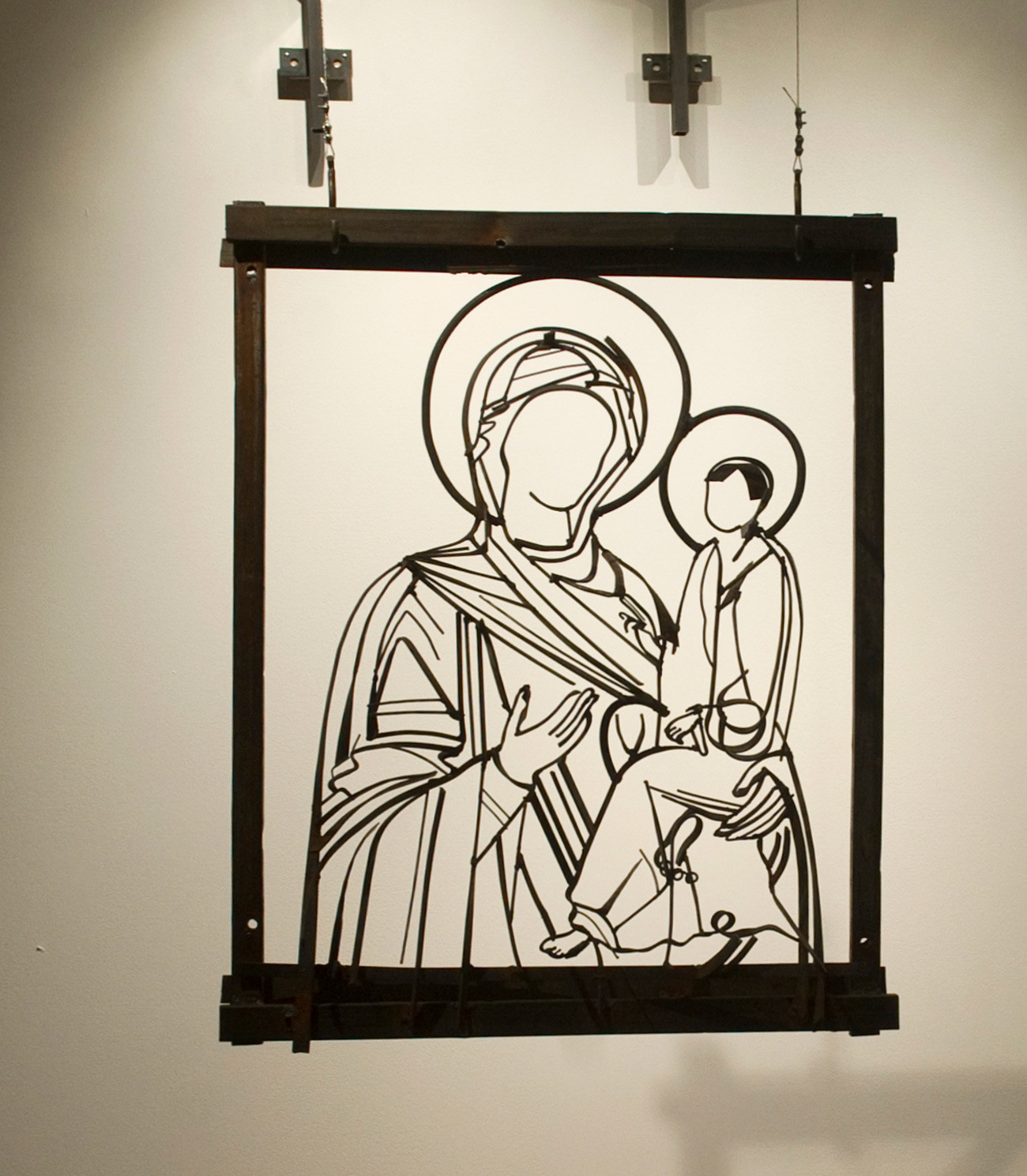
'East'IK'ΩN' project, 2012
Kirill Kallinikov/Sputnik
The listing of art venues where the artist has e'er exhibited is practically endless, from the Venice and Sydney Biennale and Documenta in Kassel to the Guggenheim Museum.
28. Alexander Ivanov

Sergey Postnikov / Tretyakov Gallery
Ivanov was an creative person close to the emperor. He was specially well-known for his paintings inspired by biblical and mythological plots. The Society of Artists even financed his trip to Italy "for further comeback".
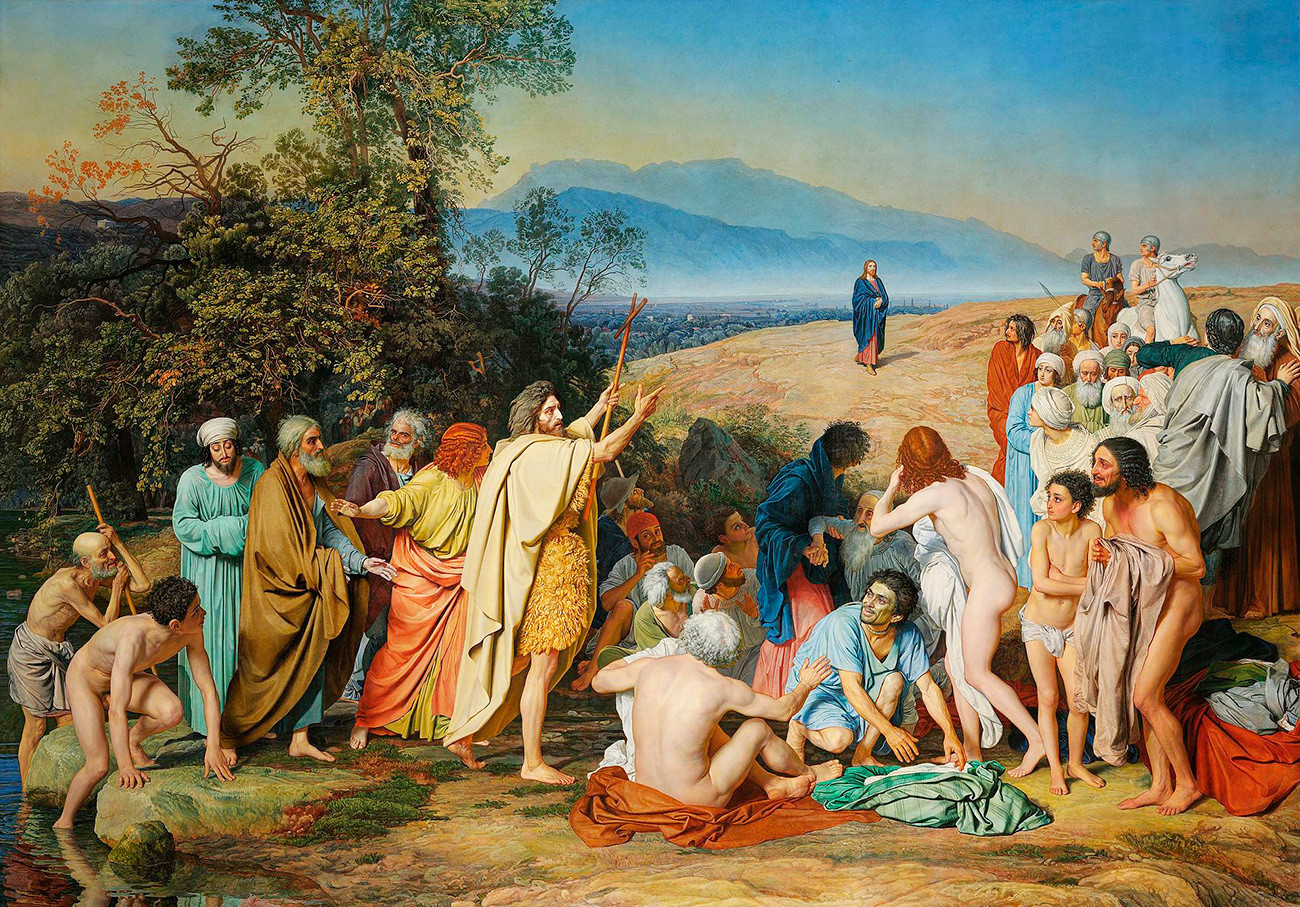
'The Advent of Christ before the People', 1837-1857
Alexander Ivanov / Tretyakov Gallery
Ivanov returned from Italian republic only after he had completed his main opus about the advent of the Messiah. It took him xx years and 600 sketches. The huge sheet was bought and brought to St. petersburg by Emperor Alexander Two. To accommodate the painting, a dedicated building had to be constructed.
29. Francisco Infante

Valerij Ledenev / Wikipedia
Born in Russia to the family unit of a Spanish political émigré, Infante became the about famous representative of Russian land art and kinetic art. The artist calls his abstract installations "artifacts" - he places mirrors and moving structures in natural landscapes, making nature an integral part of a work of art.
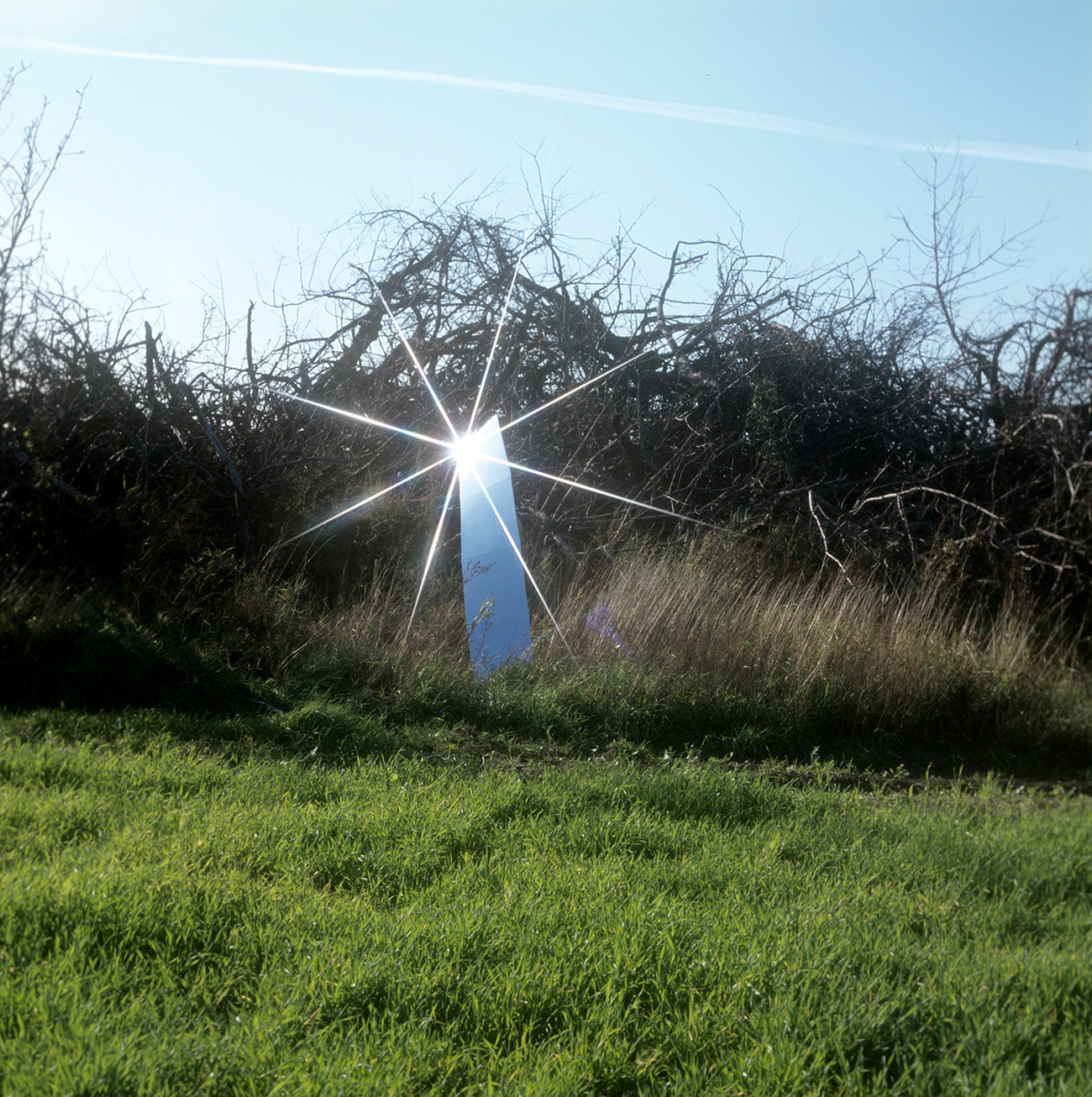
'Seat of Deformed Space' series, 1979
Francisco Infante/Sputnik
Infante is considered a successor to the traditions of the Russian avant-garde, especially Malevich and Tatlin. His works can be found in more than thirty museums and private collections around the world.
30. Alexej von Jawlensky

An expressionist artist who was built-in and grew upwardly in Russian federation, but became famous in Germany. A fan of Van Gogh, Gauguin, Cezanne and Matisse, a close friend and marry of Wassily Kandinsky, Jawlensky was close to brainchild, but remained somewhere on the edge betwixt it and figurative art. The largest collection of his works can be found in Wiesbaden.
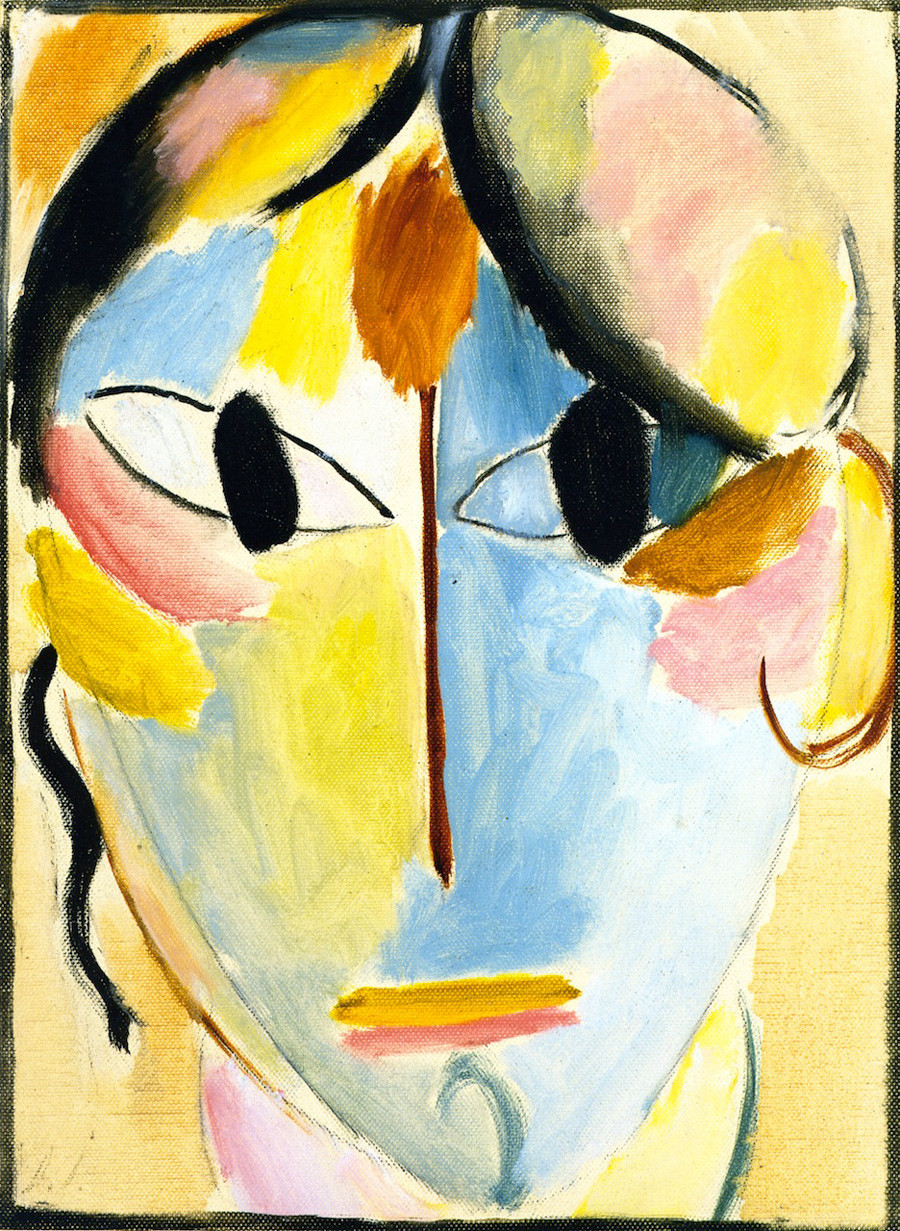
'Heads' serial
Private collection
31. Wassily Kandinsky

The inventor of abstractionism, Kandinsky was amongst the pioneers of the Russian avant-garde. Together with his swain artists - Malevich, Chagall, Goncharova, Larionov and others - heruthlessly broke away fromthe traditions of realistic painting.
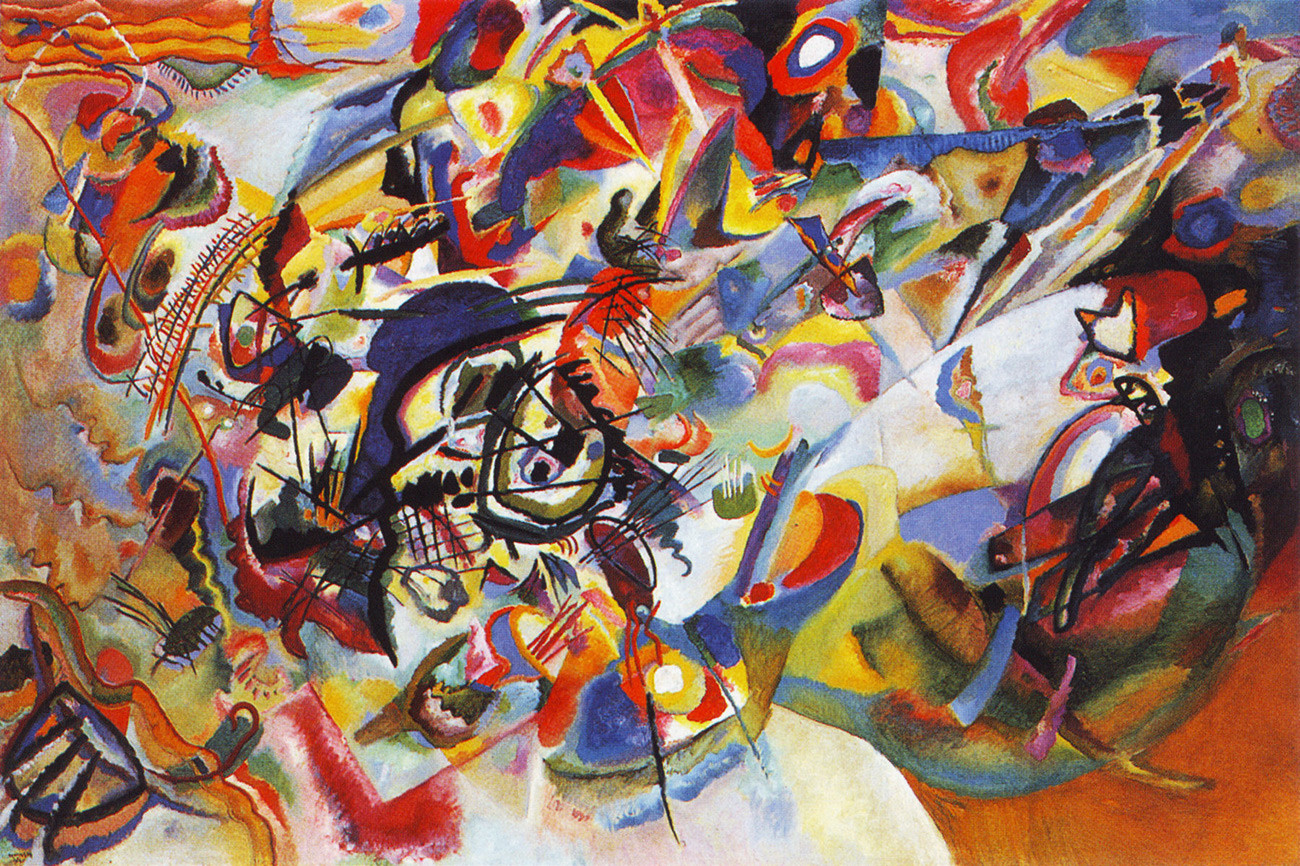
'Composition 7', 1913
Wassily Kandinsky / Tretyakov Gallery
His 'Composition Vii' is considered the pinnacle of his piece of work in the period before the Starting time World War. Can you make out the Resurrection, Judgment Day, the Flood and the Garden of Eden in it? This is what Kandinsky depicted in it, according to his notes.
32. Ilya and Emilia Kabakov

The Kabakovs are the main stars of unofficial Soviet fine art and the modern art scene. Thanks to Ilya and Emilia, Moscow Conceptualism has become the nearly famous contemporary Russian art movement in the world. The couple take lived on Long Island in New York since the late 1980s, and have their exhibitions at the Museum of Modernistic Art in New York, the Eye Pompidou in Paris, Tate Gallery in London and the Hermitage Museum in Petrograd.
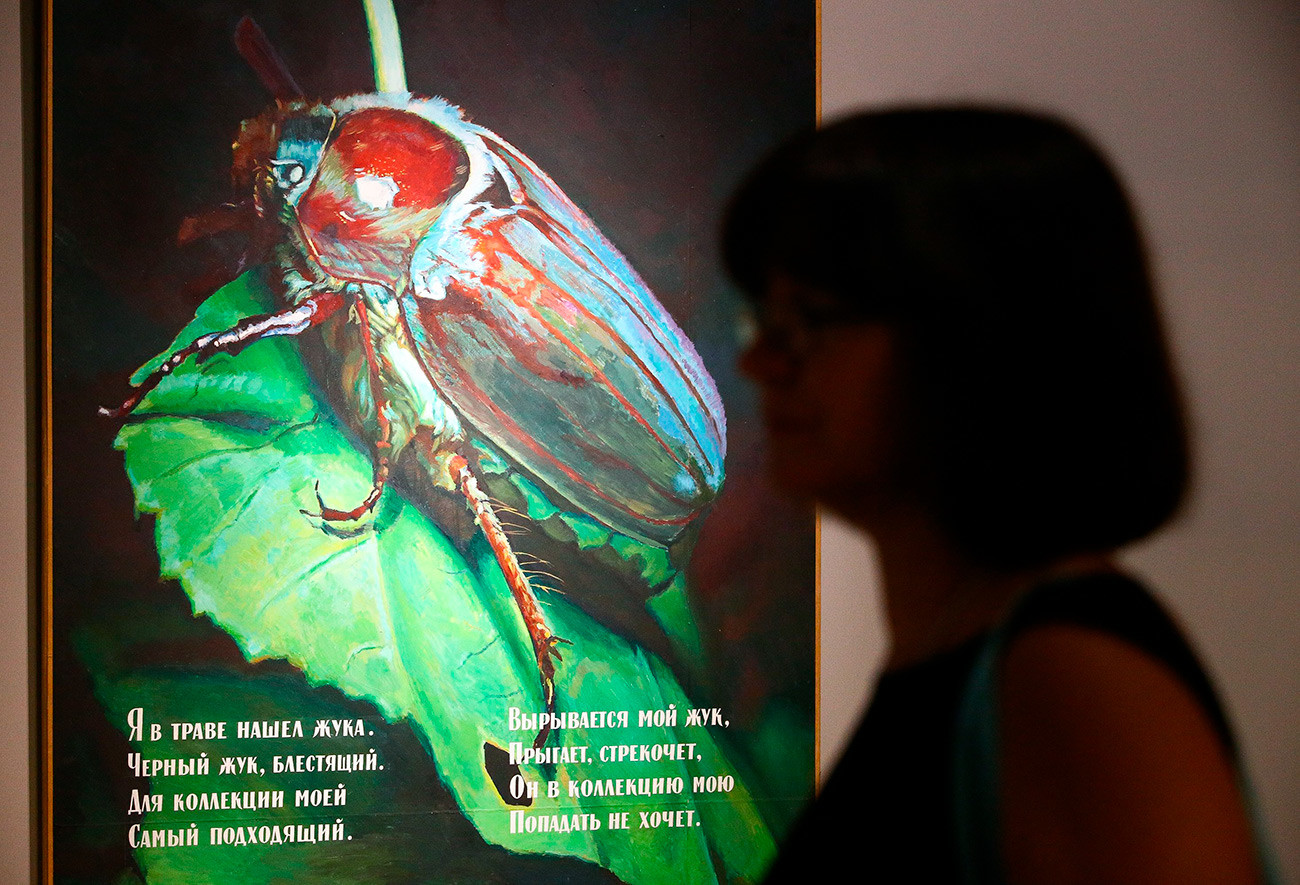
'The Beetle', 1982
Moskva Agency
In 2008, 'The Beetle' broke a price tape: it was sold for £two.6 million (almost $6 meg), and Kabakovs' piece of work became the virtually expensive of the living Russian artists. They have since remained at the tiptop of this listing.
33. Orest Kiprensky

Orest Kiprensky / Tretyakov Gallery
When Kiprensky finished the portrait of the great poet Alexander Pushkin, the latter dedicated a poem to him, which said, "Thus, from now on, my look will be known in Rome, Dresden, and Paris."
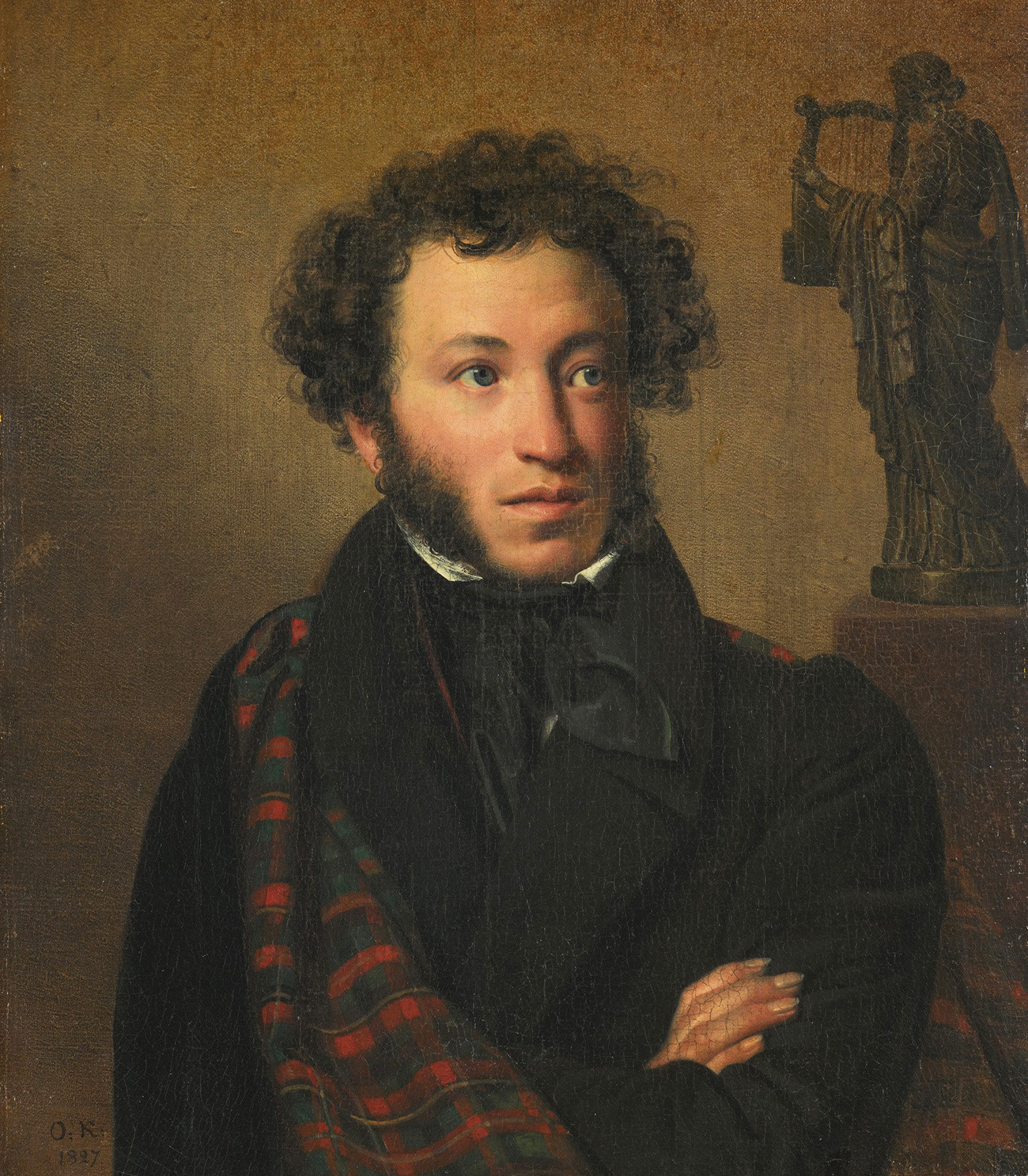
'Portrait of Alexander Pushkin', 1827
Orest Kiprensky / Tretyakov Gallery
The poet's prophesy turned out to be right. The portrait painter Kiprensky, who in the Westward was compared to, and sometimes even confused with, Rembrandt and Rubens, created what has get the most famous depiction of Pushkin in popular culture: this is what the great poet looks like to people in Russia and the balance of the earth.
34. Ivan Kramskoi

Ivan Kramskoi / Tretyakov Gallery
It has still not been established who this young woman, depicted by the ideologist of "Russian Peredvizniki" artists, is. Kramskoi chose to keep the secret and did non reveal her identity, fifty-fifty in the diaries and notes found subsequently his death. These days, one of the about emblematic portraits in Russian art is dubbed "the Russian Mona Lisa".
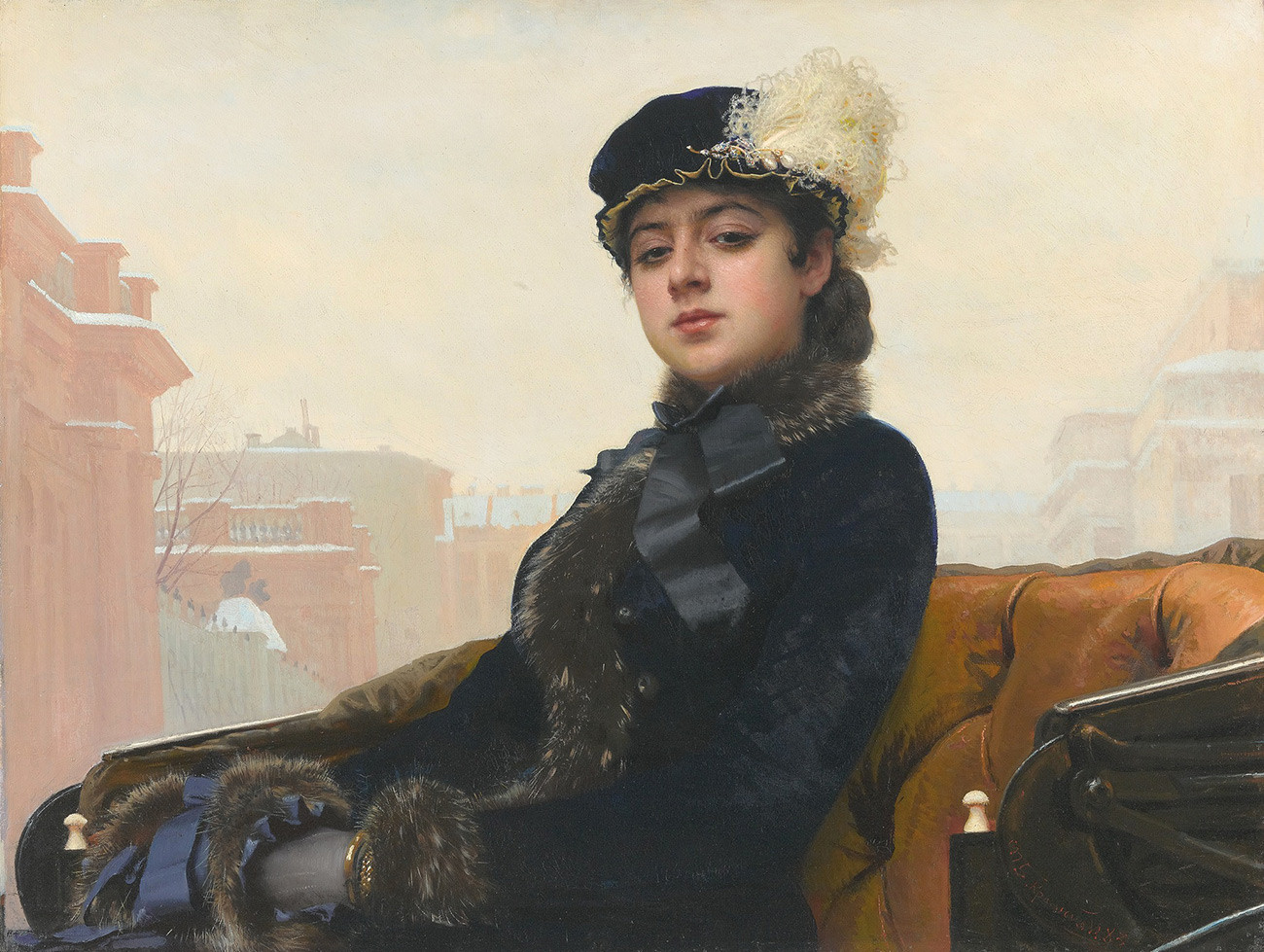
'Portrait of an Unknown Woman', 1883
Ivan Kramskoi / Tretyakov Gallery
35. Konstantin Korovin

A prominent representative of "Russian impressionism", Korovin was inspired past the urban center of Paris and painted many of his all-time landscapes at that place. Information technology is, therefore, not surprising that he was a huge success in France: there he was presented with the Légion d'Honneur and received golden and silverish medals for his works.
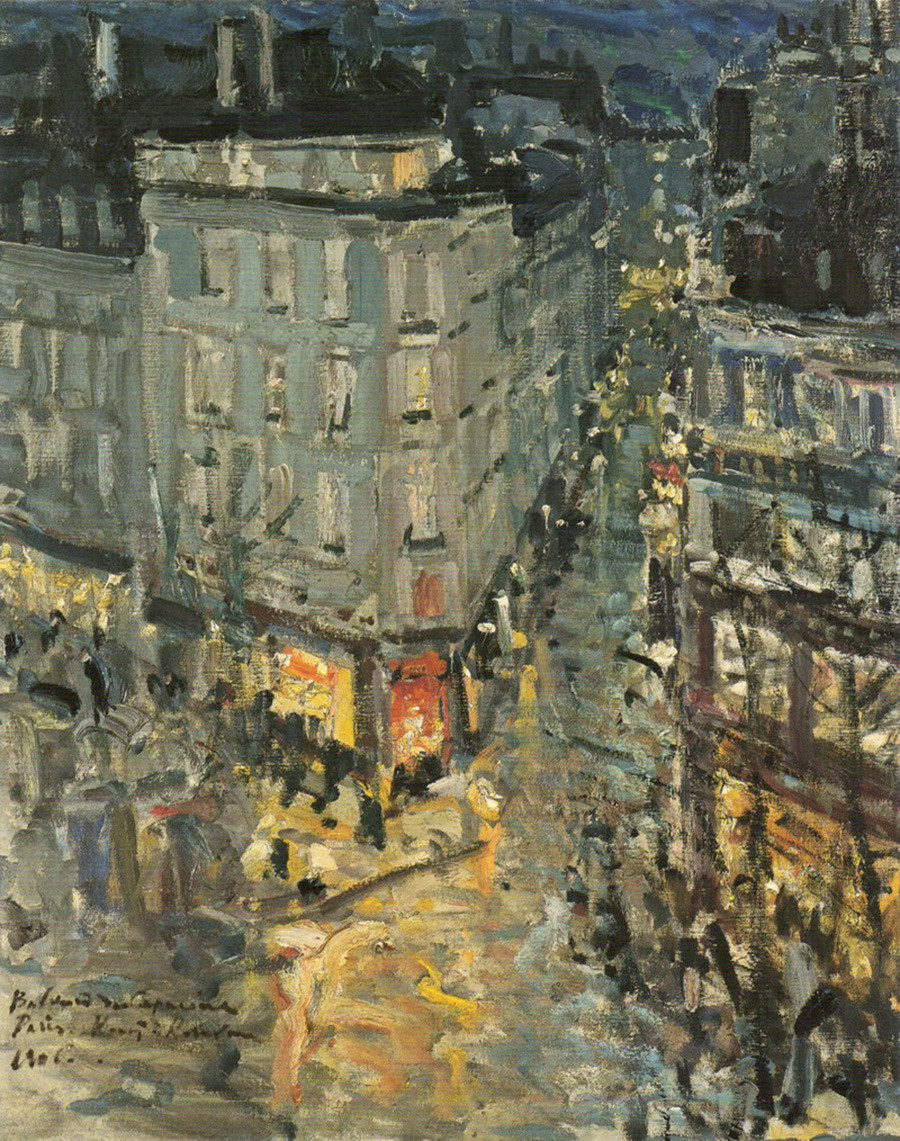
'Paris. Boulevard des Capucines', 1906
Konstantin Korovin / Tretyakov Gallery
Later the Russian Revolution, the artist decided to flee from the country of the Soviets: he found the new government's policies oppressive. In 1922, he received permission to leave - for medical treatment and holding of a personal exhibition - simply never returned. Not surprisingly, he settled down in Paris.
36. Alexander Kosolapov

Ekaterina Chesnokova/Sputnik
Coca-Cola vowed to destroy Kosolapov. He caught the attention of the FBI, his exhibitions in Russia were canceled, and some of his works even went on trial. His method consists of combining things that cannot be combined, like, for example, Lenin's contour with the famous company'southward logo.
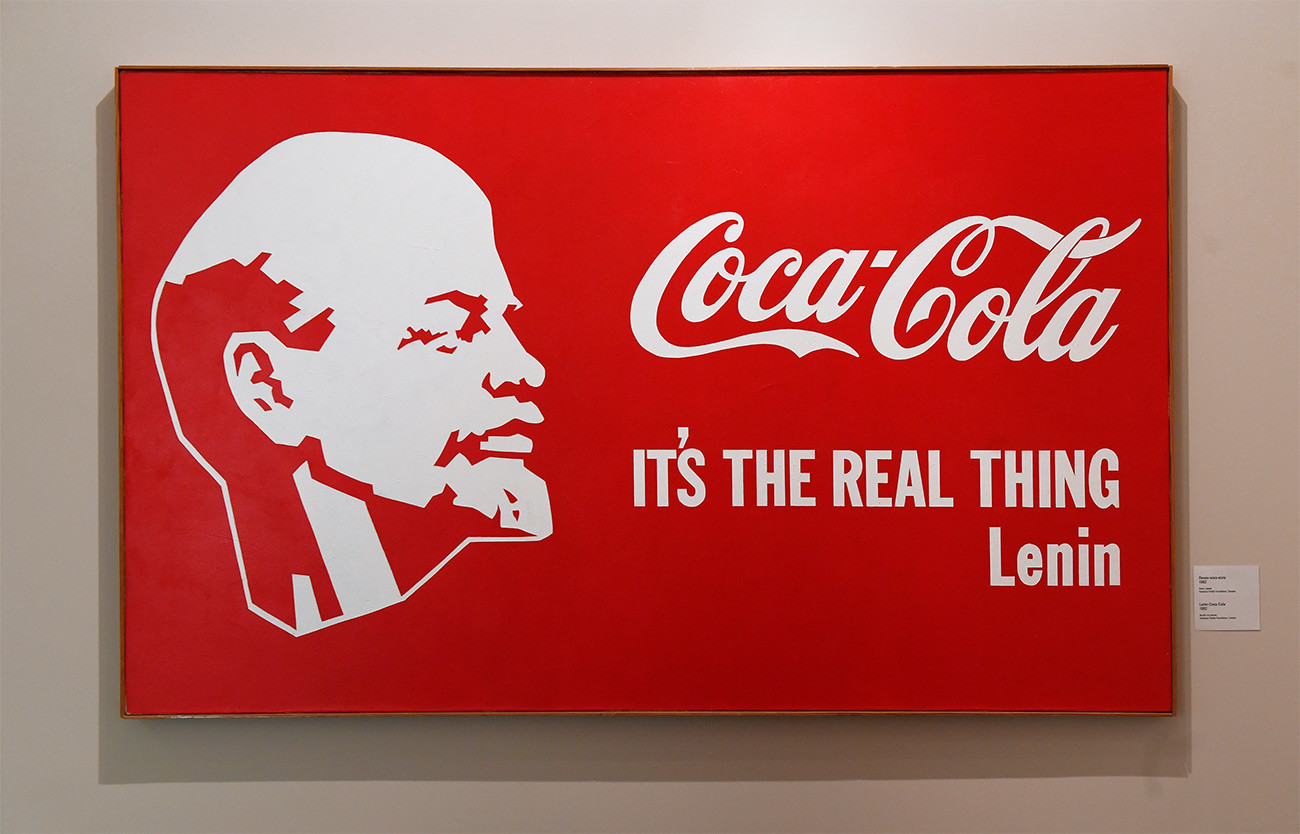
'Lenin and Coca-Cola', 1982
Ekaterina Chesnokova/Sputnik
Indeed, Kosolapov's fine art is provocative and often scandalous, but this does non prevent him from remaining a respected chief of Sots Art (the Soviet version of pop fine art), whose works tin be constitute in the collections of the all-time museums in the globe.
37. Irina Korina

For Korina, a participant in the primary project at the 2017 Venice Biennale, fifty-fifty the most seemingly insignificant details of everyday life, from the Moscow street illumination to funeral wreaths to scaffold netting, are a matter for reflection. She is described every bit a master of total installation. Korina's latest solo exhibitions were held at the GRAD foundation in London, the Brooklyn Academy of Music in New York and at the Steirischer Herbst festival in Graz, Austria.
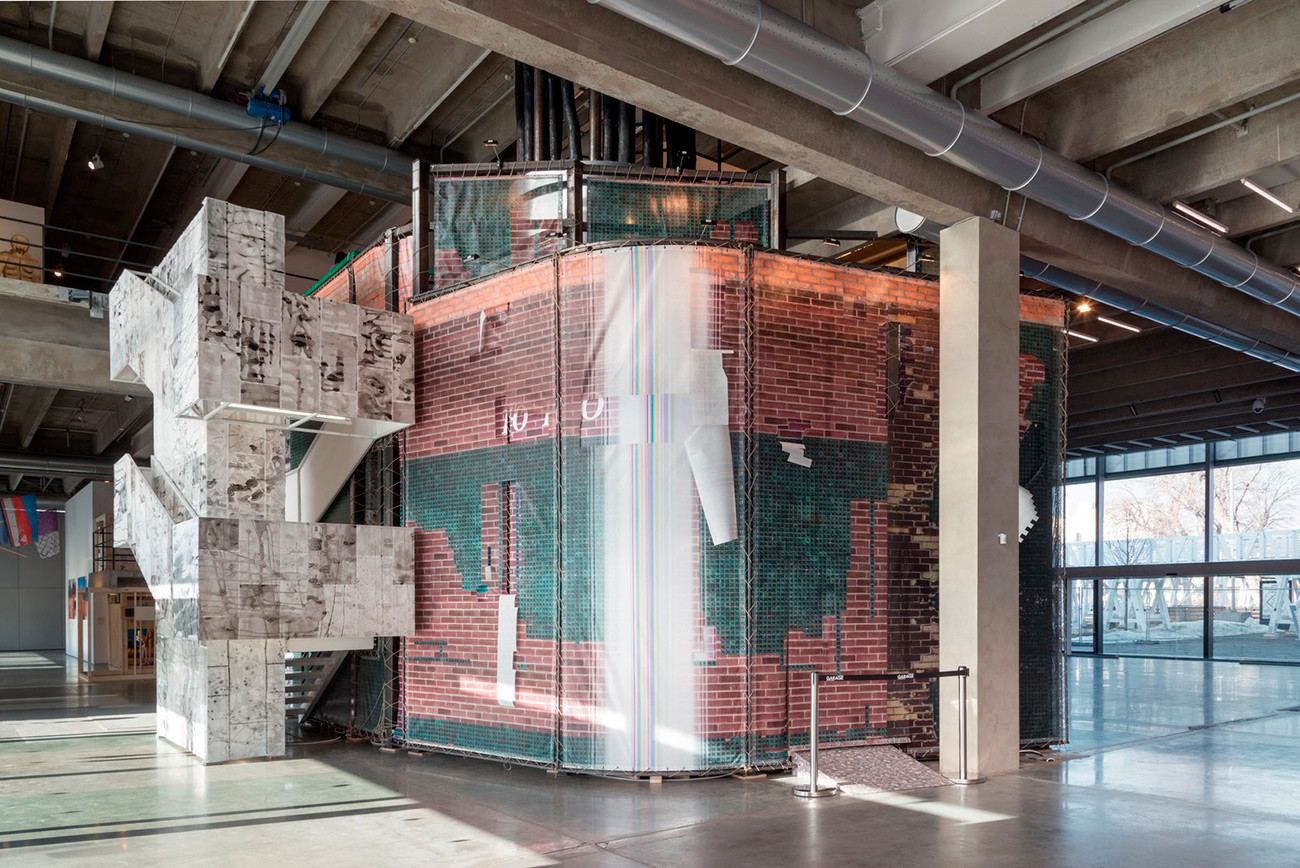
'The Tail Wags the Comet' installation, 2017
Irina Korina / photograph by Aleksey Naroditsky / Garage Museum of Gimmicky Art
'The Tail Wags the Comet', a huge three-story tower, appeared at the Moscow Garage museum and has become a collection of quotes from her career.
38. Pyotr Konchalovsky

He is known as"the main Russian Cézannist", the main "Russian impressionist" and 1 of the nigh "expensive" Russian artists at international auctions. Despite having borrowed a lot from French artists, Konchalovsky, nevertheless, managed to find his own manner, which Western critics oft described as "Slavic".
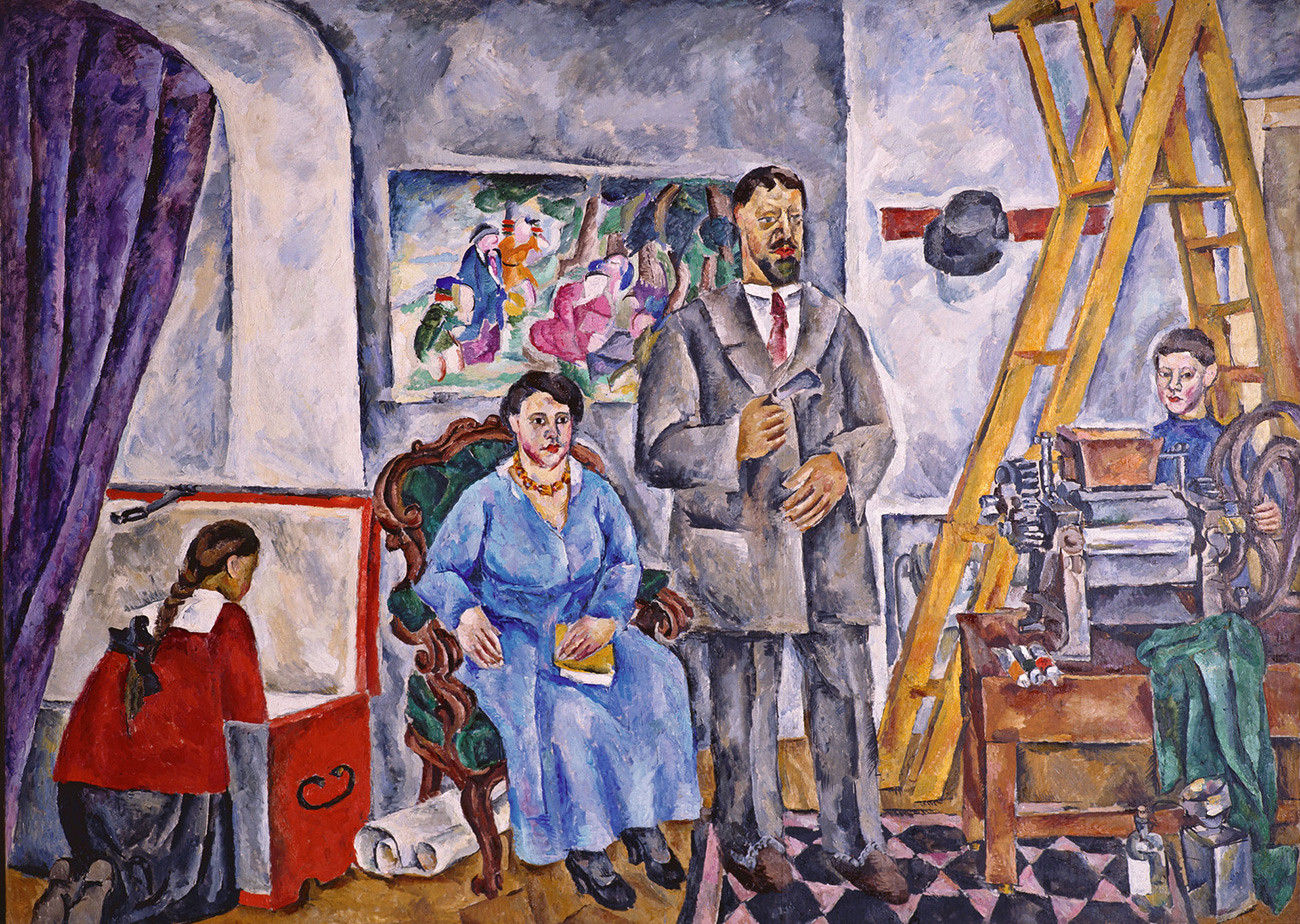
'Family Portrait (against the Groundwork of a Chinese Panel)', 1911
P.Konchalovsky
At home, Konchalovsky'due south contemporaries rejected his art so much that they even refused to exhibit their works side by side to his. Yet, when in 1924 the USSR for the first time took role in the Venice Biennale, those were Konchalovsky'southward paintings – 13 of them – that were displayed at the Soviet pavilion.
39. Vitaly Komar & Alexander Melamid

The main "trolls" of official Soviet fine art have created their own unique genre of Sots Art, the Soviet equivalent of pop fine art. They fabricated cutlets from the Soviet mouthpiece, the Pravda newspaper, depicted themselves as Lenin and Stalin, signed main Soviet slogans with their names and placedLenin against the McDonalds logo.
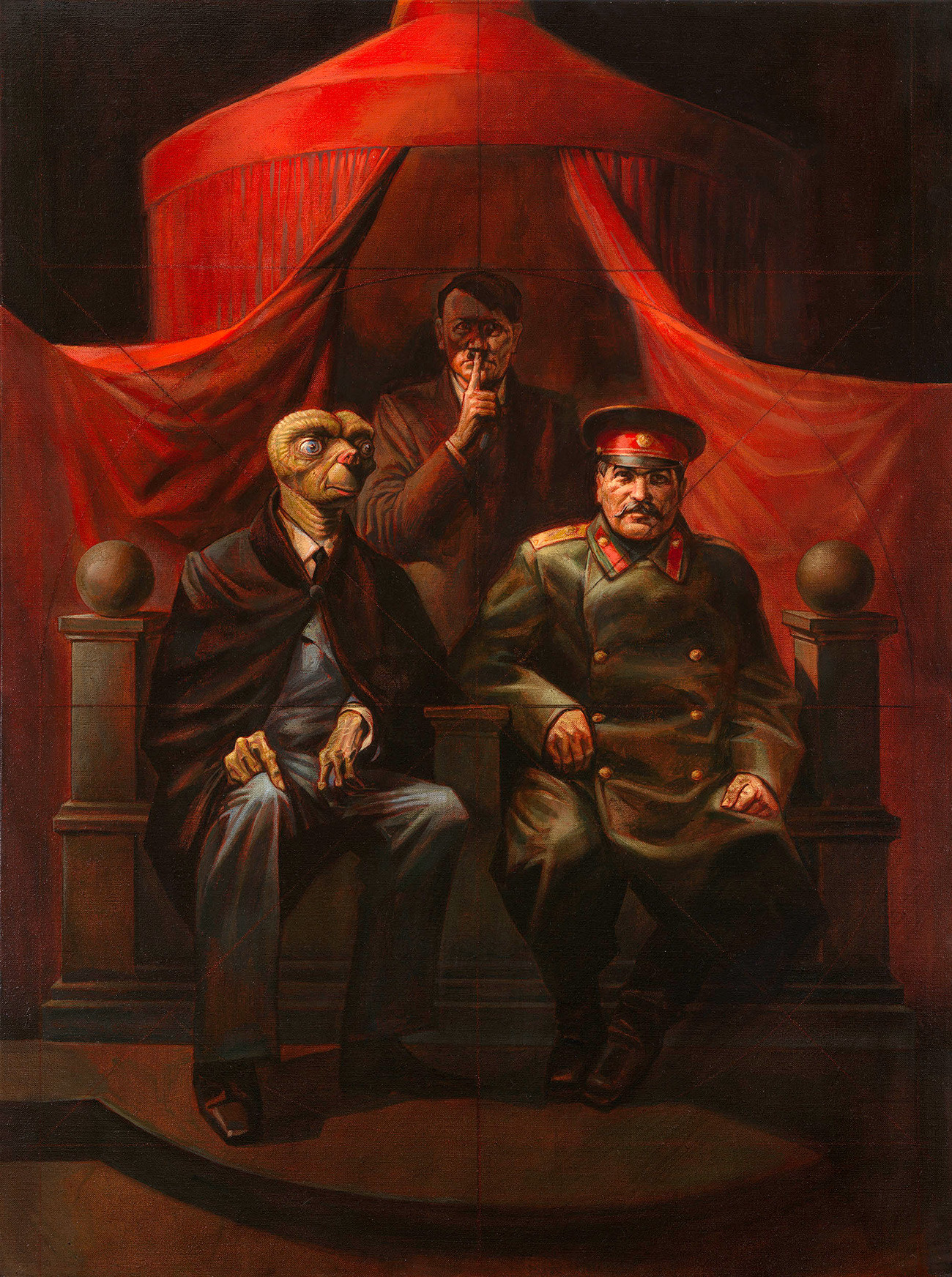
'Yalta Conference', 1982
Komar & Melamid
Even having left the USSR, the artists did not finish their caustic trolling. The list of their targets included Andy Warhol (whom they telephone call "an idiot") and Gerhard Richter ("this is how an fauna would paint if given a brush").
forty. Valery Koshlyakov

Koshlyakov'due south paintings accept a number of striking distinctive features: they are almost always painted on textured corrugated paper-thin and almost ever his urban landscapes are "streaming" down the canvas surface. Images of the by, ruins, Greek mythology, memory – these are his timeless topical characters.
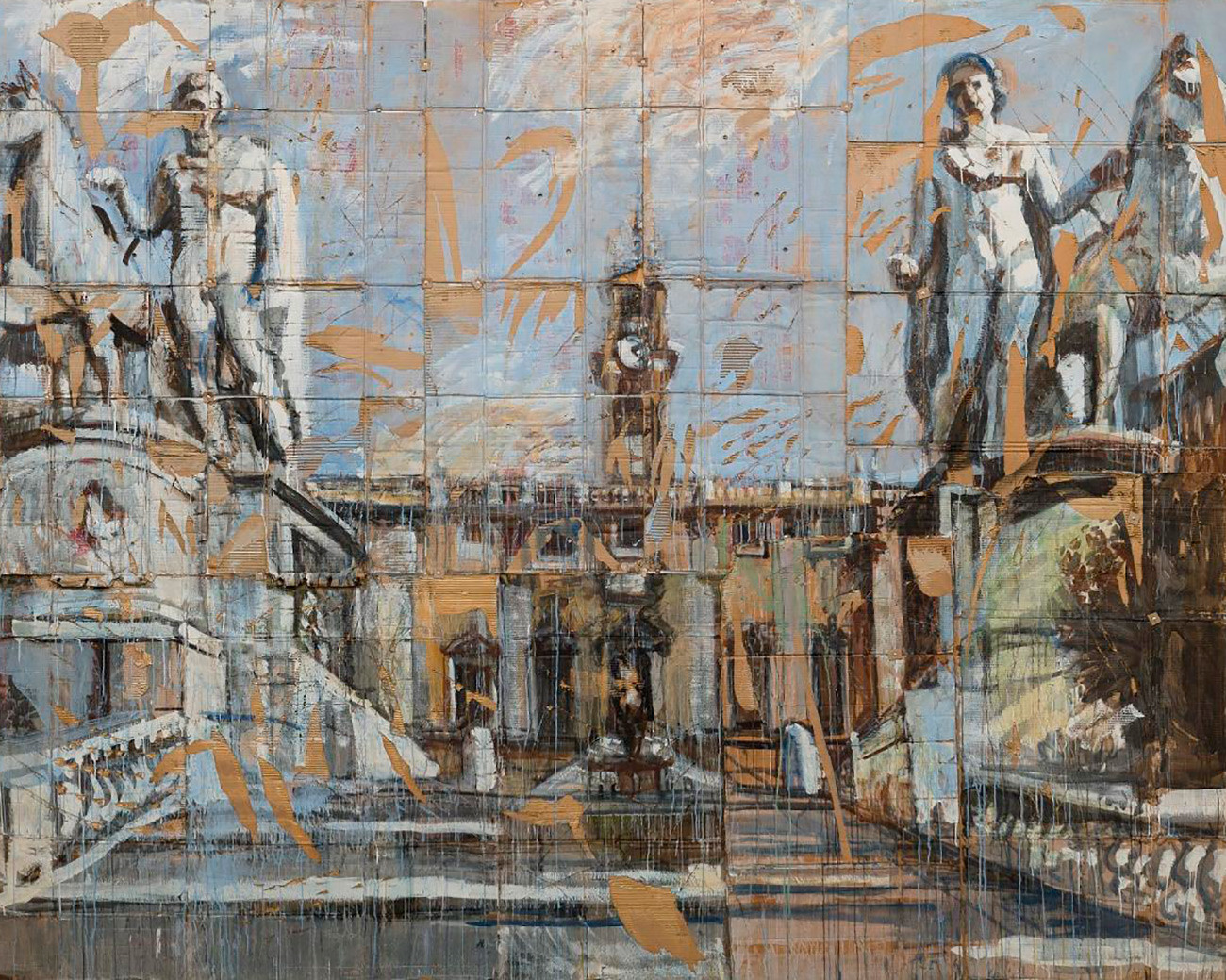
'Roman Prisoner' series, 1991-1994
V.Koshlyakov
Koshlyakov currently lives in Paris and is in neat need: he has exhibited at the Louvre, the Guggenheim Museum, the Biennale in San Paolo and Venice. Nevertheless, even these days, he likes to recall with a sense of irony that his beginning exhibition was held in a provincial public toilet.
41. Geliy Korzhev

Korzhev, jokingly, chosen himself an "old socialist realist". Art critics take labeled him "a representative of the austere style". Yet, Korzhev'south art has gone beyond those boundaries: despite holding quite senior posts in the Soviet Artists' Union, he managed to escape from political commissions into a sensual, sometimes surrealistic sphere. He is above all an artist of potent human emotion, for which the state of war, the revolution, and the Soviet "construction projects of the century" were just a background.
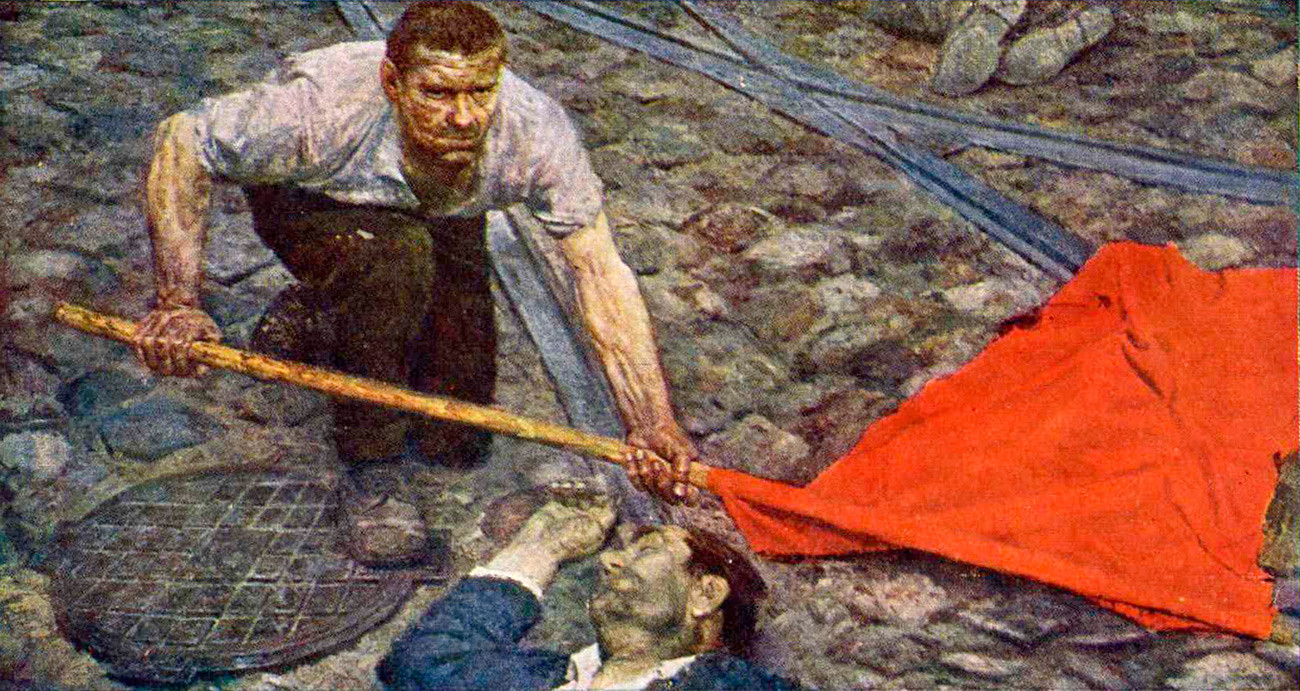
'Raising the Imprint', 1960
Gely Korzhev / Russian Museum
42. Arkhip Kuindzhi
He was often accused of employing various ploys, similar using subconscious devices to low-cal his paintings. Conversely, his well-wishers called him "the Russian Monet" for his masterly piece of work with colors. His 'Moonlit Night…' with the moonlight reflected in the Dnieper River became a sensation. All the more so, since it was the first fourth dimension in the history of Russian art that an exhibition consisted of a single piece of work.
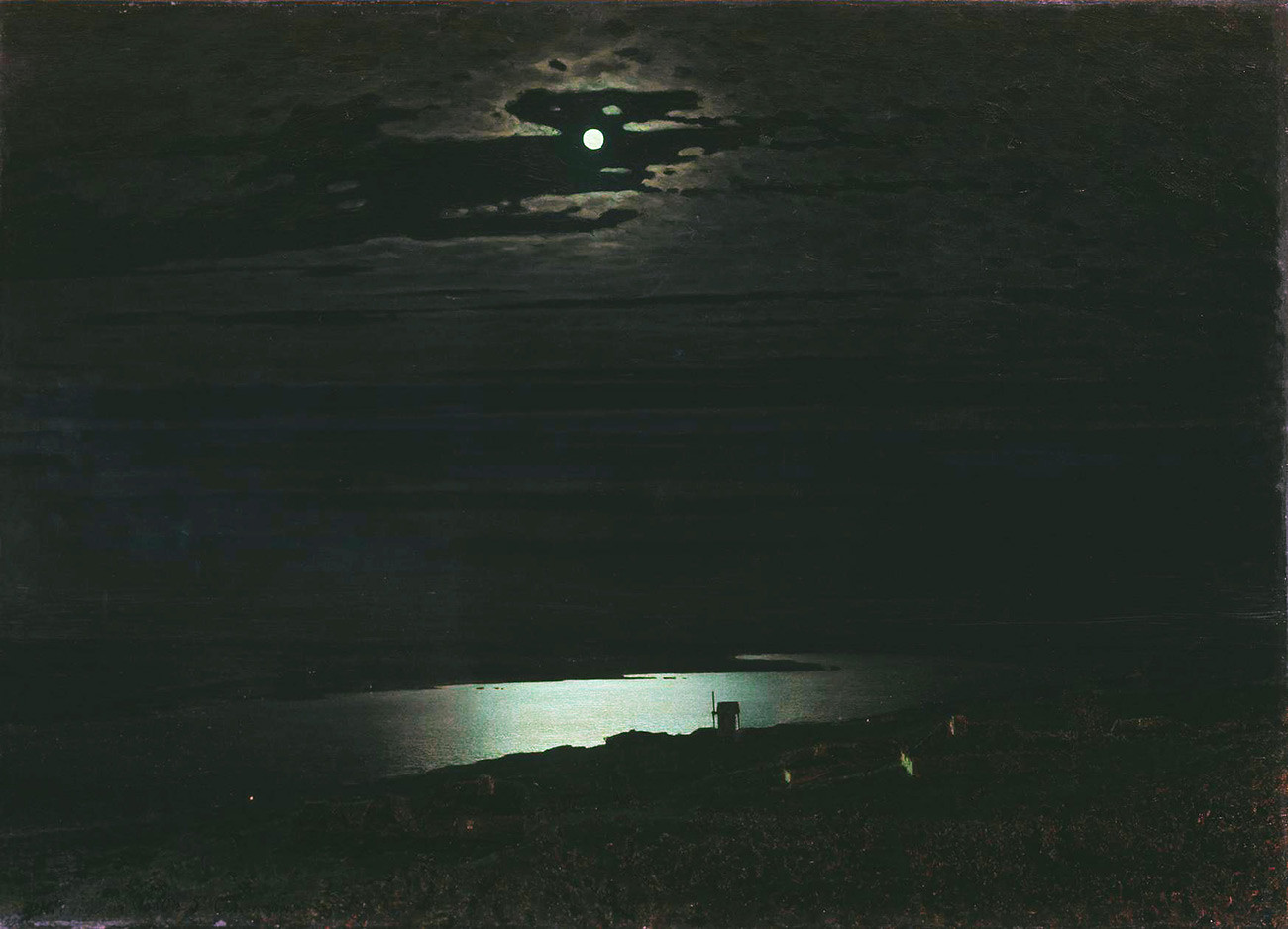
'Moonlit Night on the Dnieper', 1880
Arkhip Kuindzhi / The State Russian Museum
Its success was such that Kuindzhi went into a voluntary exile for thirty years: the critics did non have works that followed 'Moonlit Night…', and the artist spent a long time struggling with it.
43. Boris Kustodiev

The national flavor, from samovars and fairs to plump tradeswomen in colorful dresses, is what attracted Kustodiev and distinguished him from other artists of his time. He is the simply Russian artist to have e'er won a gold medal at the Venice Biennale.
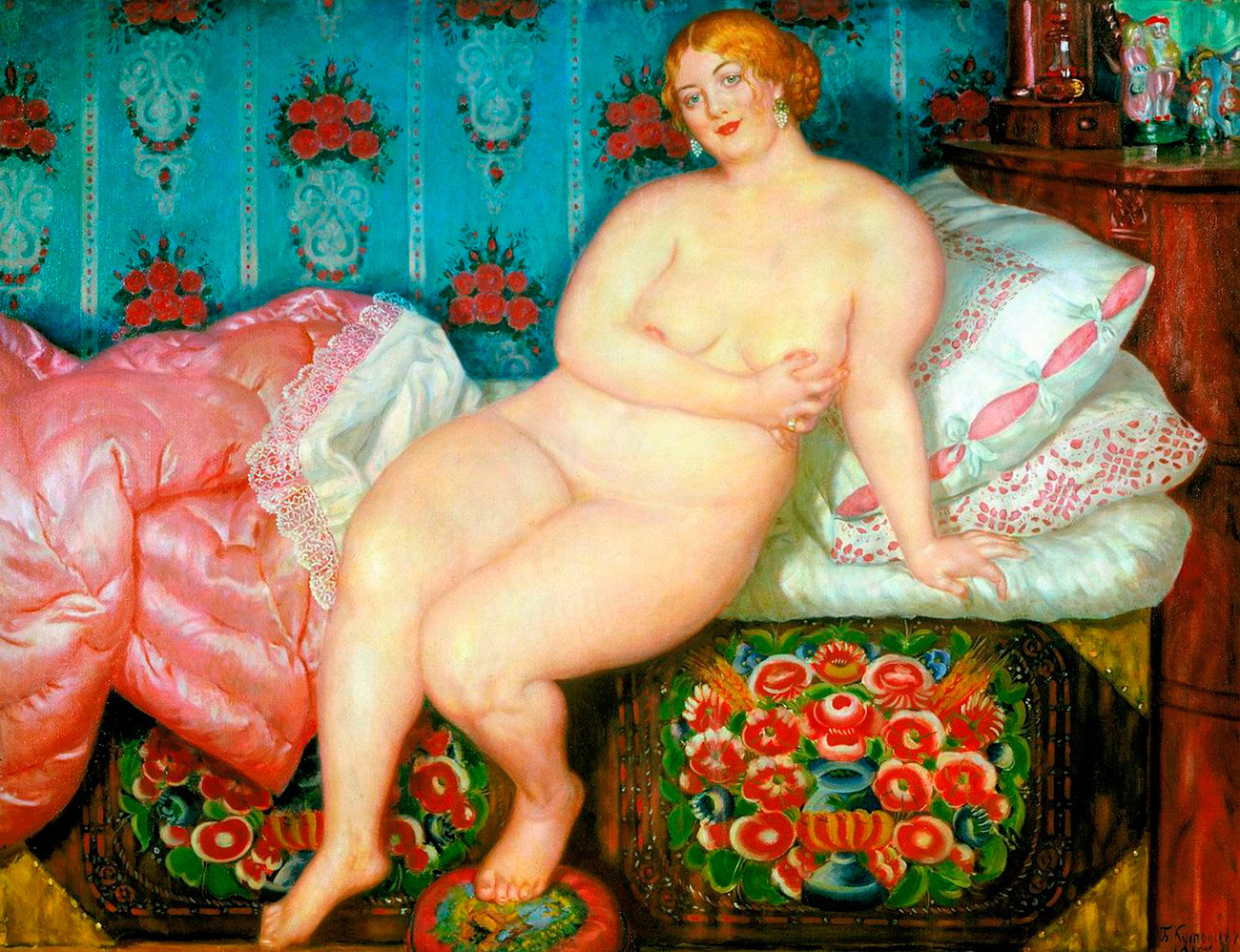
'The Beauty', 1915
Boris Kustodiev / Tretyakov Gallery
'The Beauty', a depiction of a Russian merchant's wife, became his manifesto and the effect of a search for a unique manner. "Slim women do non inspire one to creativity," he used to say. The artist created this andother famous workswhile being already paralyzed - he had had several operations on his spinal cord.
44. Oleg Kulik

'Mad Domestic dog' was Oleg Kulik'due south first operation: naked, he crawled on all fours and attacked passers-past. Its main character became one of the symbols of the crazy 1990s, and Kulik - 1 of the founders of Moscow action art.
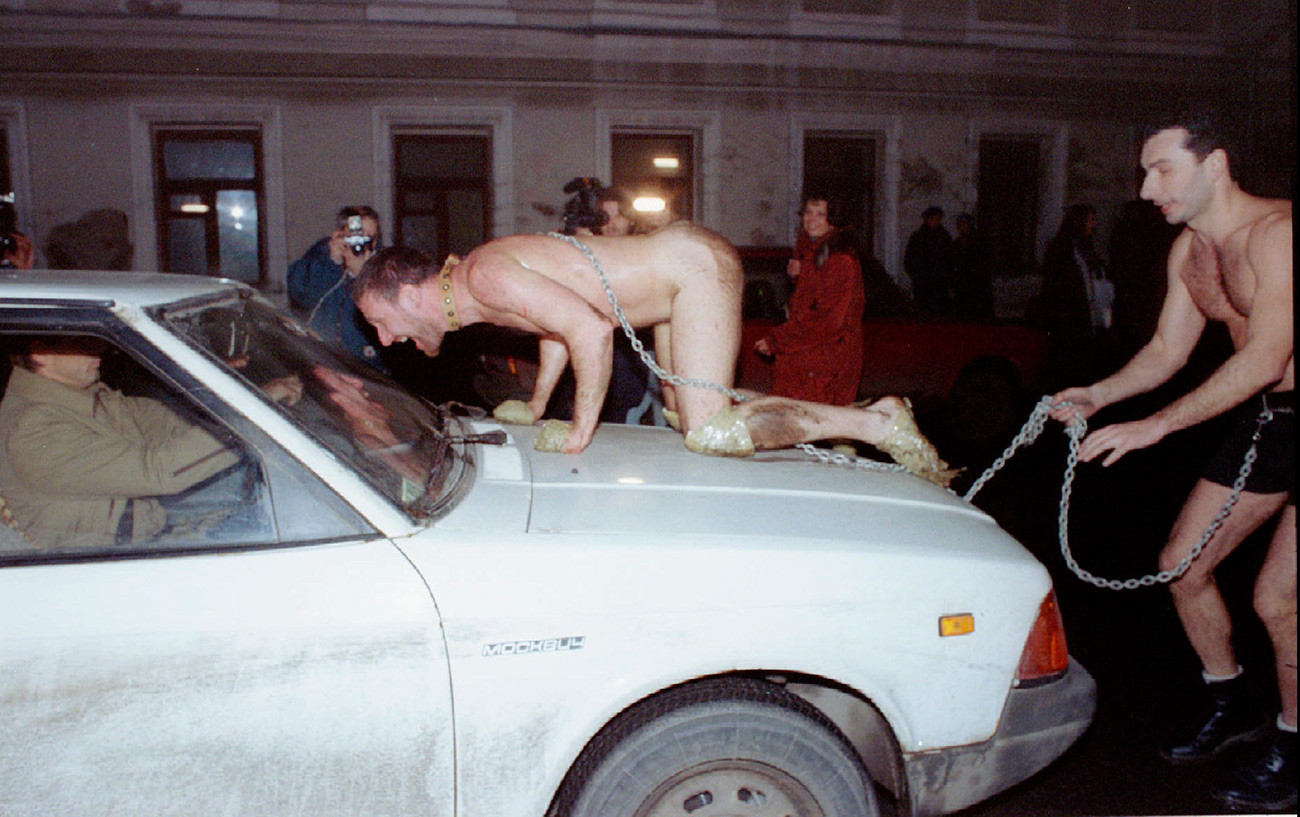
'Mad Dog' performance, 1994
Reuters
Later, the creative person tried himself in a multifariousness of styles and techniques, from sculpture to painting, and continues to experiment till present 24-hour interval. His works can be found at the Centre Pompidou in Paris and Tate Modern in London.
45. Mikhail Larionov

A person perceives non an object but a cluster of rays coming from a source of light and reflected from this object - this is how Larionov explained Rayonism, an avant-garde abstract art movement he had invented.
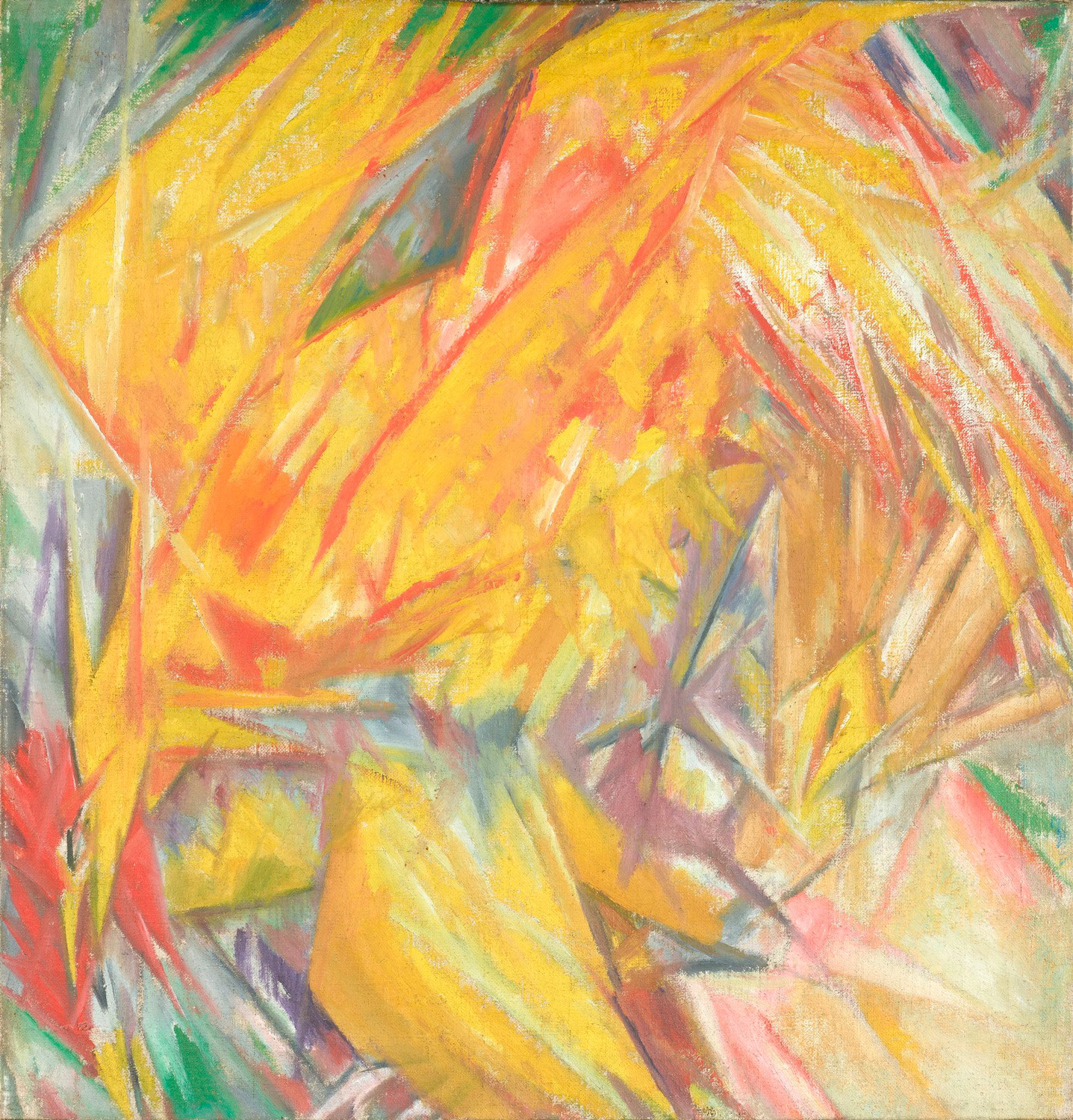
'Rooster. A Rayonist Sketch', 1912
Tretyakov Gallery
At the aforementioned time, Larionov himself constantly balanced between representational and abstract art, and left quite a diverse legacy. He was married to "the Amazon of the avant-garde", Natalia Goncharova, but, unlike his wife, while in emigration in France for the last thirty years of his life, he did not create annihilation significant.
46. Aristarkh Lentulov

self-portrait / Saint petersburg State Museum of Theater and Music
Lentulov boldly juggled unlike styles: his works were influenced now past symbolists and impressionists, at present by cubists and abstractionists. But he was ane of the outset to build his fine art around color, rather than an object.
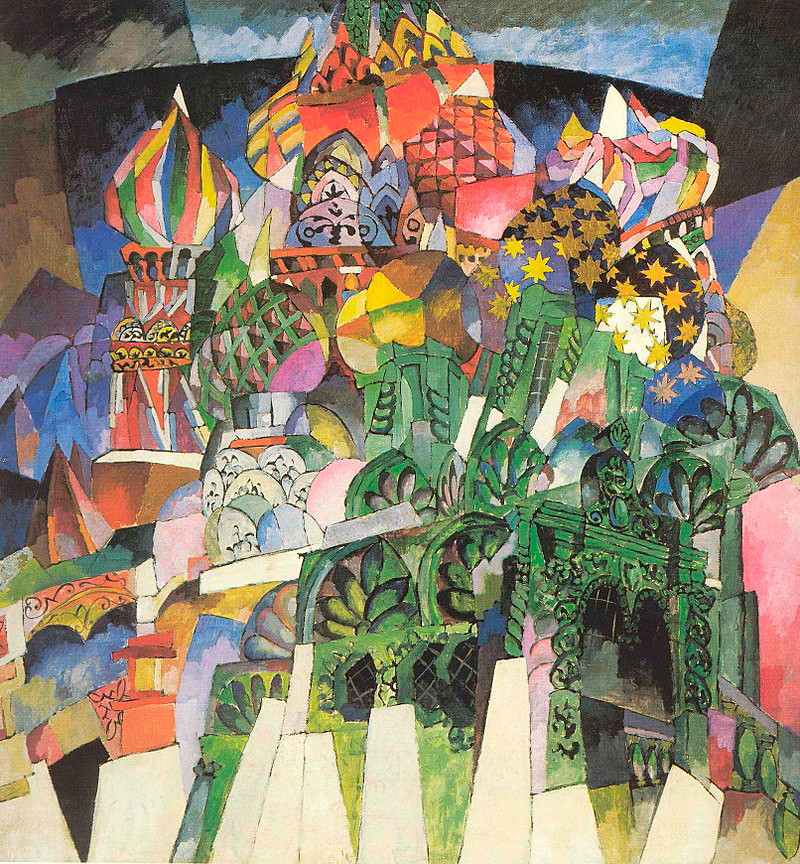
'Saint Basil's Cathedral', 1913
Tretyakov Gallery
The riotous colors of his diverse works earned him the nickname of "an artist of the sun". To give simply one telling example from Lentulov'southward life: on the anniversary of the October Revolution, he painted the trees and the backyard on Teatralnaya Square (next to the Kremlin) in a tearing purple color.
47. El Lissitzky

This is what a propaganda poster looks like if information technology is created by a violent supporter of suprematism. The red triangle symbolizes the Red Bolshevik Army, which crushes the defenses of the imperialist White Regular army with a wedge.
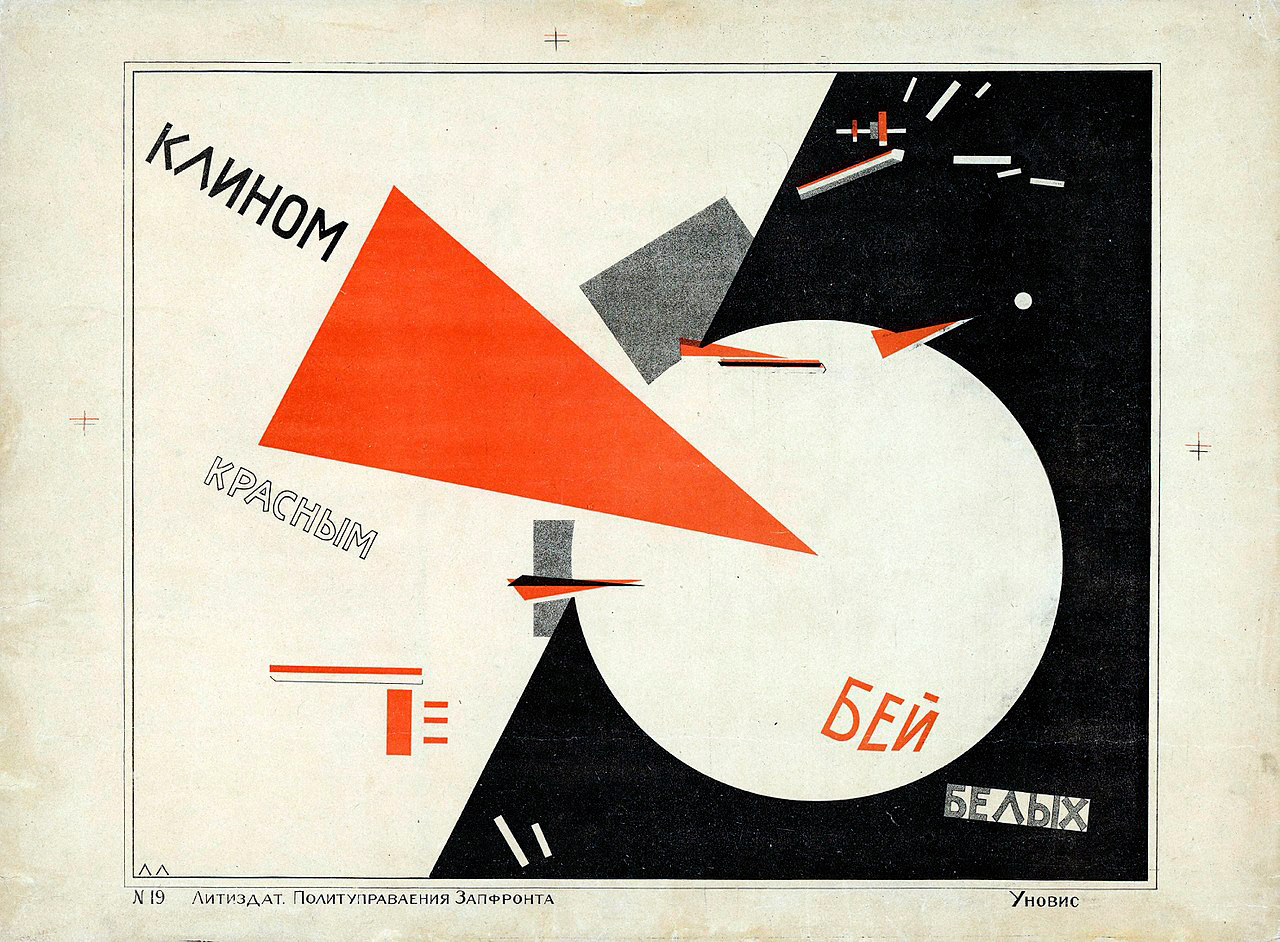
'Trounce the Whites with the Ruddy Wedge!', 1919-1920
Public domain
El Lissitzky was an associate of Malevich and contributed to the evolution of the ideas of avant-garde art. For instance, it was thanks to him that suprematism fabricated its way into architecture.
48. Isaac Levitan

Levitan was in love with the Russian countryside and became a primary of the "mood mural". In the end, that was what secured him membership of the Academy of Arts. The Jewish artist had to come up a long style to achieve this accolade: some of Levitan's teachers believed that a Jew should non bear on the Russian landscape, every bit only ethnic Russian artists could depict Russian nature. Furthermore, Levitan was expelled from the capital letter, by a royal decree, considering he was a Jew.
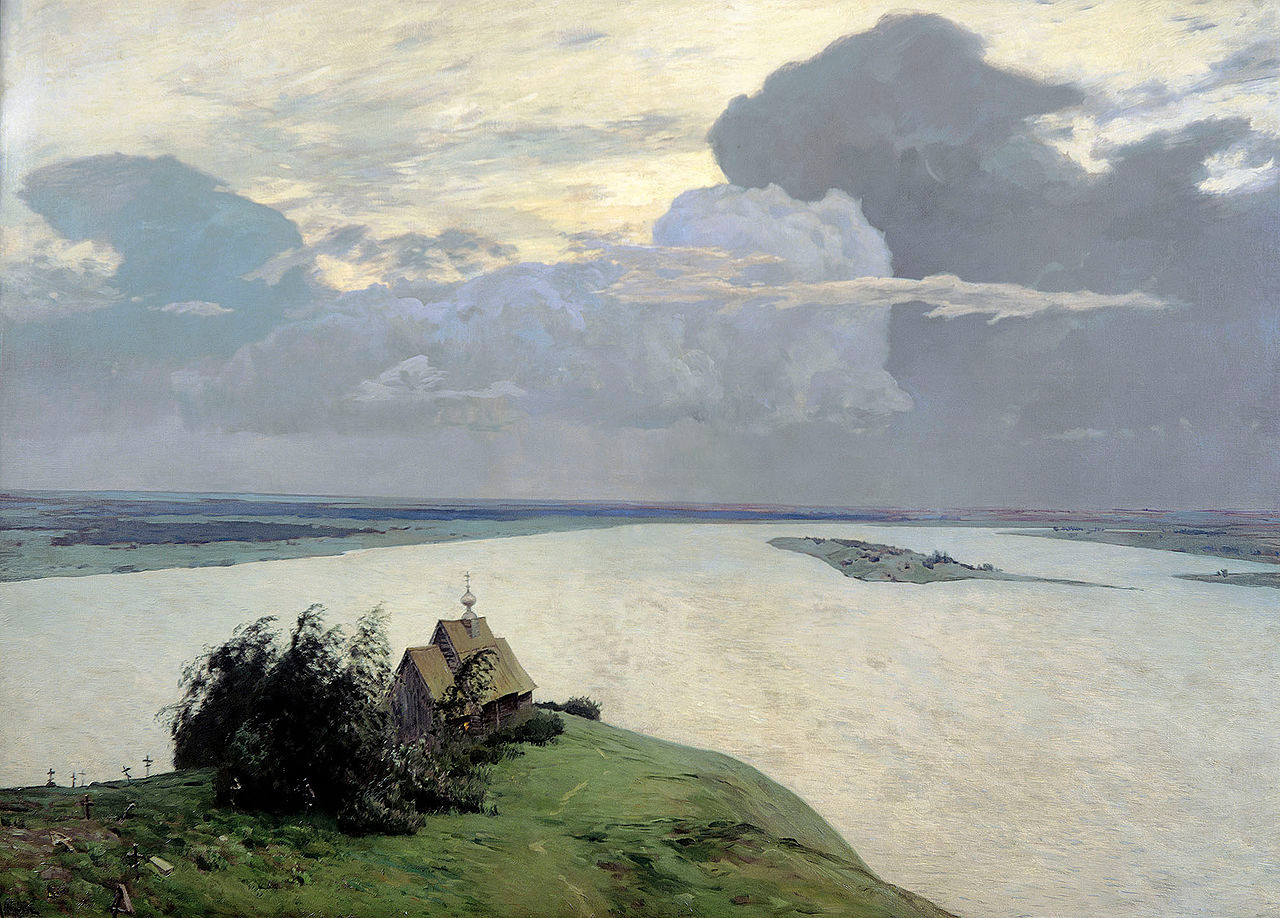
'Above the Eternal Peace', 1894
Tretyakov Gallery
All the same, fourth dimension has set everything direct: in that location is a widely held stance that 'Higher up the Eternal Peace' is "the most Russian" of all paintings on the Russian theme.
49. Dmitry Levitzky

Hither is another 18th century main of the official portrait. His talent is manifest by the illustrious circle of his sitters, from Empress Catherine the Great and French philosopher Denis Diderot to Prokofiy Demidov, a mining magnate.
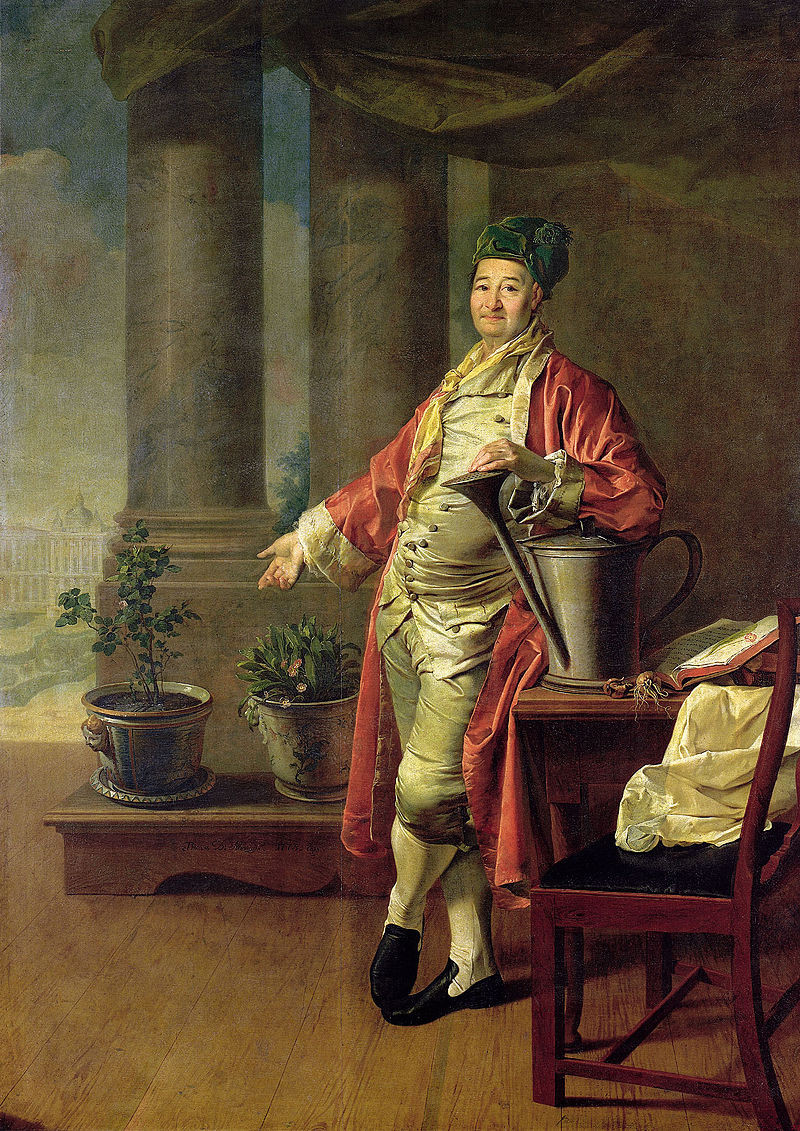
'Portrait of Prokofiy Demidov', 1773
Tretyakov Gallery
Demidov had the reputation of an educated tycoon and an eccentric. For example, one time he bought all the hemp fiber in St. Petersburg normally reserved for the British to teach them a lesson, who during his stay in England had forced him to pay an exorbitant price for a commodity he needed. And for his official portrait, Demidov chose to clothes not in his uniform with all his awards, but in a dressing gown and a nighttime-cap...
50. Kazimir Malevich

Malevich isthe main symbolof Russian avant-garde, while his 'Black Square' is a pictorial manifesto ofSuprematism. Malevich believed that after Suprematism there was no art, so he suggested burning all paintings and displaying their ashes in museums. Tragically, this is what partially happened in the first months after the 1917 Bolshevik Revolution.
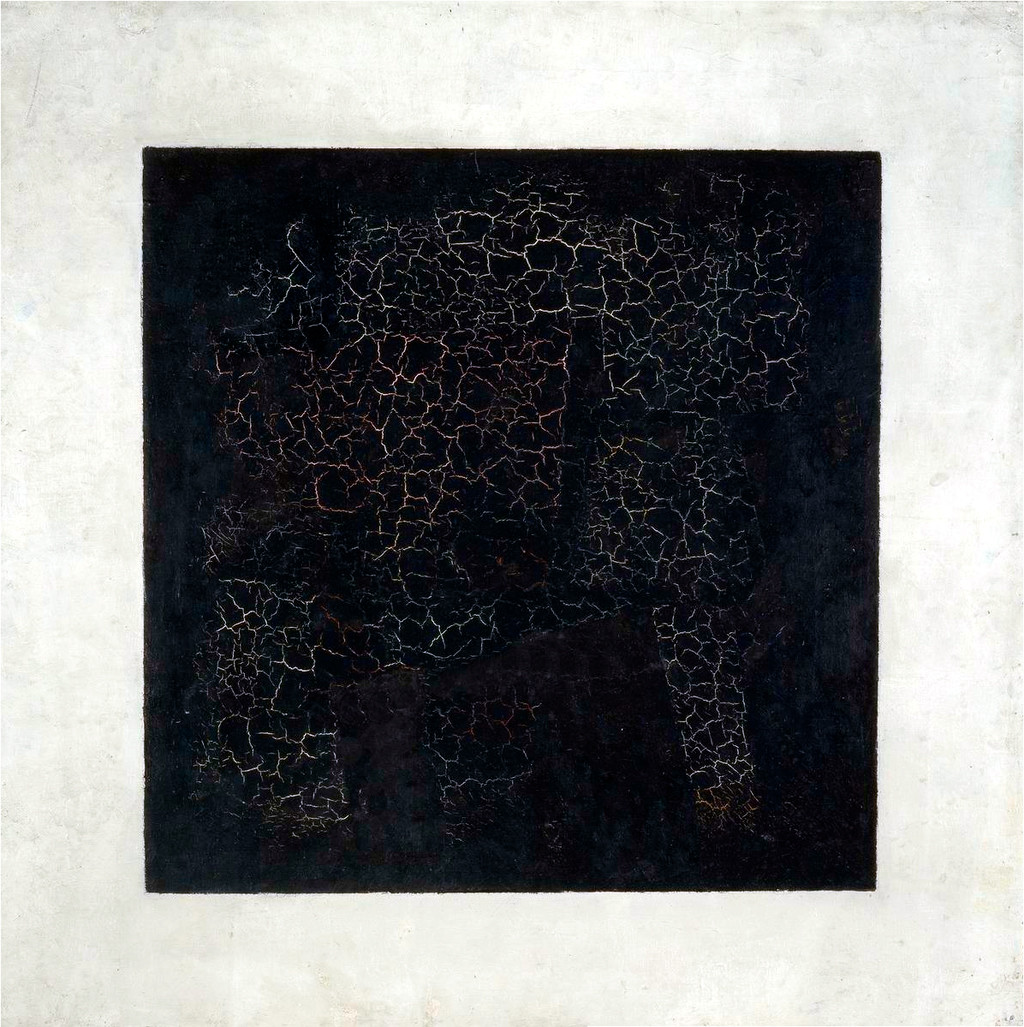
'Blackness Square', 1915
Tretyakov Gallery
51. Filipp Malyavin

"Hollow!" This is how the Petersburg Academy of Arts responded to expressionist Malyavin's graduation work 'Laughter'. The graduate did not despair, and two years subsequently took his laughing peasant women with him to Paris. There, the canvas caused a sensation at the World Fair: the artist was presented with a golden medal, and the painting was bought by the Italian government for a modern art gallery in Venice.
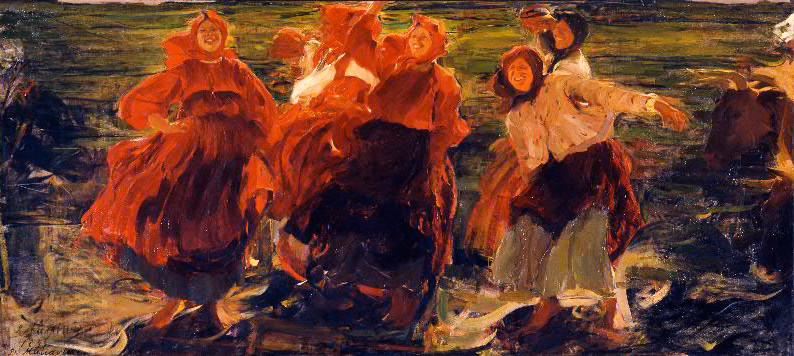
Ca' Pesaro International Gallery of Modern Art, Venice
Needless to say, Malyavin returned to Russian federation a celebrity. All the criticism of 'Laughter' was promptly forgotten and in 1906 he became a member of the Academy.
52. Vladislav Mamyshev-Monroe

A main of reinvention, he turned his life into a lifelong functioning. Practically the only representative of travesty art in Russia, Mamyshev-Monroe explored the personalities of famous figures in world history and popular culture, trying on their images for himself.
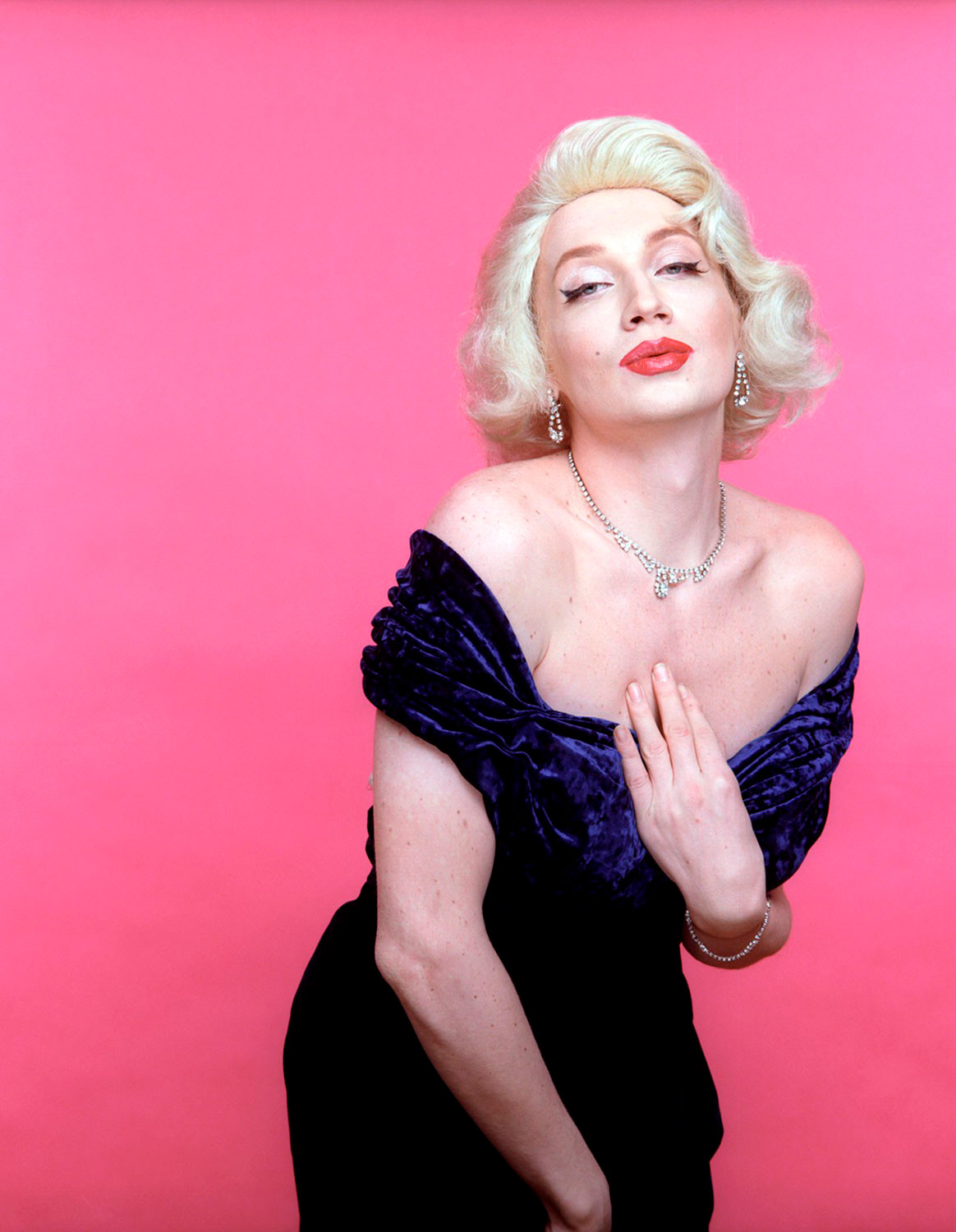
'The Life of Illustrious People' series, 1996
МАММ
During his brusque life (he died at the age of 44), the artists tried on a multitude of famous personalities, from Marilyn Monroe and Hitler to Jesus Christ and Lenin to Andy Warhol and Vladimir Putin.
53. Konstantin Makovsky

In the tardily 19th century, Makovsky was considered a fashionable and expensive portrait painter and writer of historical paintings. He also had a big gold medal of the Paris Earth's Off-white to his name.
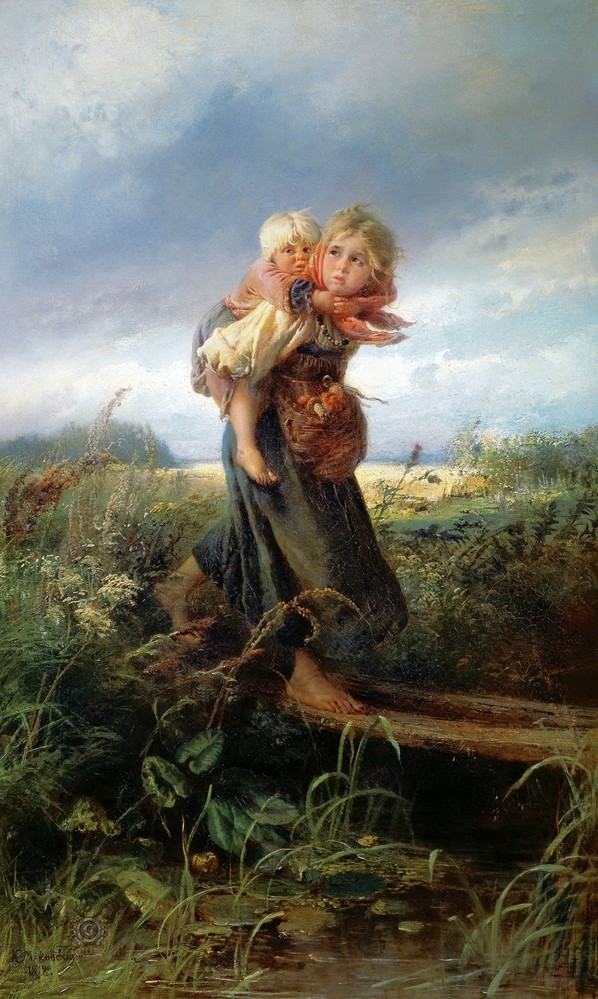
'Children Running from the Storm', 1872
Sputnik
Yet, Makovsky often painted touching and sentimental pictures about hard rural life too. His barefoot girl running with her brother from a thunderstorm is a real scene from life observed by the artist during 1 of his trips to the Russian provinces.
54. Vera Mukhina

One of the main symbols of the Soviet era and monumental propaganda, the 24-meter-alpine 'Worker and Kolkhoz Adult female' was created for the 1937 World'due south Off-white in Paris. The author, Vera Mukhina, wanted to depict the two figures naked, however, the political party demanded that they be "dressed". That detail, however, did not detract from the issue that the monument produced: the French fifty-fifty wanted to purchase it, but the Soviet Wedlock refused.
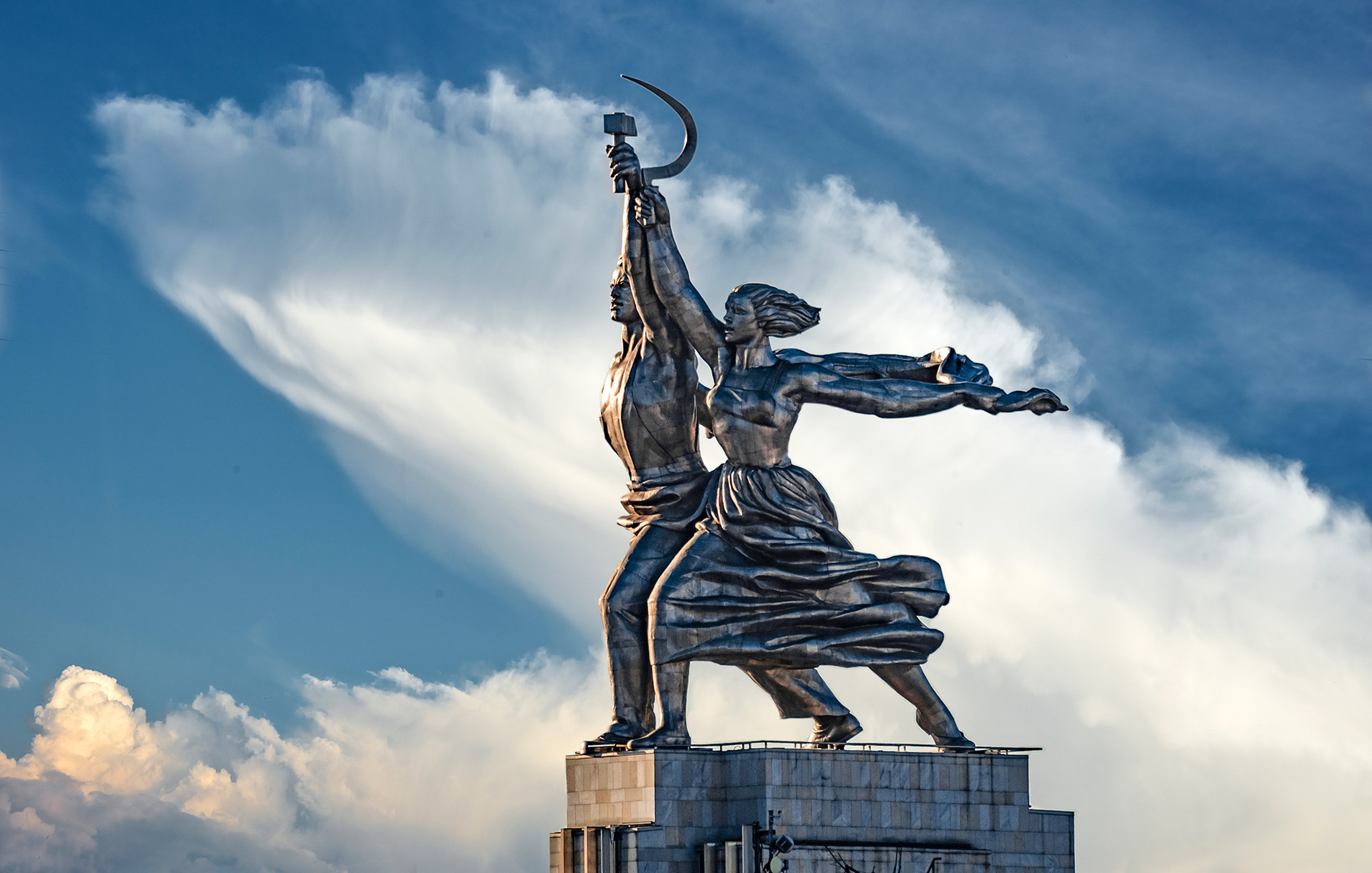
'Worker and Kolkhoz Woman', 1937
Global Look Press
Vera Mukhina had been fulfilling land orders for monuments since 1920, merely despite numerous awards (she had four Stalin Prizes solitary), she was never commissioned to make sculptures of either Lenin or Stalin. The reason was that Mukhina was non considered to exist reliable plenty. In the early 1930s, she was even expelled from Moscow, and after the Paris exhibition, an order was issued to never allow her to get away.
55. Irina Nakhova

Conceptual artist Nakhova is considered the author of the showtime "total installations" in Russian contemporary art. In the mid-1980s, she changed one of the rooms in her flat across recognition, thus becoming simultaneously the writer of her piece of work and a character living inside information technology. Thus, for several years her flat served as a testing ground for her experiments. In 2015, Nakhova became the commencement female artist to exist exhibited in the Russian pavilion at the Venice Biennale.
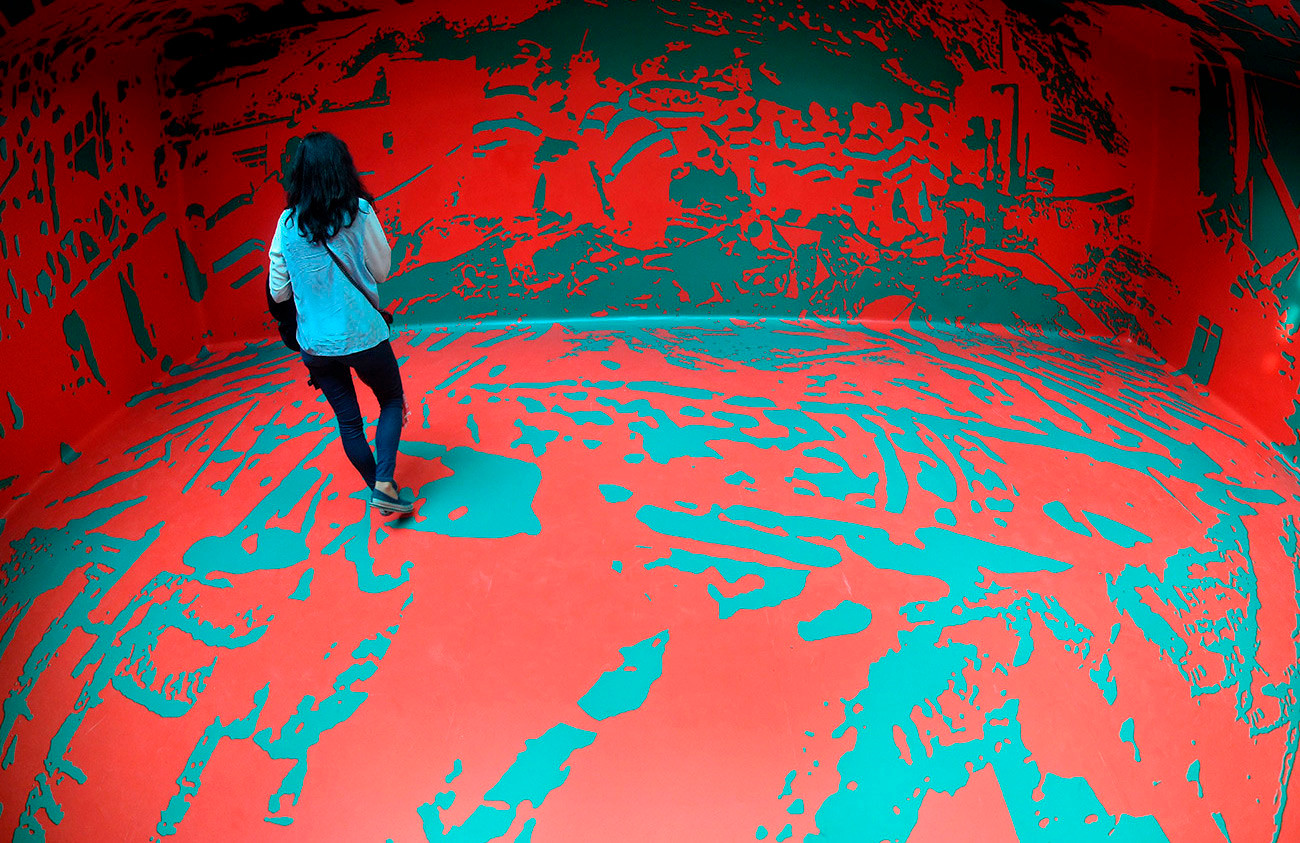
'Rooms' project, the 1980s
Global Look Press
56. Ernst Neizvestny

Neizvestny created monumental works that can exist seen today in Russian federation, Ukraine, the U.s., Arab republic of egypt, Sweden and the Vatican. However, in the Soviet Spousal relationship, the sculptor was subjected to harsh ostracism. Because of disagreements with the official cultural style - socialist realism - he was savaged past newspapers; beaten on the street, and summoned for chats with party officials. The then head of land, Nikita Khrushchev, called his works "degenerate fine art". Ironically, when Khrushchev died, his family commissioned the tombstone from Ernst Neizvestny (and he fabricated it from two marble blocks — white and blackness — symbolizing Khrushchev'southward internal contradictions).
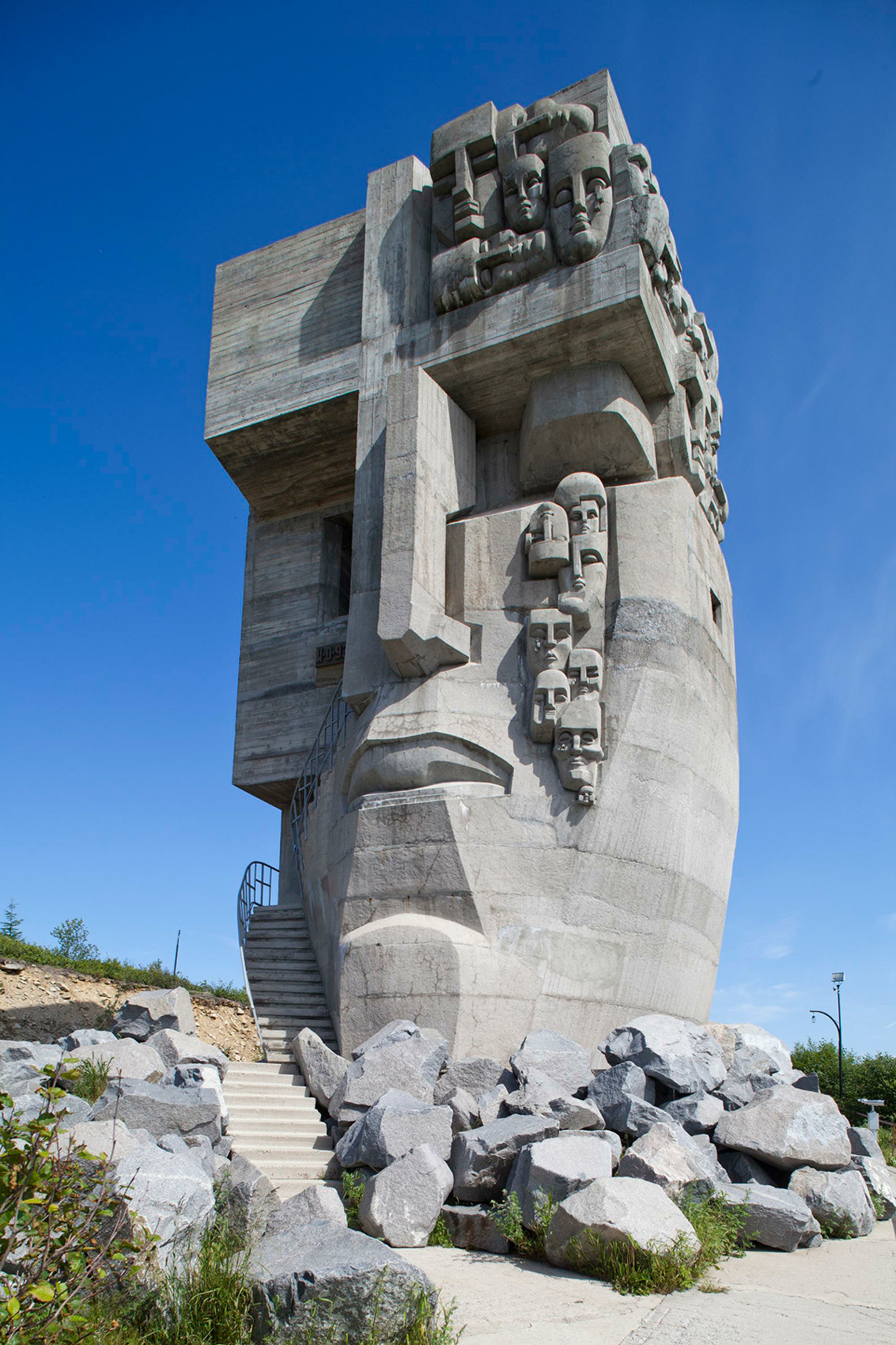
'Mask of Sorrow', 1996
Global Look Press
Possibly his most famous piece of work is 'Mask of Sorrow', a xv-meter monument in Magadan, dedicated to the memory of victims of political repression. It is standing at the site of a Stalin-era transit military camp, from where prisoners were sent to Kolyma labor camps.
57. Vladimir Nemukhin

Nemukhin is ane of the most important representatives of Soviet Nonconformist Art. He was expelled from the art institute for his radical language and was officially banned, although he enjoyed popularity amidst the public during the catamenia of the Khrushchev Thaw.
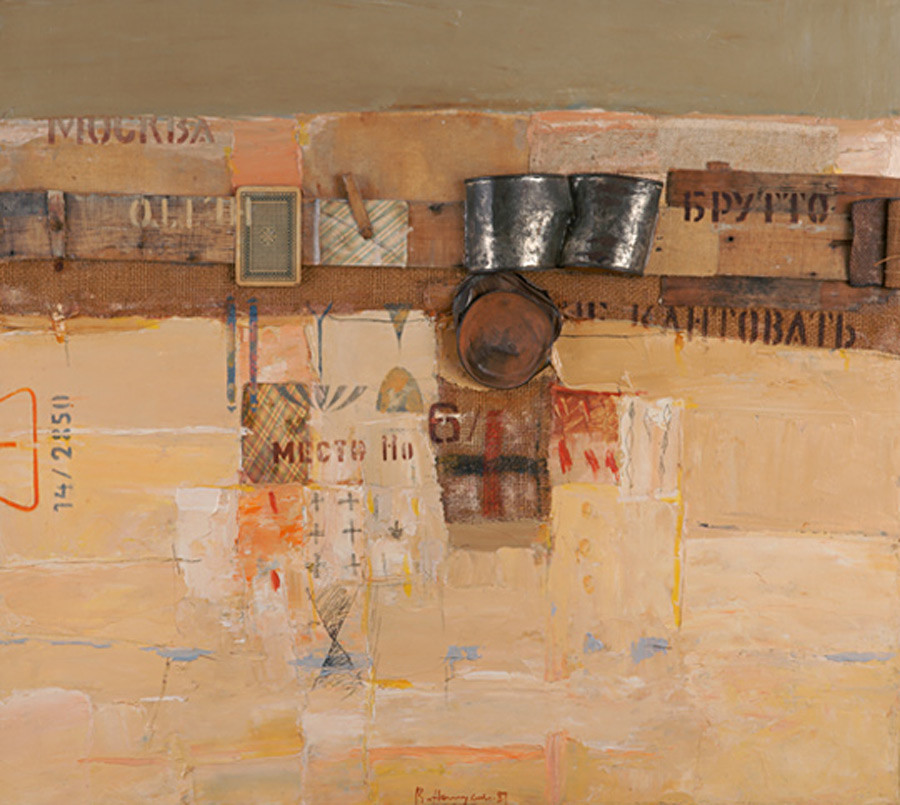
'Cans. Playing Cards on the Beach', 1989
Victor Mincin'southward collection
In 1956, he met Oscar Rabin and joined the Lianozovo Group. For many years, his favorite flim-flam, his "signature" and the subject of many of his works were playing cards. They were always present in his works – as a single card, in pairs or in solitaire - becoming a symbol of the uncertainty of the future.
58. Mikhail Nesterov

Religious artist Nesterov created the image of "the Russian Christ" through the paradigm of Sergius of Radonezh, a Russian Orthodox Church saint and ascetic. Nesterov dedicated a huge bike of paintings to him, merely considered 'The Vision to the Youth...' his best work ever.
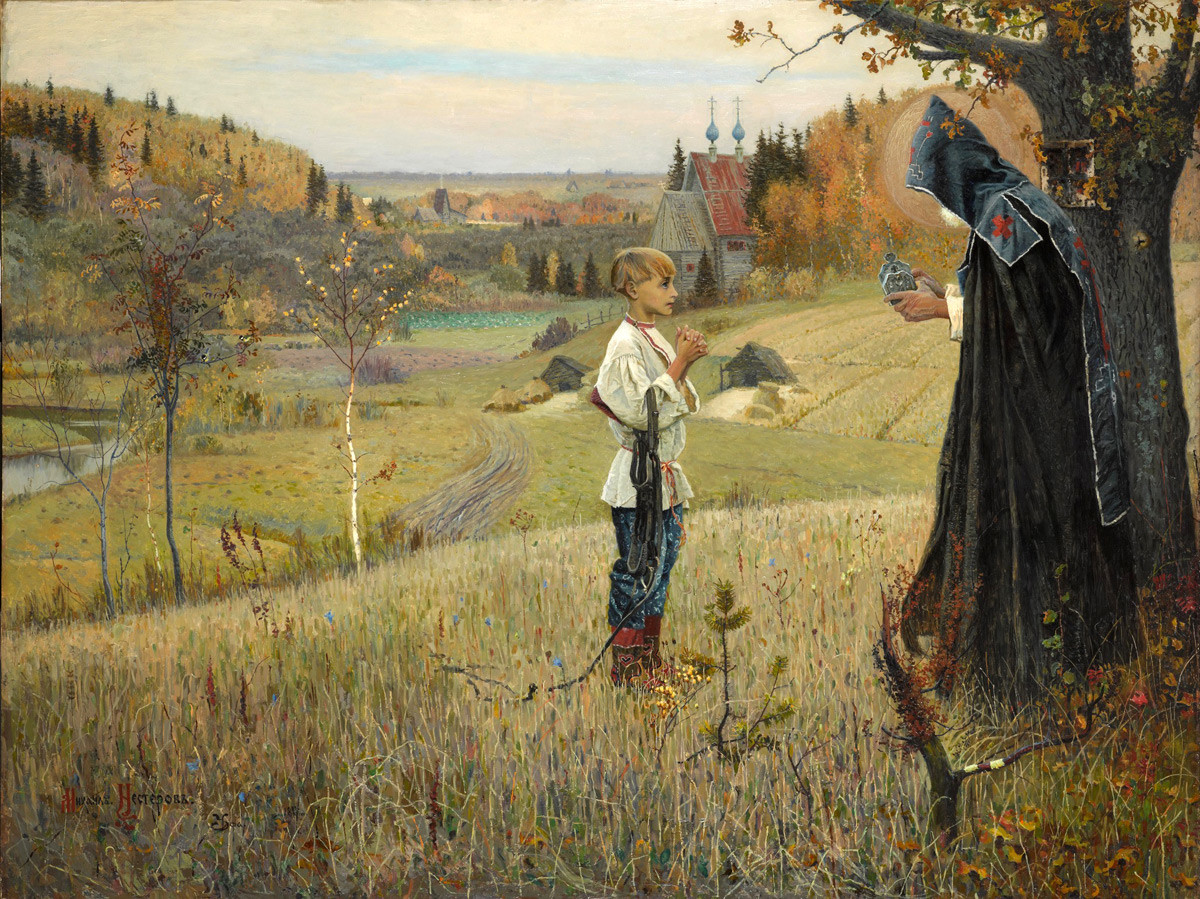
'The Vision to the Youth Bartholomew', 1890
Tretyakov gallery
And even so, Nesterov (who was rarely satisfied with his works and often destroyed them) damaged this canvas, also: he fell on the picture when he was repainting the youth'south face for the hundredth time.
59. Timur Novikov

Bernd.Brincken (CC By-SA 3.0)
Novikov is the founder and leader of i of the primary art associations in the Russian contemporary art of the 1980s called New Artists. In one case he exhibited a plywood shield with a hole in it, calling the work 'Naught Object'. Novikov is best known for his fabric appliqués.
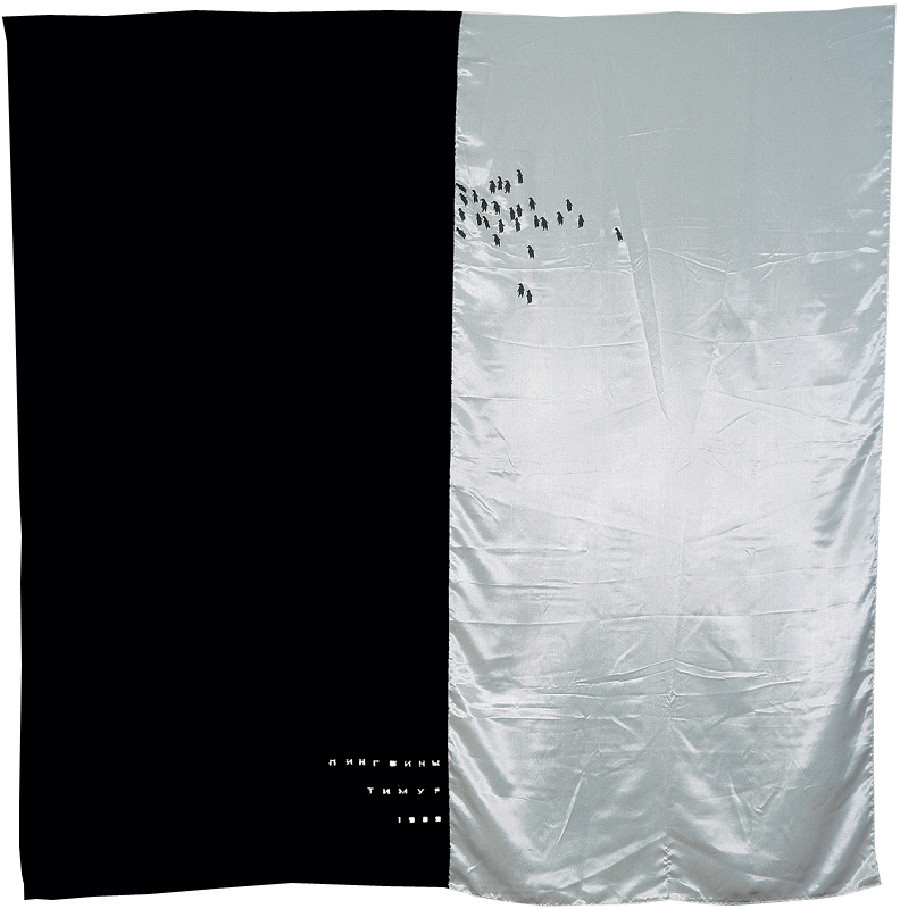
'Penguins', 1989
Moscow Museum of Modernistic Fine art
He was credited with continuing the work of the Russian avant-garde in new realities and with new materials. In the late 1990s, he exhibited at Tate in Liverpool, at Stedelijk in Amsterdam, in museums and galleries in Berlin, Hamburg, Paris, New York, Moscow and St. Petersburg.
60. Boris Orlov

A classic of Sots Fine art, in his works Orlov explores the regal style and the phenomenon of an empire in the broadest sense. His works may depict different historical eras in different cultures, but they all revolve effectually 1 topic - the patriarchal system based on the idea of domination.
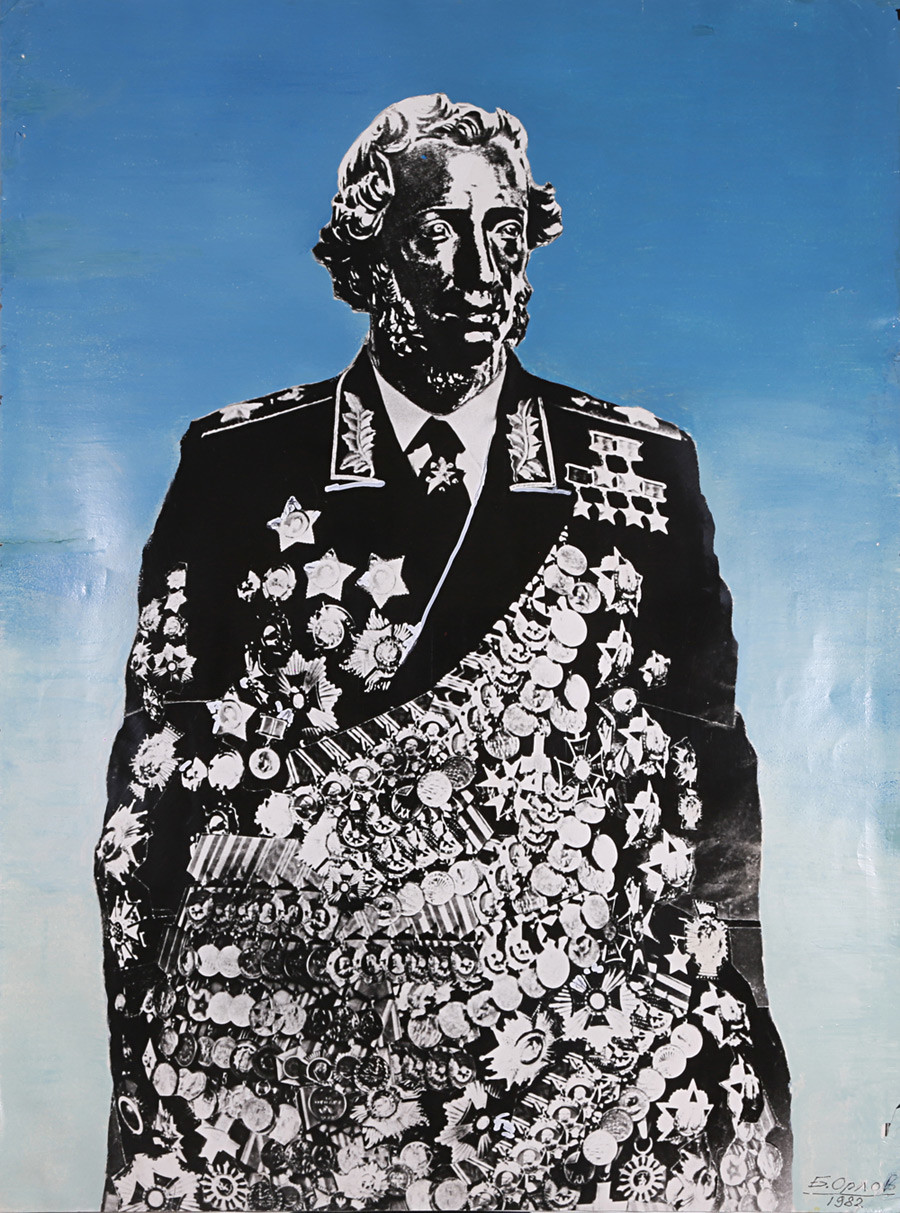
'National Totem', 1982
The Vladimir Potanin Foundation
One of his favorite methods is the use of militaristic accessories: "Considering an empire ordinarily has a war machine face up. And even a non-military one puts on a uniform."
61. Anatoly Osmolovsky

Garage Museum of Contemporary Art
Osmolovsky is Russia'southward main activist artist, whose actions, poetry, lectures and even fights amounted to an exciting political statement in the 1990s. He carried a fridge with a Lenin bust within to Reddish Square; laid out an obscene word on the same square with the bodies of his comrades; smoked on the shoulder of the Mayakovsky statue, and was behind many other actions and happenings.
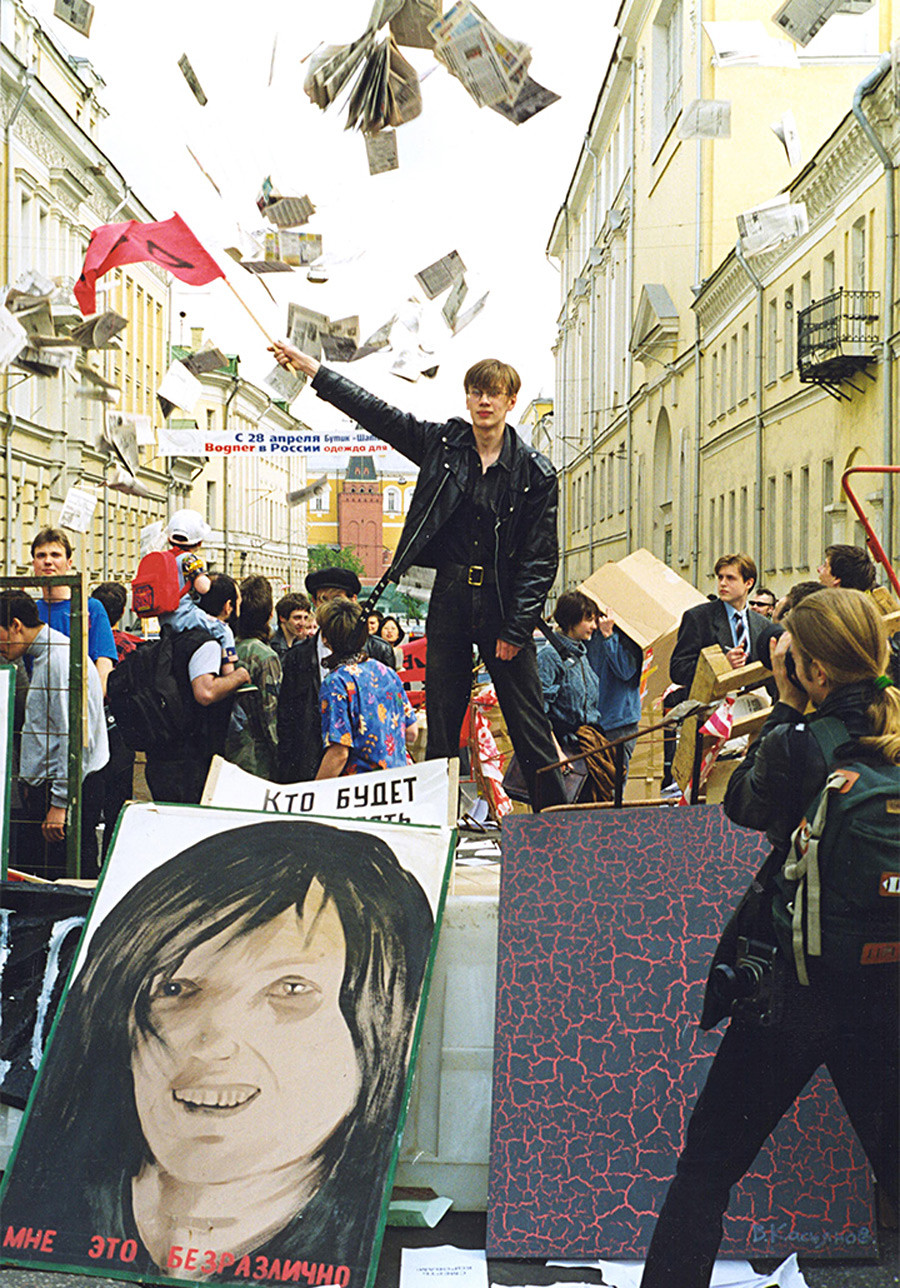
'Barricades', 1998
Anatoly Osmolovsky
In 1998, he and 300 other activists for barricaded Bolshaya Nikitskaya Street, which leads to the Kremlin, for three hours, dedicating their activity to the 1968 French Revolution. Vii leaders of that procession were subsequently convicted and sentenced to fines.
62. Vasily Perov

Many of Perov's paintings provoked heated debates among his contemporaries. The artist painted scenes from the harsh life of ordinary people. 'Troika…', depicting children who were brought from the village to boondocks every bit hired labor, is peradventure his best work on this subject.
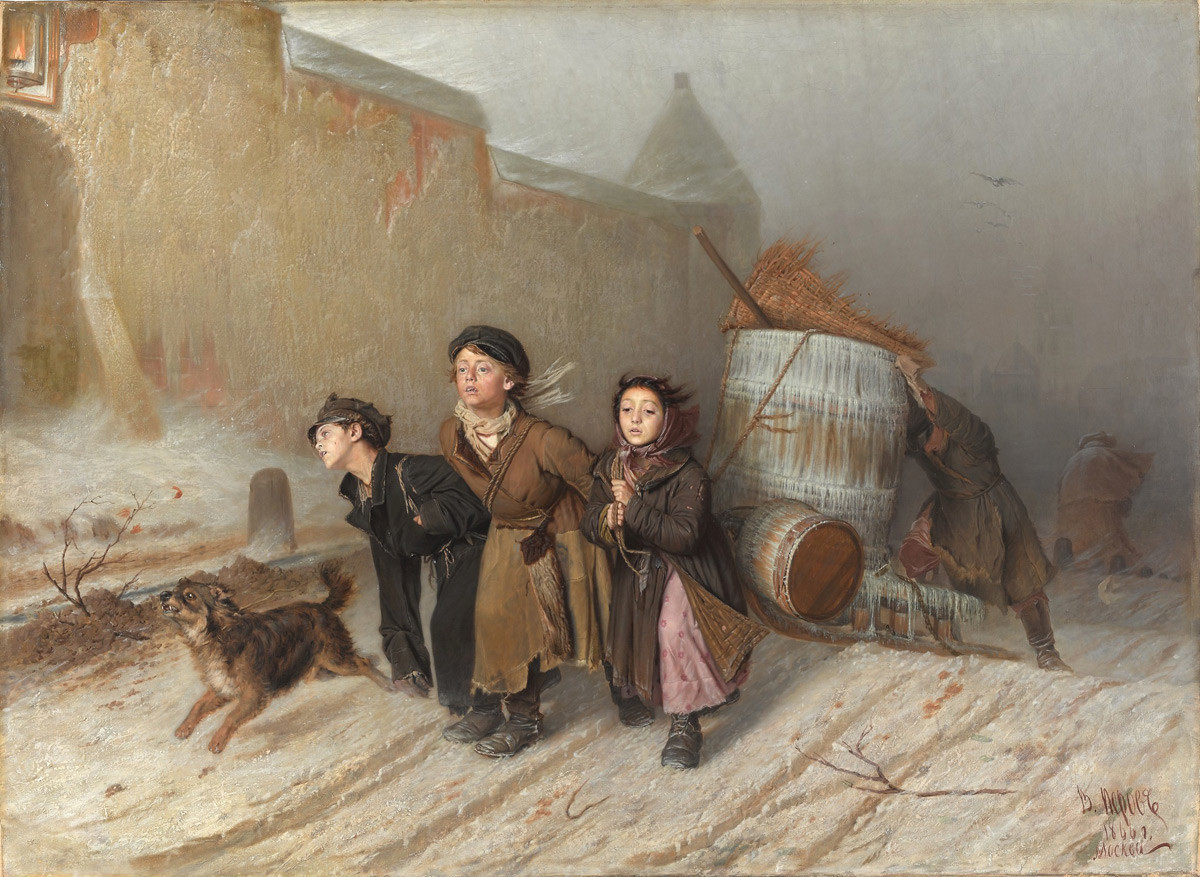
'Тroika. Amateur Workmen Carrying H2o', 1866
Tretyakov gallery
63. Yuri Pimenov

Pimenov was a loyal follower of the art policy of the Communist Political party. In the darkest times of Stalin's purges, he painted idyllic scenes of the everyday life of Soviet people andglorified manufactory and plant workers.
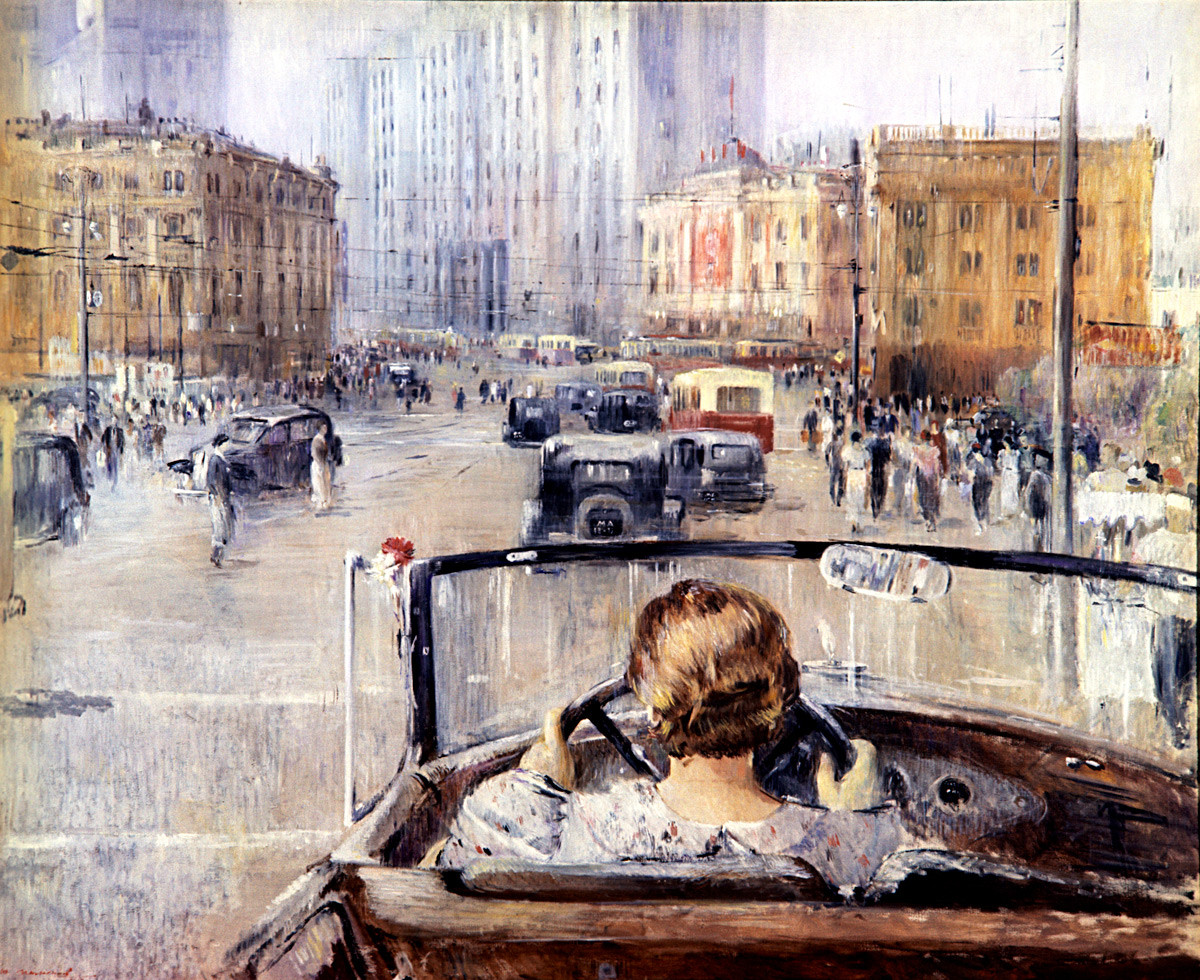
'New Moscow', 1937
Tretyakov gallery
His 'New Moscow' is one of the best examples of socialist realism: a adult female, as a symbol of a new era, is driving through blossoming Moscow. 1 assumes that her destination is no less brilliant and cute future.
64. Pavel Pepperstein

Pepperstein was born and grew up in the circumvolve of Moscow conceptualists (his father is the famous artist Viktor Pivovarov). Perhaps that is why his creative impulse was nourished from the very start. Today, Pepperstein is ane of the most prolific Russian artists and a famous writer.
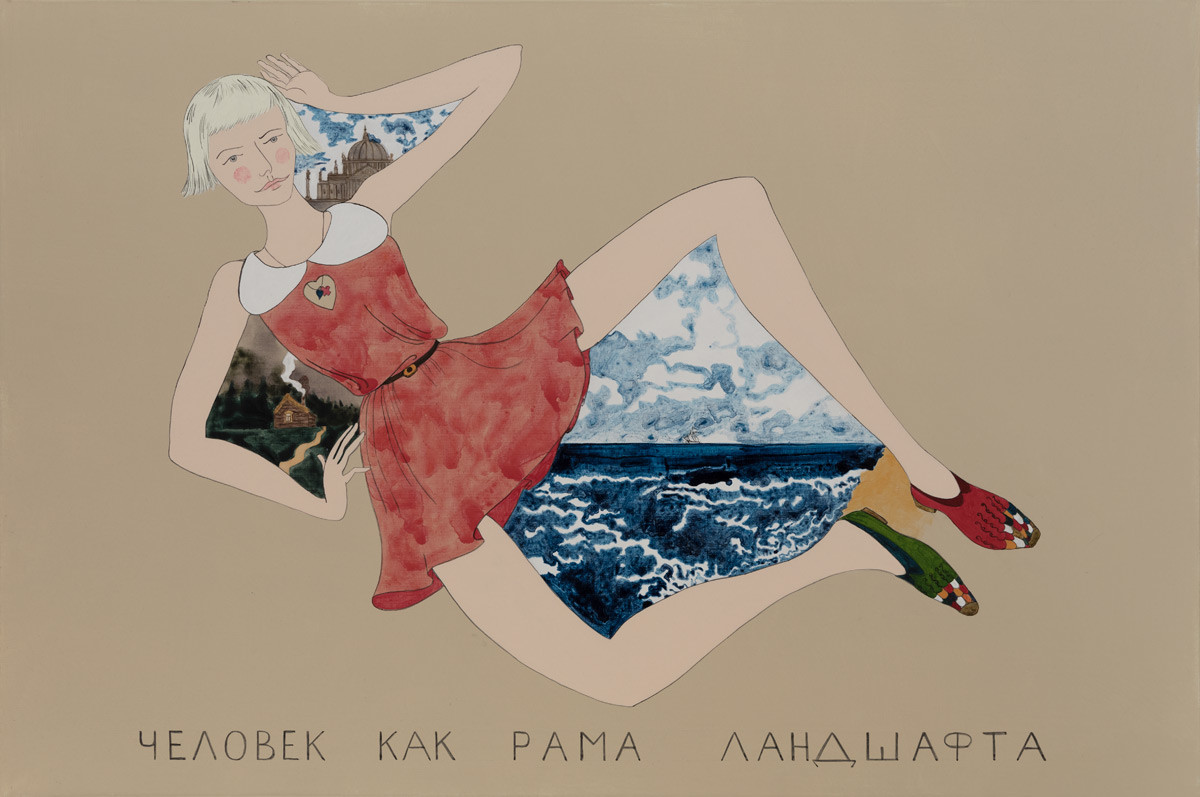
'The Girl as a Frame for the Landscape', 2018
Courtesy of the artist
In his works, he creates whole fictional worlds and his ain mythology. Which makes him particularly popular amid intellectuals.
65. Kuzma Petrov-Vodkin

He was the son of a shoemaker who wanted to paint icons. Although he did not become an icon painter,the artistwas made world famous past his epitome of the Messiah depicted every bit a young human on a scarlet horse. Created a few years earlier the Russian Revolution, this painting is considered prophetic and has numerous interpretations. According to one theory, the horse is Russian federation, which awaited a "red" destiny in the 20th century.
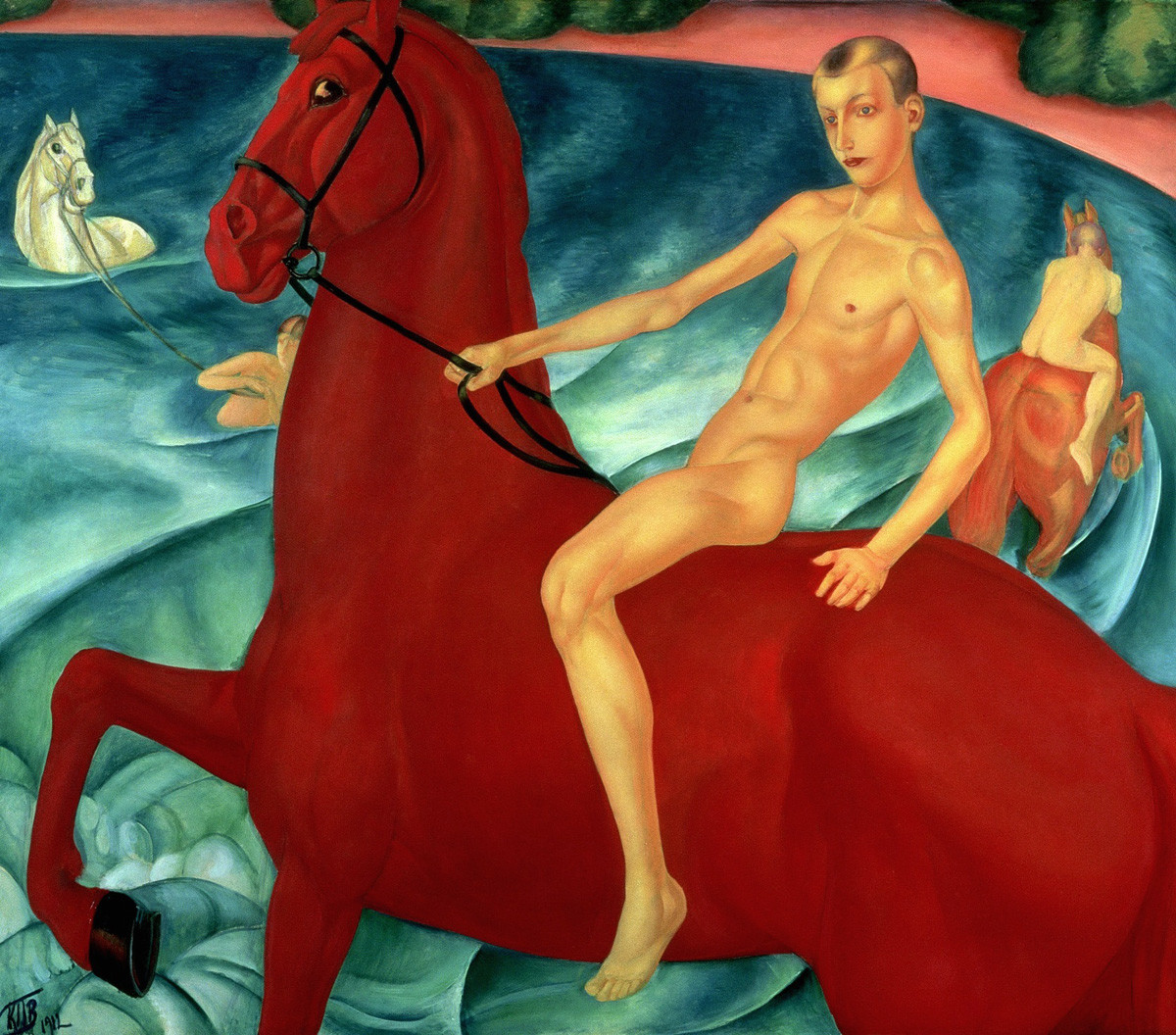
'Bathing of a Red Horse', 1912
Tretyakov gallery
66. Dmitri Prigov

By education, Prigov was a sculptor and this is how he fabricated a living during Soviet times, although all his busy creative action was aimed at condign a "monument" himself. In the 1970s, he also became known as a poet who turned his recitals into real performances. His so-chosen 'Cans', supposedly containing single words and whole poems, resemble Piero Manzoni's can cans with "Artist's Shit" written on them. Thus, Prigov equated poems to all the other secretions of the body.
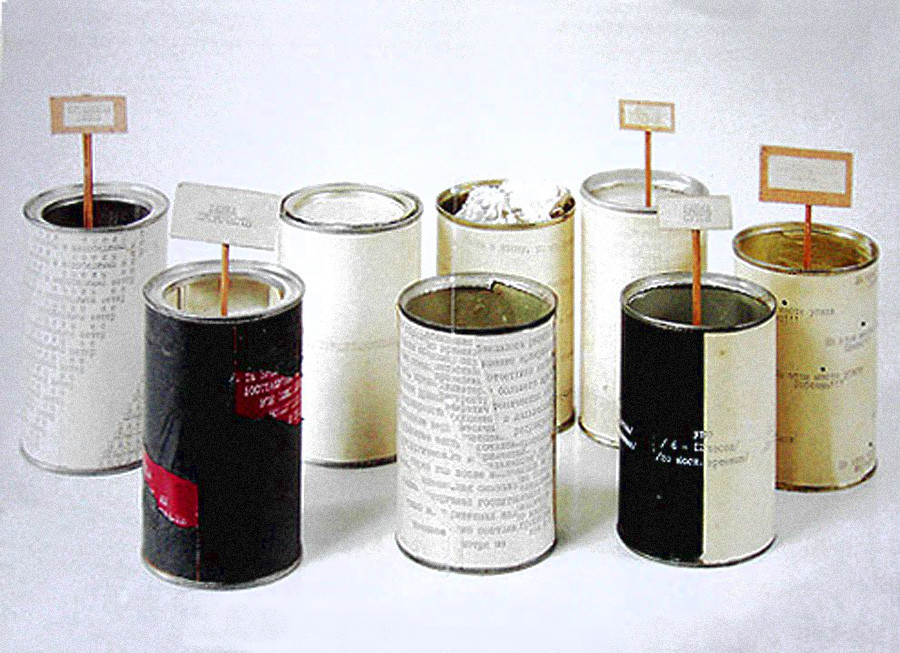
'Cans' project, 1975
Dmitri Prigov
With the arrival of perestroika, Prigov moved away from poetic performances to conceptual art: he created graphic art, installations, collages, crossing ideas, words and thoughts, "deciphering the civilization genome" and new symbols.
67. Vasily Polenov

One of the leading religious artists, Polenov wanted to create something as ambitious equally Ivanov's 'The Appearance of Christ before the People'. To this finish, he prepare off on a yr-long journey through Constantinople, Palestine, Syria, and Arab republic of egypt, from where he brought the starting time sketches to 'Christ and the Woman Taken in Adultery', his master work. The journey from the thought to the completion of the canvas based on a scene from the Gospel of John took him every bit long as fifteen years.
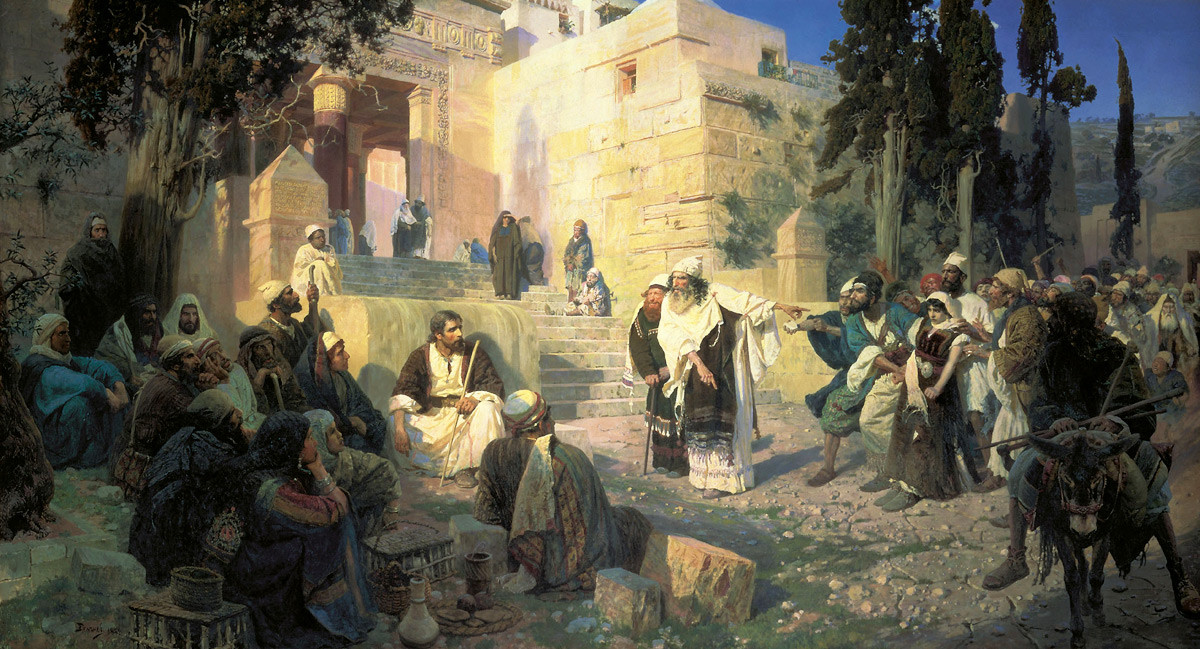
'Christ and the Adult female Taken in Infidelity', 1888
Russian Museum
68. Lyubov Popova

Despite having died very young (of cherry-red fever at the historic period of 35 together with her son), in her lifetime the creative person managed to be a futurist, a student of Malevich, an adept of cubism and, finally, a constructivist. It was in that last chapters that Popova designed working wearing apparel for "revolutionary" professions.
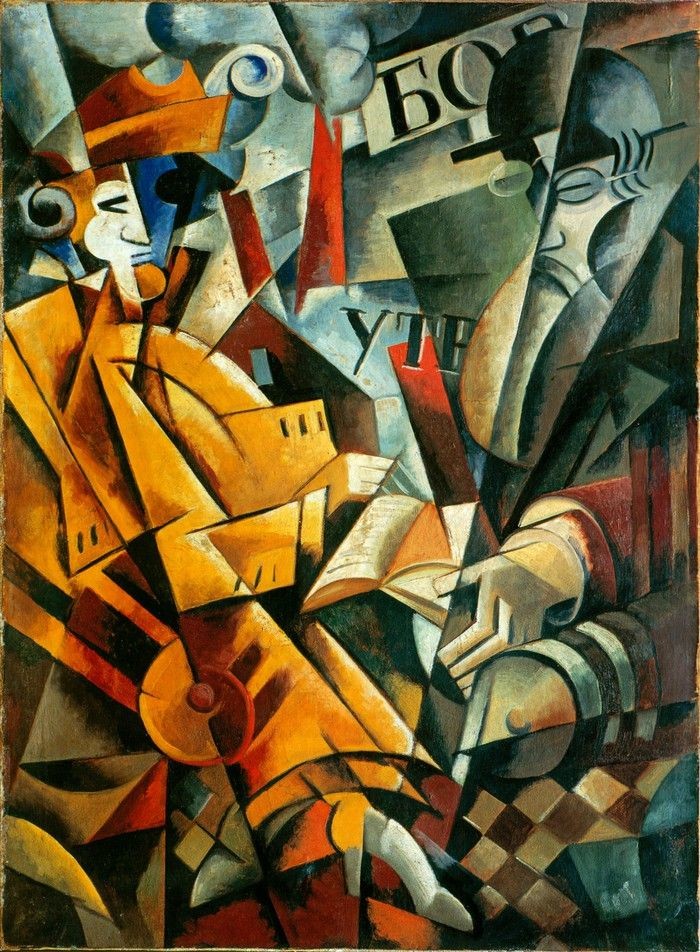
'Limerick with Figures', 1915
Perm State Art Gallery
69. Viktor Pivovarov

Unlike his colleagues, this classic of Moscow Conceptualism largely focused on the "secret life of the human soul". In the words of the artist's son, Pavel Pepperstein, "all his life, Pivovarov has been painting the room of the soul", where all external attributes, like the view from the window, go role of information technology.
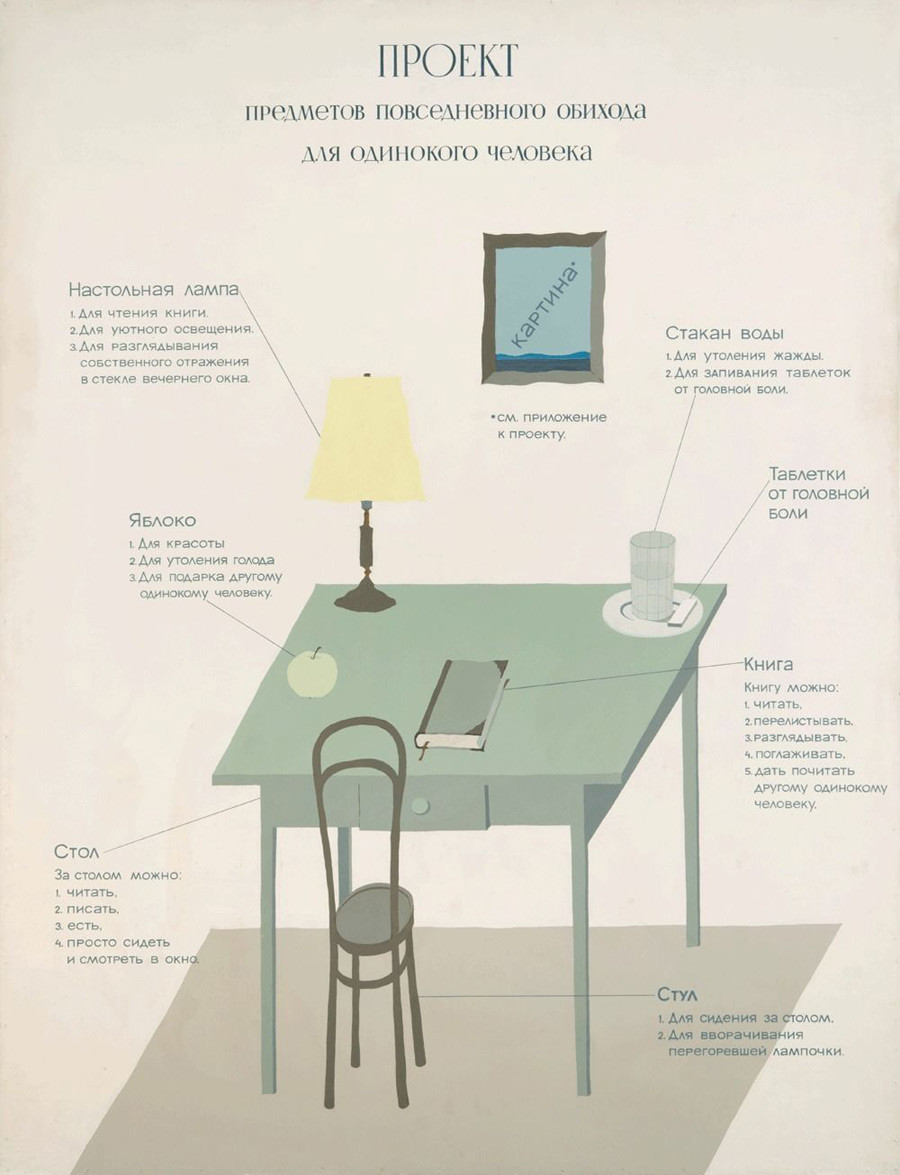
'Projects for a Lonely Man', 1975
Viktor Pivovarov
Pivovarov's main "invention" was the genre of a conceptual album. Information technology is in this genre that he created ane of his most famous cycles, 'Projects for a Lone Man', painting the daily routine, dreams, interior and even the sky of a hero, who is experiencing extreme loneliness. Incidentally, many viewers recognize themselves in the hero's daily routine. "In principle, it [the daily routine] has not changed much,"saysthe artist.
seventy. Vasili Pukirev

"Among his young man artists and students, he left a warm and lasting retentiveness, and in the history of Russian art - a brilliant, admitting a short trace," the artist'south contemporaries said in his obituary. Indeed, Pukirev, like a number of his colleagues, became the author of one masterpiece.
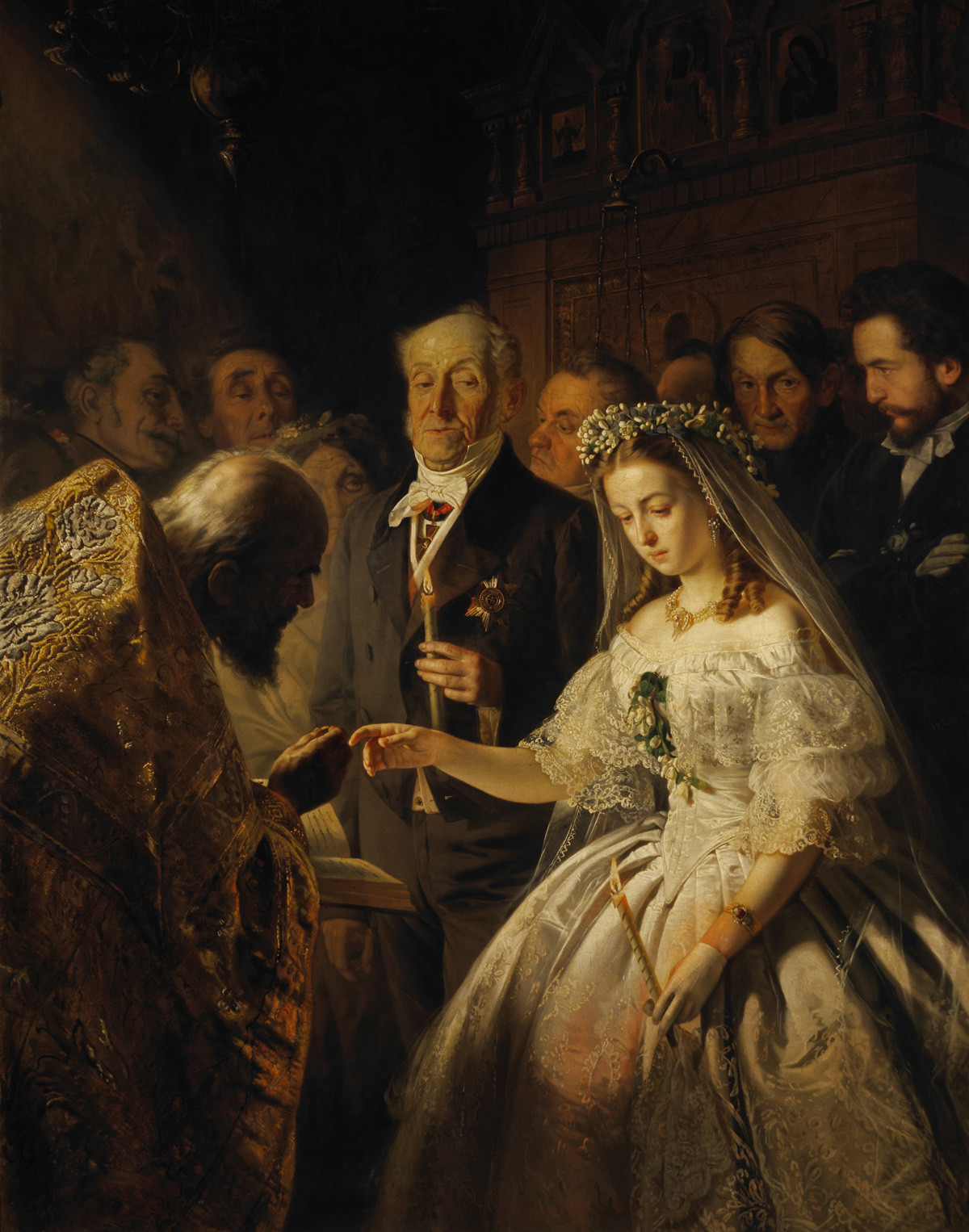
'The Unequal Wedlock', 1862
Tretyakov gallery
'The Diff Marriage' propelled him to the ranks of the leading genre painters of the mid-19th century, but remained Pukirev's only masterpiece.
71. Recycle group

The fine art group of Andrey Blokhin and Georgy Kuznetsov from Krasnodar was fix in 2008 and has already exhibited three times at the Venice Biennale with total installations and multimedia projects about augmented reality. All their works, in one mode or another, are most the life of a modern person in the era of the Internet and various gadgets.
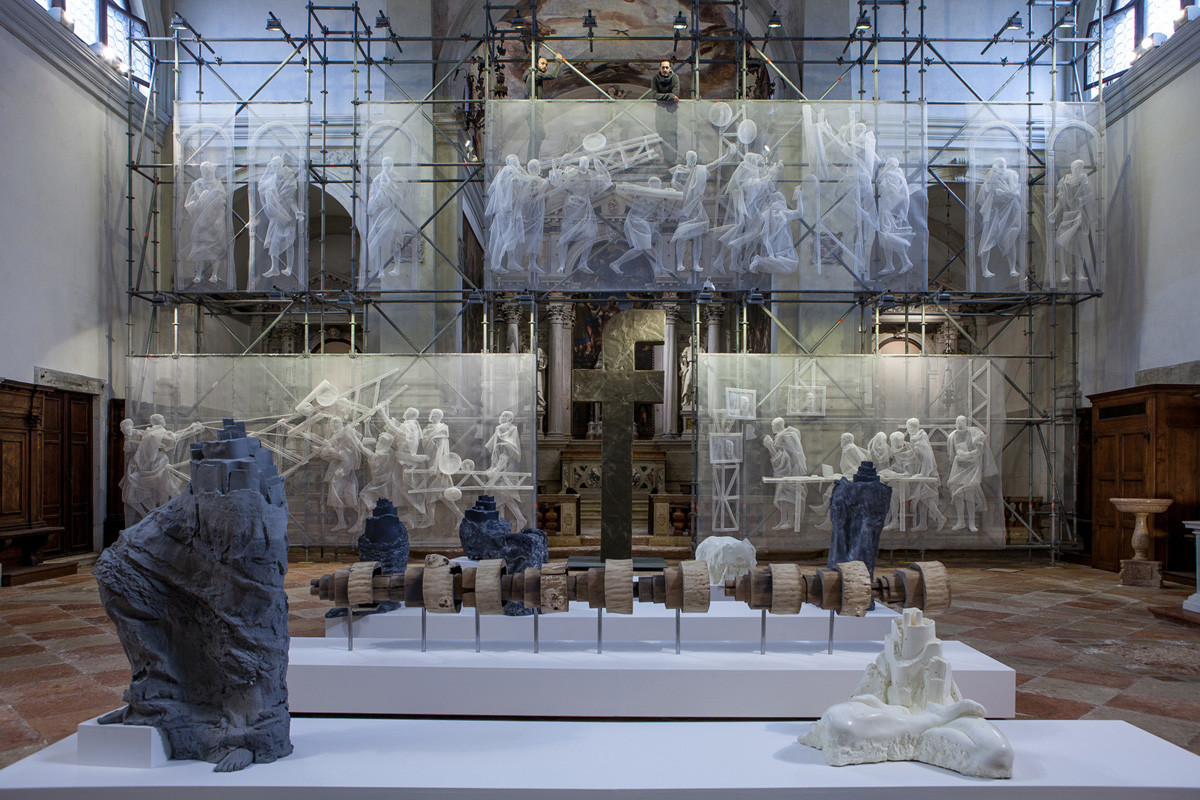
'Сonversion', 2015
Recycle art group
'Conversion' is a huge construction, with sculptures and bas-reliefs depicting "neo-apostles", the carriers of a new religion called "global network".
72. Oscar Rabin

Rabin is the leader of nonconformism, the unofficial Soviet art of the 1960-1970s. His paintings are full of all that was banned by official Soviet art — barracks, garbage dumps, vodka bottles, and crumpled newspapers. They depict the other, and bigger, side of glossy Soviet reality.
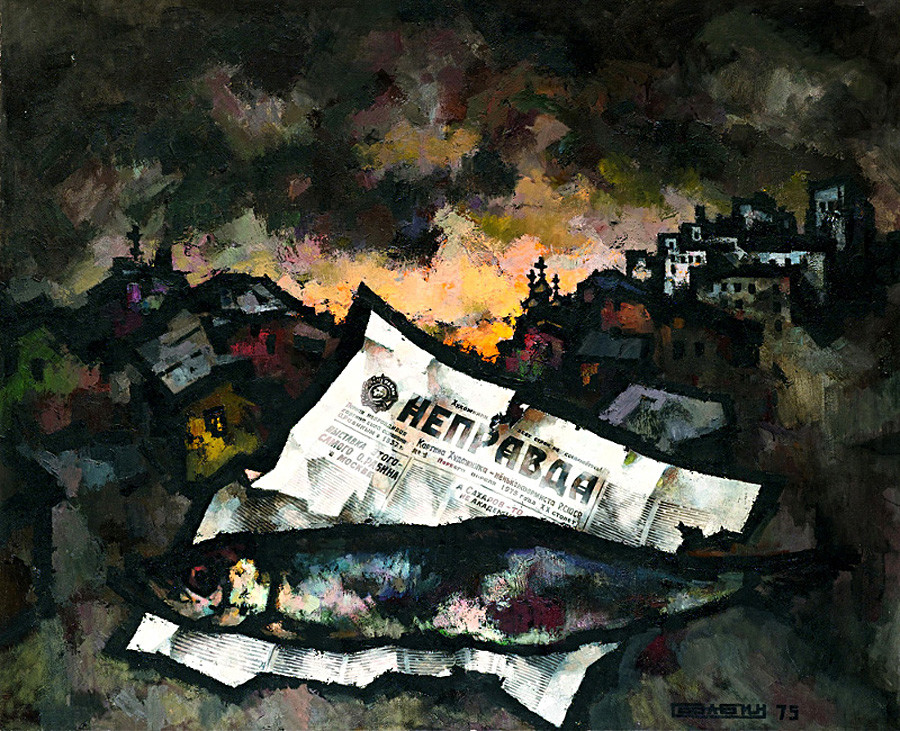
'Nepravda', 1975
Tsukanov Family unit Foundation
The artist said that all that garbage from the suburbs was he himself: "I have been painting one film all my life - my portrait against the background of the country."
73. Nicholas Roerich

A philosopher, traveler and orientalist creative person with an absolutely unique style, Roerich left a legacy consisting of more than than seven,000 paintings and sketches, many of which are now kept in the world's all-time museums. He spent all his life traveling, from which he drew his subjects - from an expedition in the Himalayas and Republic of india to Central Asia.
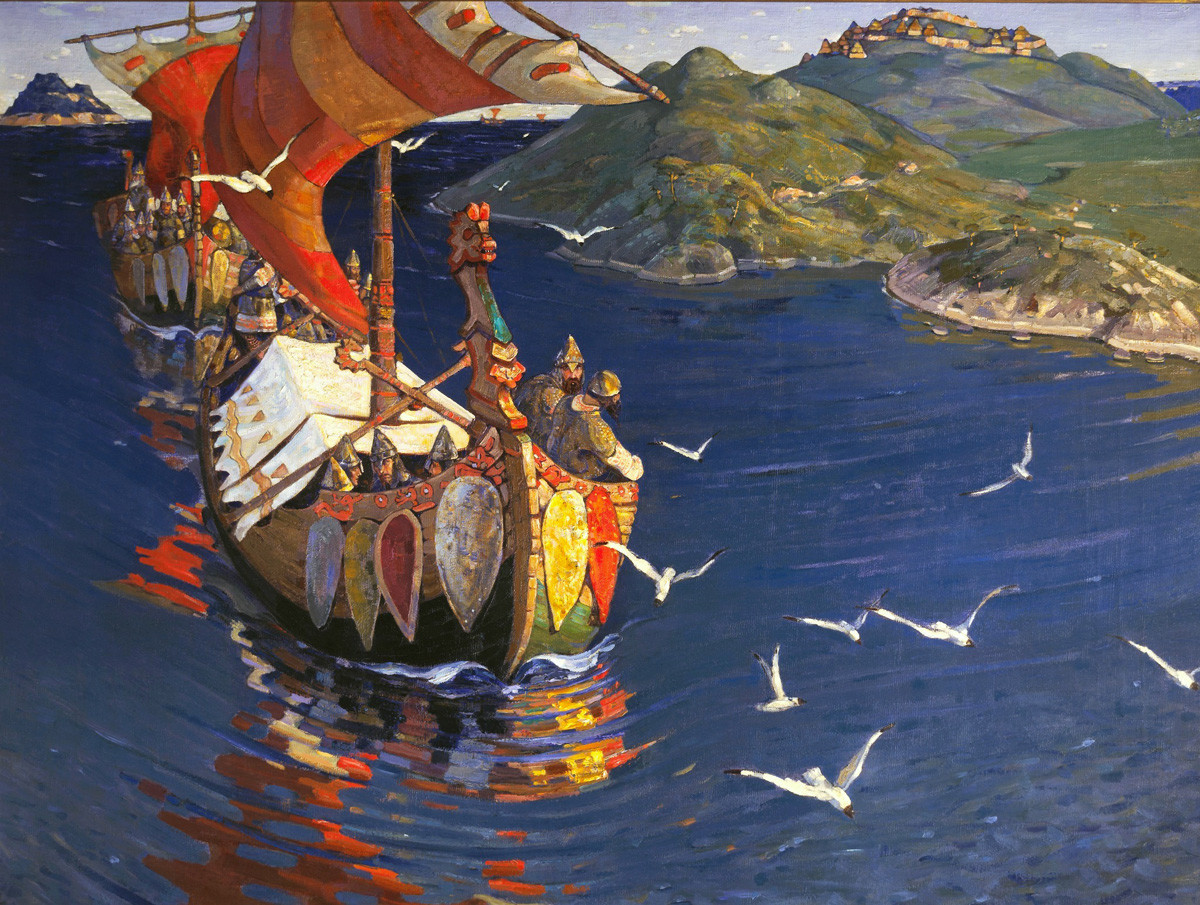
'Guests from Overseas', 1902
Tretyakov gallery
'Guests from Overseas' was painted in Paris and tells of travels in aboriginal Russia.
74. Ilya Repin

Repin was very good at depicting the suffering of the people in the 19th century. The harsh lives of barge haulers and revolutionaries, everyday scenes from the life of the lower classes, people's processions - all these subjects made him acardinal figure in Russian realismand an artist of social history. Yet, his near controversial painting depicts an episode from another era.
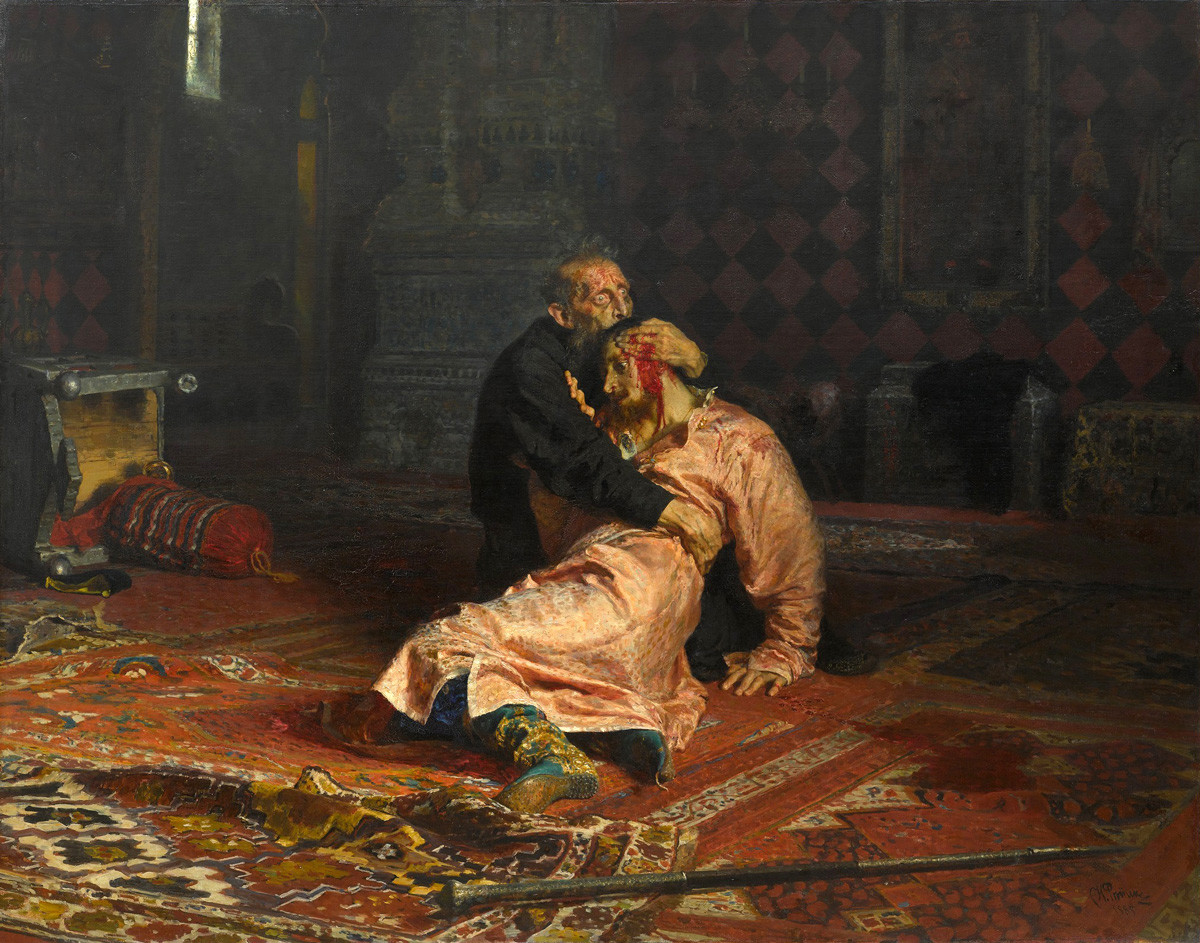
'Ivan the Terrible and His Son Ivan', 1885
Tretyakov gallery
The story of Ivan the Terrible killing his own son is so controversial (historians are still arguing whether it really happened or not) that Repin's masterpiece was repeatedly attacked, fifty-fifty during the creative person's lifetime. The latest attack took place in 2018, when a drunken vandalsplashed the canvas with paint.
75. Fyodor Rokotov

Rokotov was one of the most sought-later portrait painters among St. Petersburg nobility of the 18th century, while Alexandra Struyskaya depicted by him was considered i of the most beautiful women of the century.
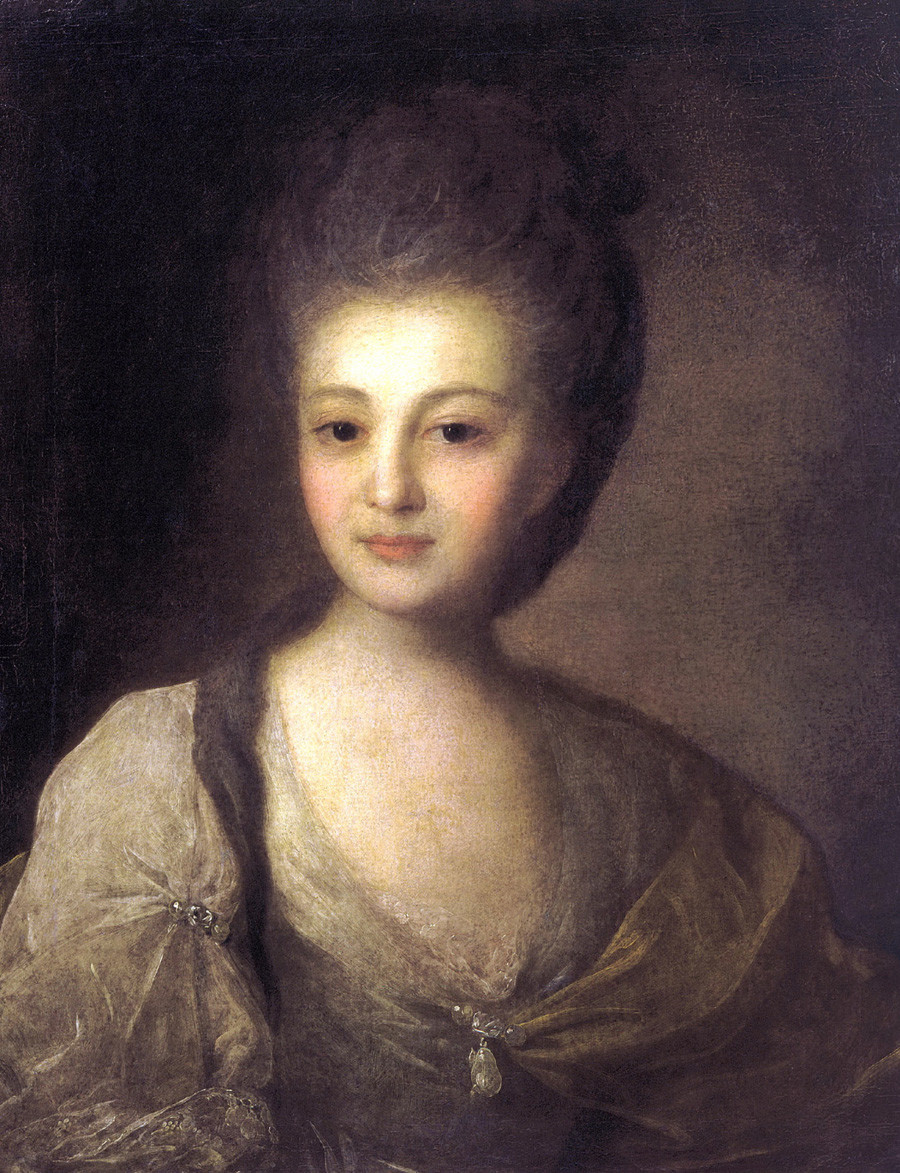
'Portrait of Alexandra Struyskaya', 1772
Tretyakov gallery
The artist was so popular that he could have up to 50 unfinished portraits in his apartment at any one fourth dimension. In 1763, he painted the coronation portrait of Catherine 2.
76. Alexander Rodchenko

Rodchenko, the "father" of Soviet advertising and design, a constructivist and an advanced artist, embraced the Bolshevik Revolution.
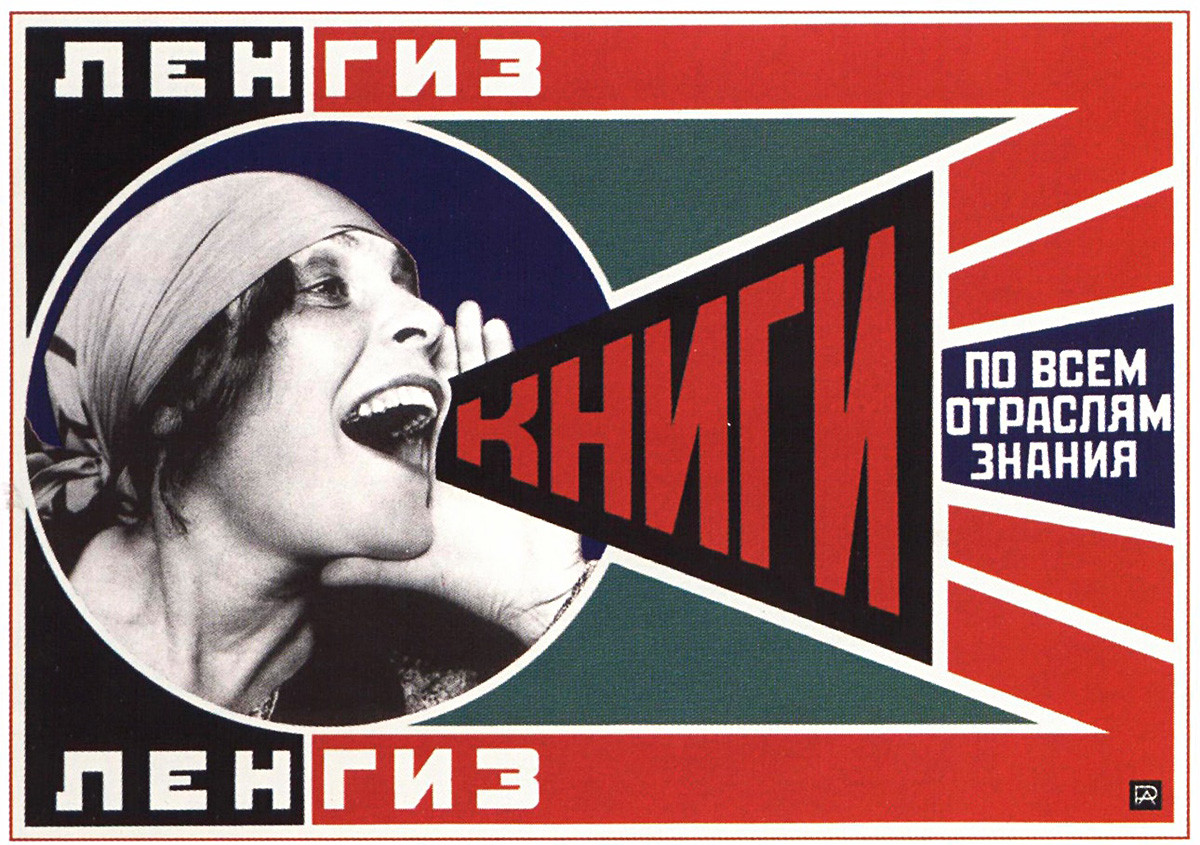
Poster 'Lengiz. Books on all the branches of knowledge', 1925
Archive photograph
His poster for Lengiz, the main and only official Soviet publishing house, is a hit instance of advanced advert, with all its favorite techniques in the form of geometric designs and bright spots. In its middle is a photograph ofLilya Brik, "the muse of the Russian avant-garde".
77. Olga Rozanova

In the history of the Russian avant-garde, her 'Green Stripe' is no less significant than Malevich's 'Black Foursquare'. However, at outset, the creative person and her all-time work remained in the shadow of the chief suprematist, and later they were almost totally forgotten until their rediscovery in the 1970s.
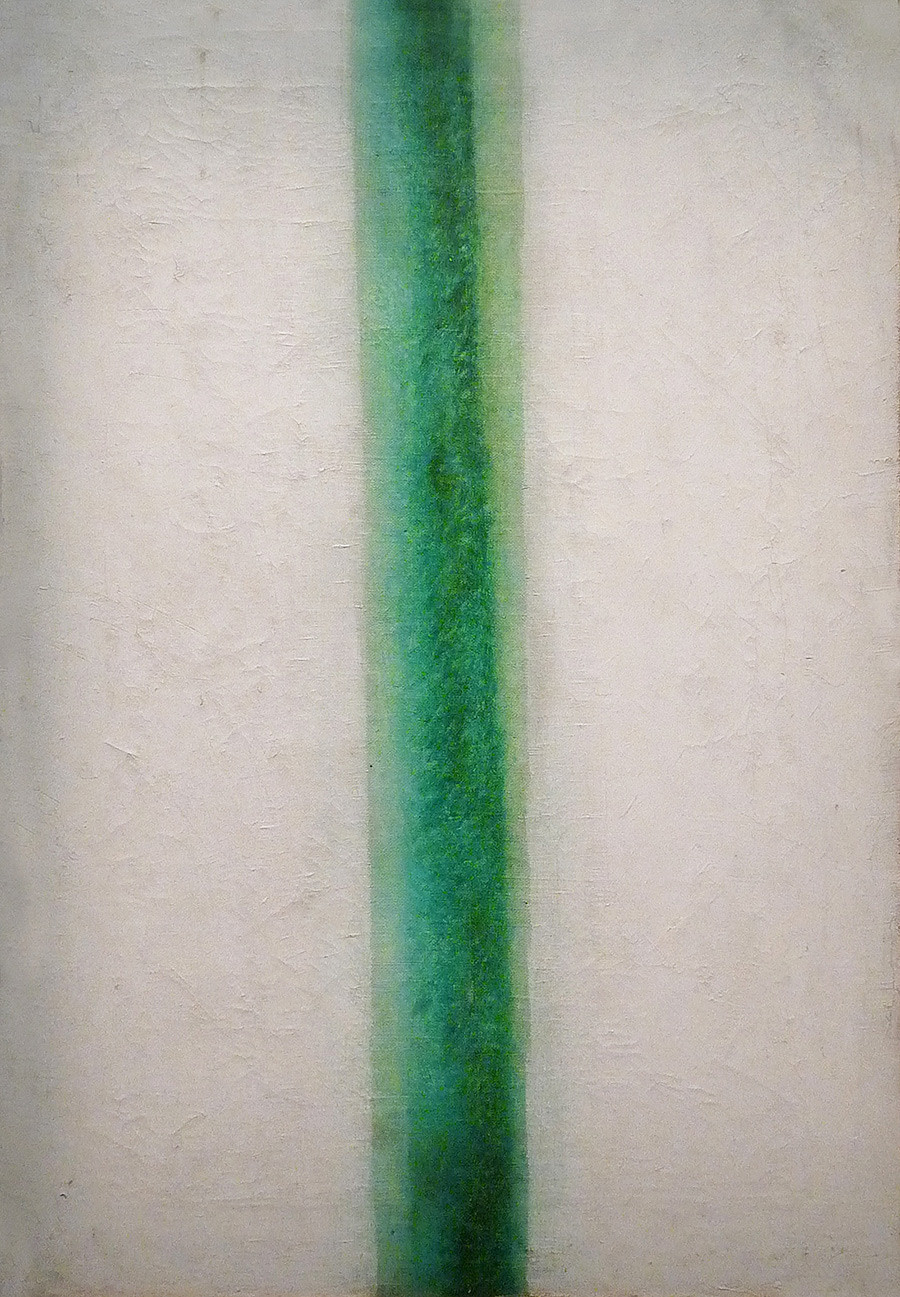
'Greenish Stripe', 1917
Rostov Kremlin Museum-Preserve
Rozanova achieved fifty-fifty more than than Malevich did: she not simply put the colour in a higher place the form, she also successfully resolved the dilemma of the background. Her stripe looks like a projection rather than a figure on the canvas, information technology seems that it continues beyond the frame. That was the first fourth dimension in the history of abstract painting that this consequence was achieved.
78. Andrei Rublev

The nearly famous religious artist in Russian history, Andrei Rublev created a standard of Orthodox icon painting. In the 16th century, his works were recognized equally a model to which all icon painters should aspire, while his "Trinity" became the spiritual symbol of all Russian fine art.
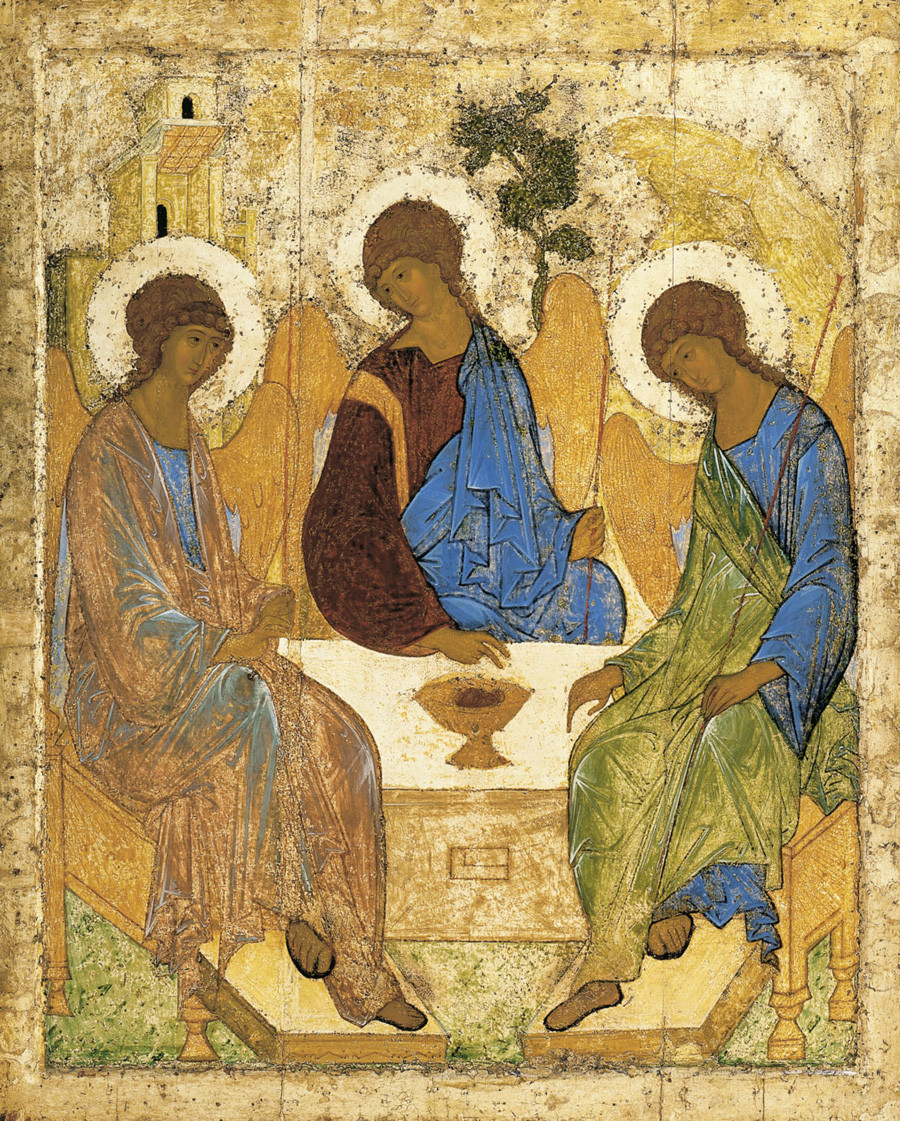
'Trinity', 1422-1427
Tretyakov gallery
Little is known nearly Rublev himself. He was a monk, and devoted all his life to God and painting. In 1988, the Russian Orthodox Church canonized him every bit a saint.
79. Aidan Salakhova

Many describe Salakhova'south art equally "feminist" and "political" because it explores the East and the West, the male and the female, in a hitting combination of sex and Islam. Marble phallic minarets and black Kaaba vaginas have fabricated her famous and recognizable all over the world.
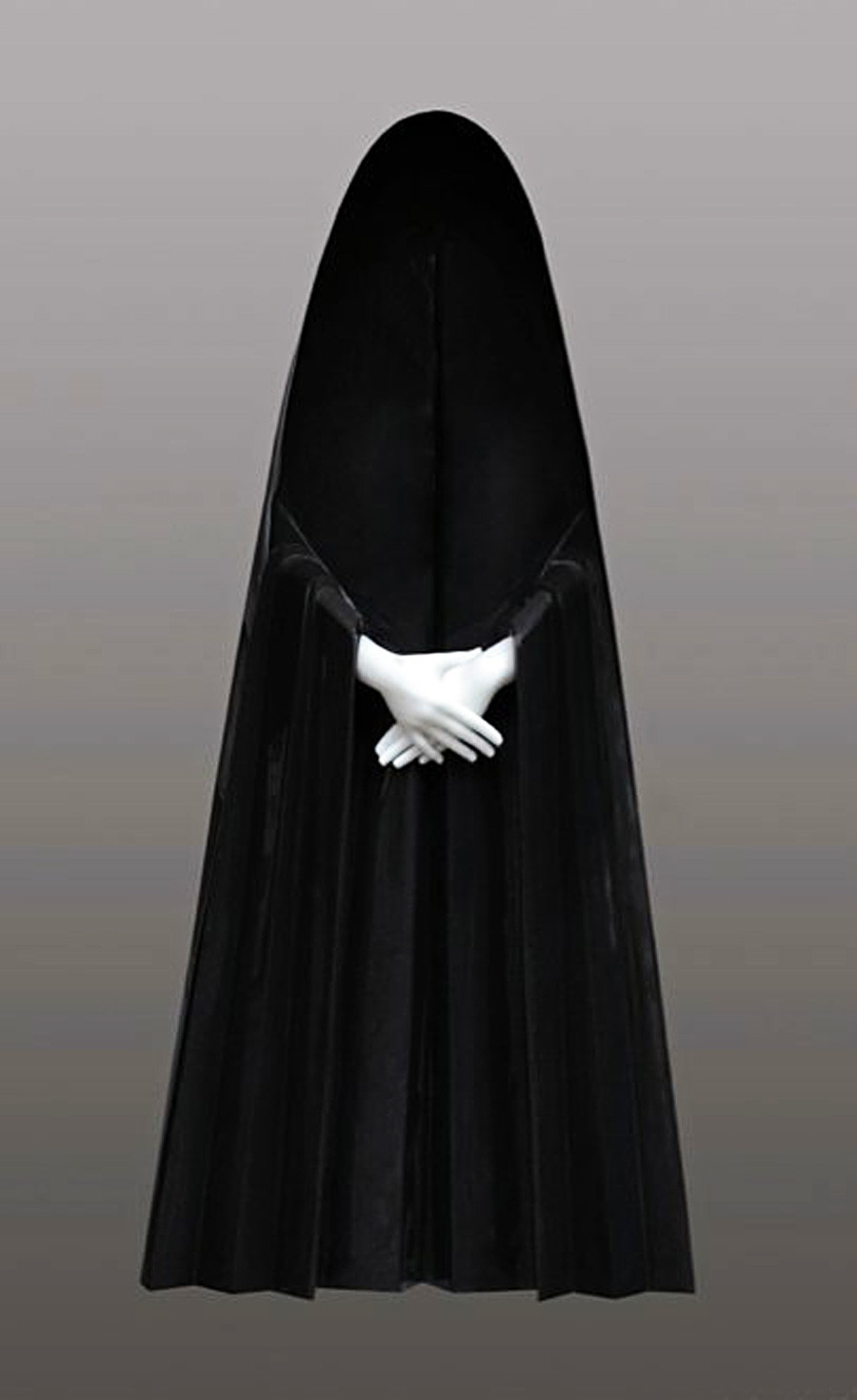
'Intercession', 2010-2011
Aidan Gallery
At the 2011 Venice Biennale, her 'Intercession', a sculpture of a adult female in a niqab, had to exist covered with a white sheet after the president of Republic of azerbaijan ('Intercession' was displayed in the Azerbaijan pavilion) tried to censor it. Many saw a huge irony in it: the sculpture was covered with a veil because the president did not like it that it depicted a woman in a veil.
80. Zinaida Serebriakova

Given its status in popular culture, this portrait has maybe go Serebriakova's main work. For many, its spontaneous and frank nature brand it an epitome of femininity.
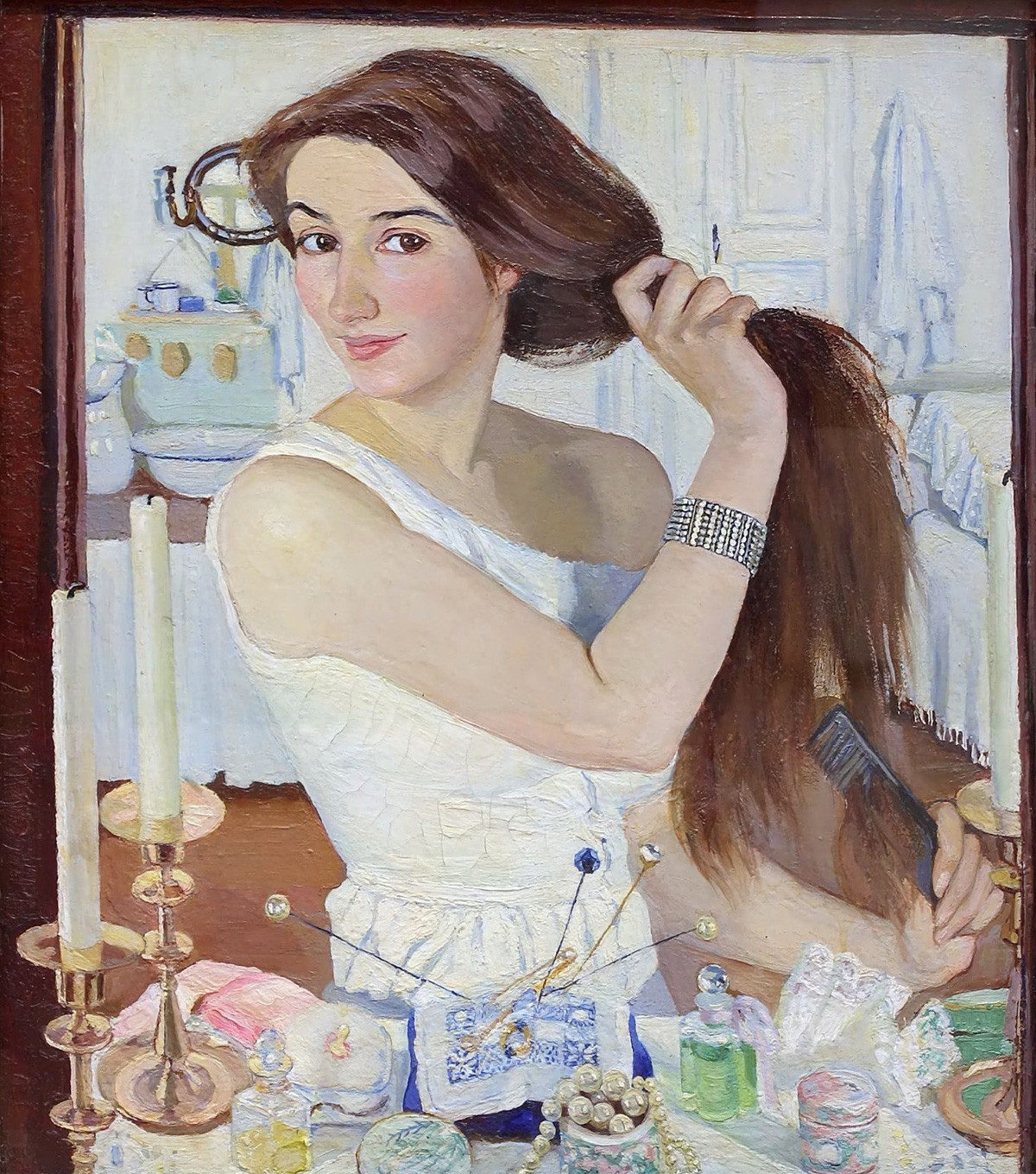
'At the Dressing-Table. Self-portrait', 1909
Annal photo
When the portrait was first presented to the public, the artist Valentin Serov said of it: "A very prissy and fresh affair." The picture was immediately bought by the Tretyakov Gallery.
81. Valentin Serov

For the Russian elite, sitting for a portrait past Serov was considered an accolade. A master of psychological portraits, the Russian impressionistValentin Serov, painted famous composers, writers, members of the imperial family unit and Russian princes.
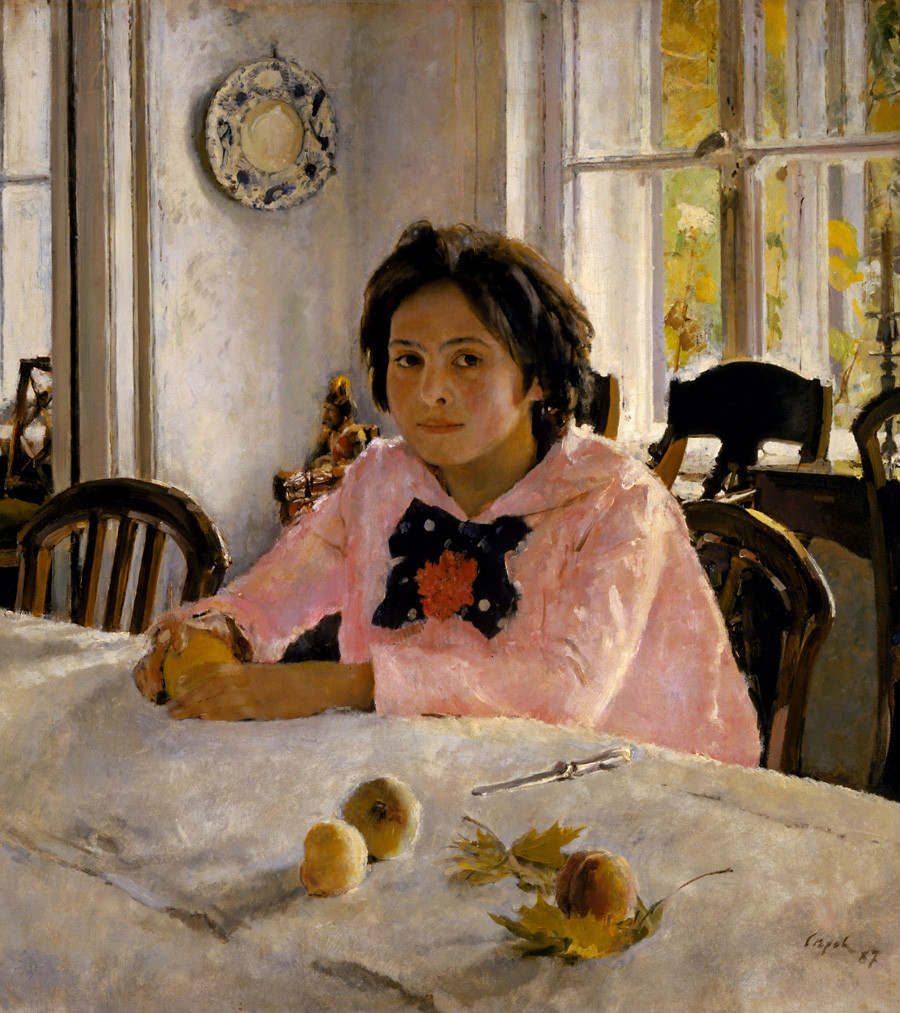
'Girl with Peaches', 1887
Tretyakov gallery
And yet, one of his most meaning and famous canvases isthe portrait of a 12-year-old girl, Vera Mamontova. She was the daughter of a major entrepreneur and philanthropist, Savva Mamontov, but Serov later removed her proper noun from the picture title. According to the artist, he was painting not the daughter of a famous person but Youth itself.
82. Henryk Siemiradzki

For nearly xxx years, Siemiradzki lived in Rome. He earned the reputation of 1 of the most prominent representatives of belatedly European academism, but not directly away and not amidst everybody. The artist was interested only the ancient world with its myths, festivities, and orgies, for which he got a lot of flak dorsum home, where Peredvizhniki were already in style with their delineation of peasants, impoverished orphans and other elements of "the truth of life".
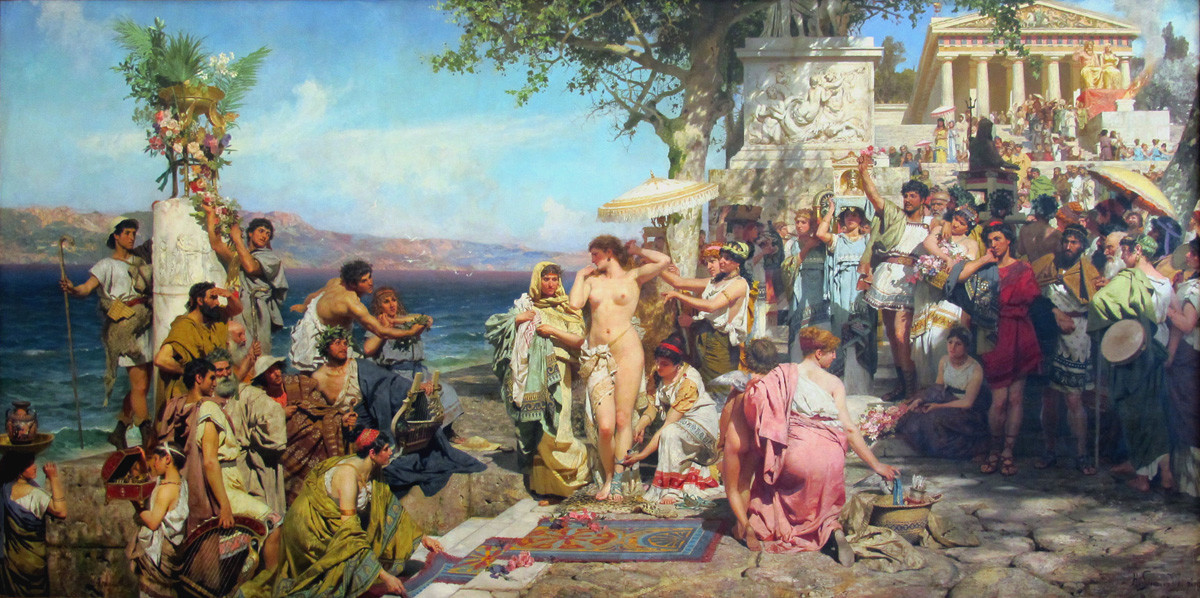
'Phryne on the Poseidon's celebration in Eleusis', 1889
Russian Museum
For example, the most influential fine art critic of the fourth dimension, Vladimir Stasov, considered Siemiradzki a hopeless classicist, who "had fallen casualty to everything Italian". For his part, Ilya Repin called him a charlatan, while the famous collector Tretyakov refused to buy his works. However, Russian tsars have always been fans of academism: for instance, 'Phryne' was bought by Alexander 3 straight from the exhibition.
83. Alexei Savrasov

An artist of lyrical landscapes, Savrasov quickly earned fame and recognition: at the tender historic period of 24, he had already become a member of the Academy of Arts. All the same, down the generations, this realist creative person is remembered as a "1-hit wonder": none of his numerous landscapes tin compare in popularity to 'The Rooks…'. Every schoolchild in Russia knows this textbook picture, considering they take about likely have had to write an essay on information technology.
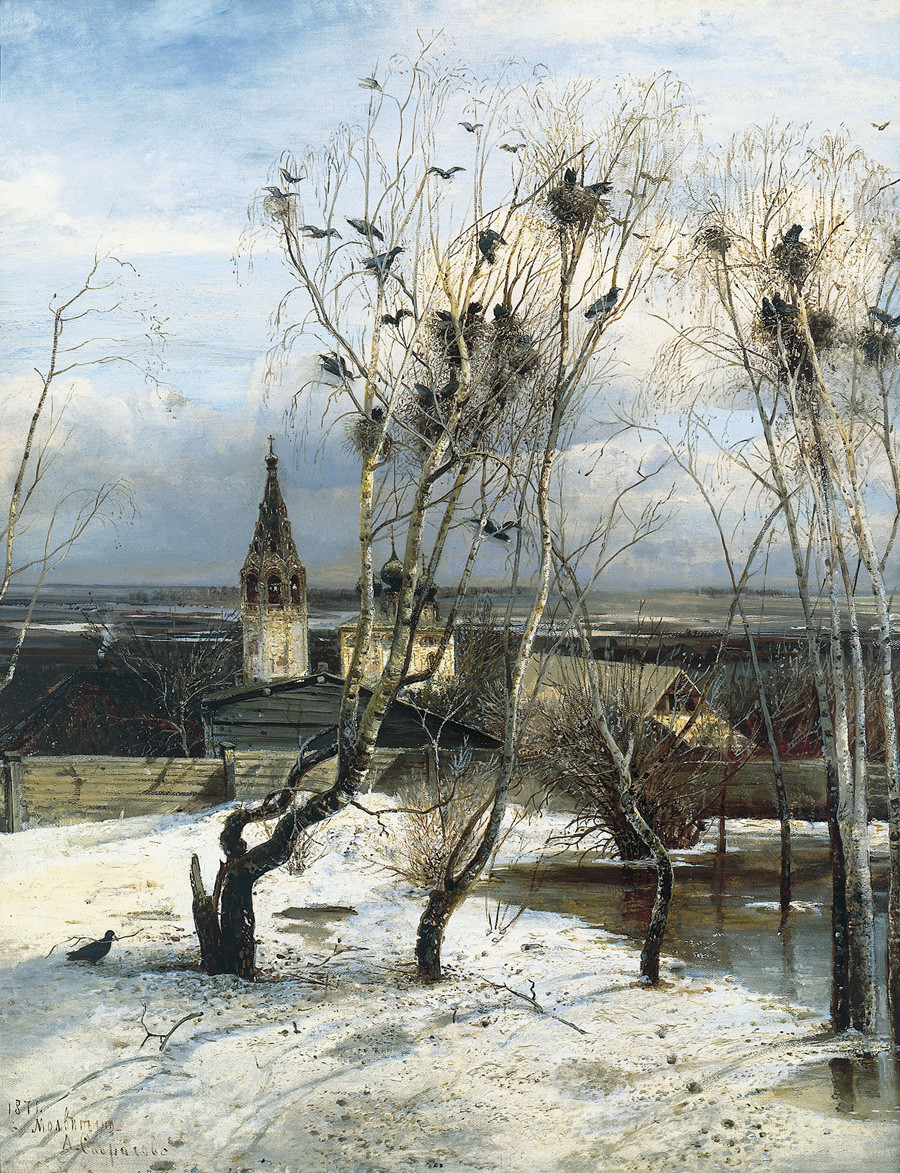
'The Rooks Have Come Back', 1871
Tretyakov gallery
84. Ivan Shishkin

Archive of Audiovisual Information of the Nizhny Novgorod Region
If you lot encounter a painting of an amazing Russian forest or fields with pine trees on the side of the route, you can be sure that it'south a Shishkin. Co-ordinate to a poll conducted past the All-Russia Public Opinion Research Center, he is the most recognizable artist in Russia.
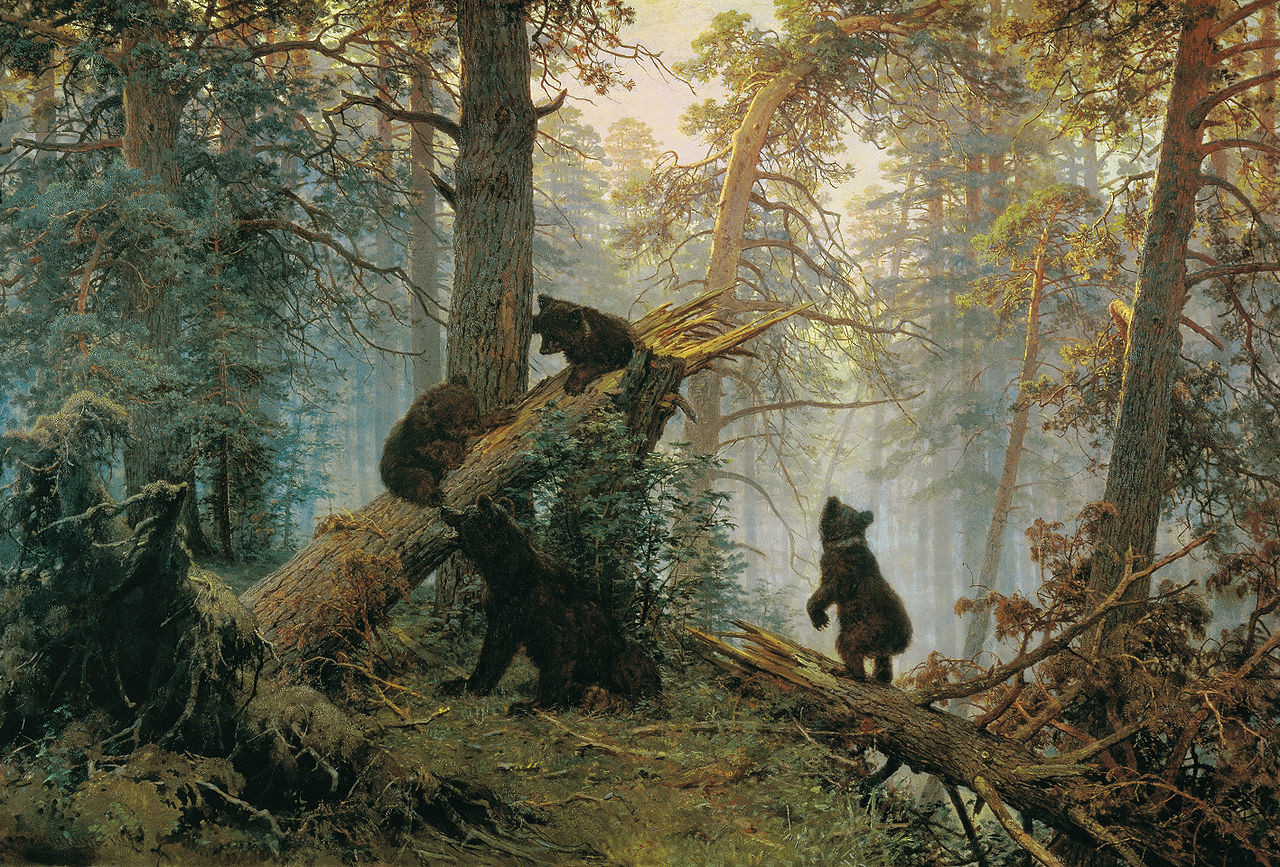
'Morn in a Pine Forest', 1889
Tretyakov Gallery
Which may be largely due to the Mishka Kosolapy (clumsy bear) candies, whose wrapper features a fragment of this picture. And yet, no-one painted remote thickets, meadows and fields quite like him, either in terms of quantity or quality. The forest was everything that Shishkin was ever interested in.
85. Sylvester Shchedrin

Many Russian artists of the 19th century visited the European creative mecca, Italy, simply few made information technology their creative home. Landscape painter Shchedrin spent practically all his life depicting the beauty of Italy, and in particular Naples. This is where he died also, before reaching 40. He painted his mannerly 'Sorrento' 4 years before his death.
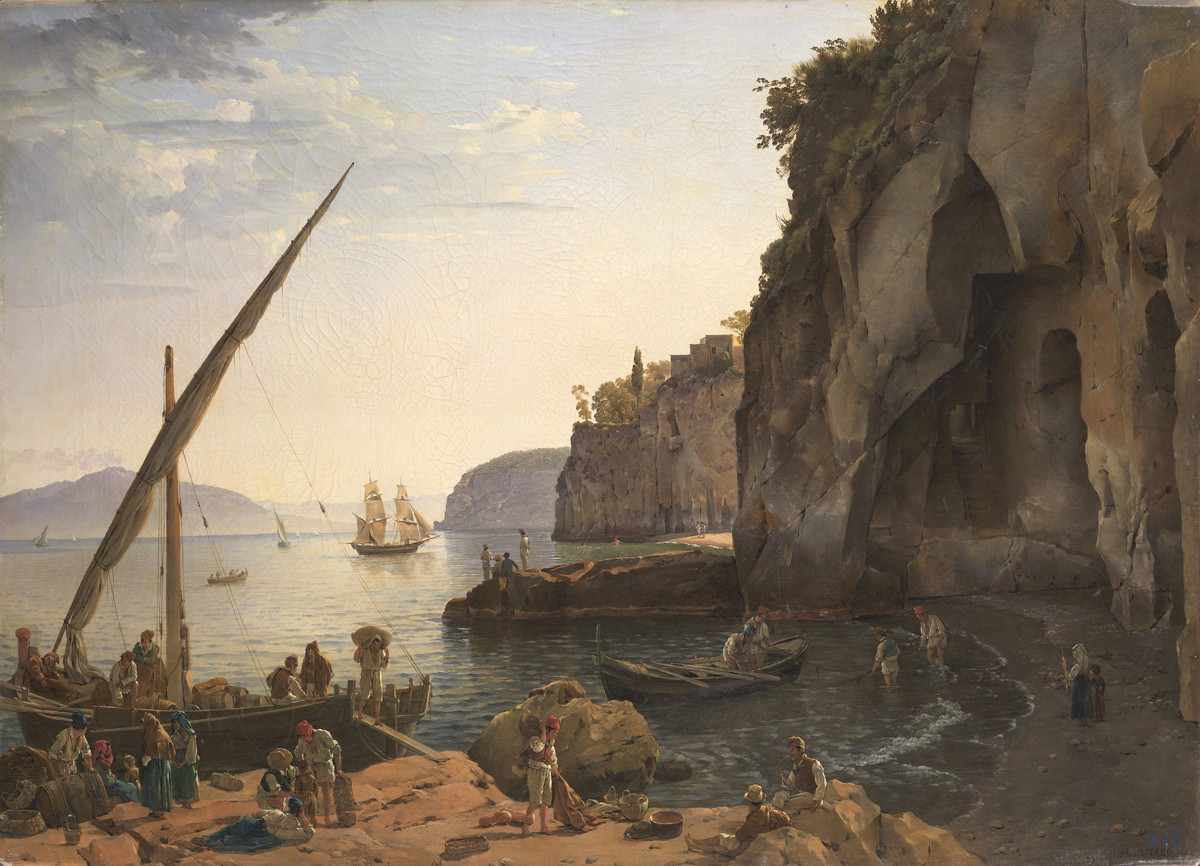
'Sorrento', 1826
Tretyakov Gallery
86. Leonid Sokov

Nebydlogop (CC Past-SA 4.0)
A representative of Sots Art and, equally he himself termed information technology, "folk pop art", for more 30 years, Sokov worked with the myths, images and symbols of Russian culture, juxtaposing them with Western civilization.
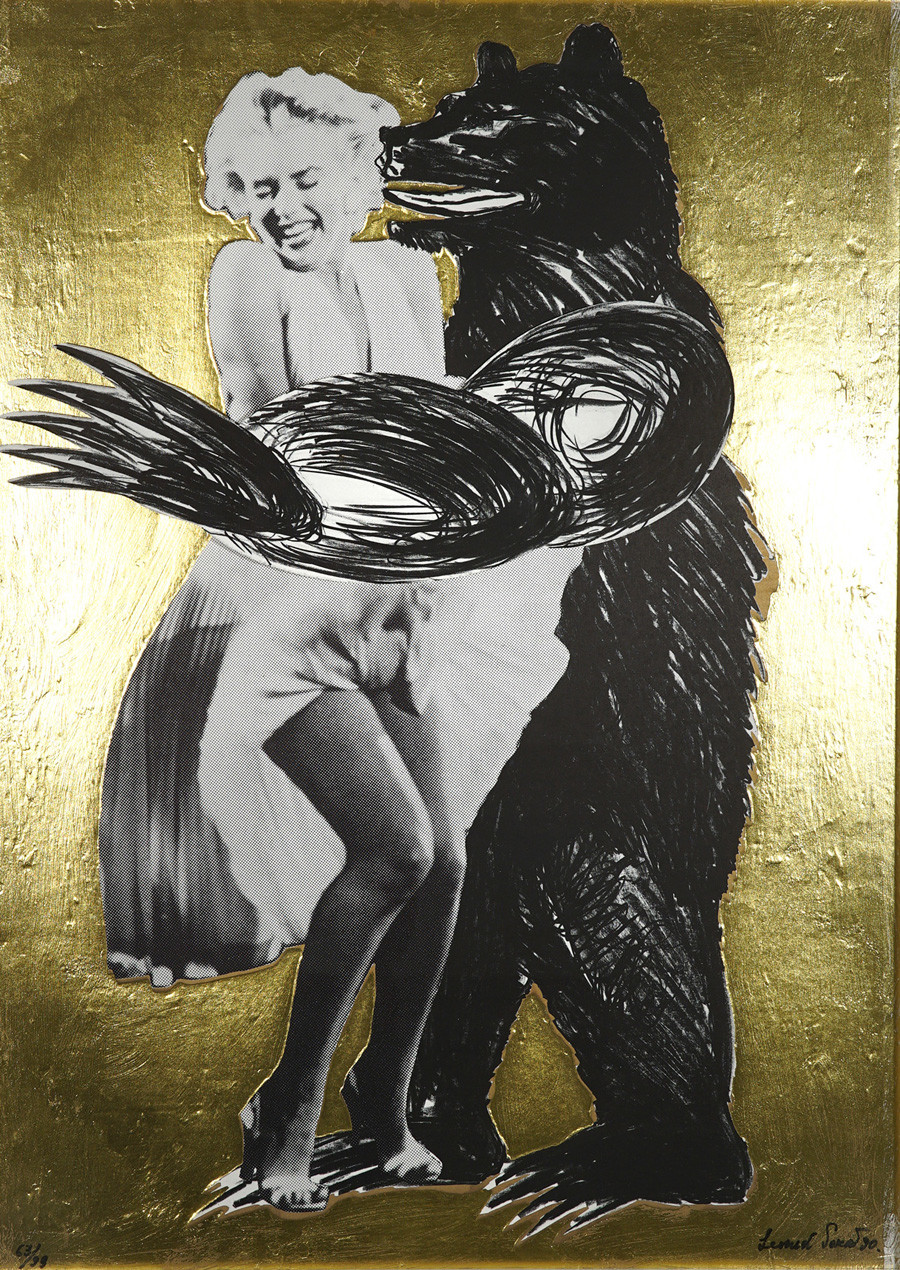
'Merlin and the Bear', 1989-1990
Russian Museum
The artist and sculptor left the USSR for the United states, in club "not to break" under the force per unit area of the totalitarian system of the state guild, which dictated everything to the creative person, down to the smallest details: "In which mitt Lenin should hold his cap, how long the pioneer's pants should be and which was Marx'south pin foot, " Sokov quipped.
87. Vasily Surikov

Surikov fabricated a name for himself past depicting various tragic moments in Russian history. For example, 'Boyarina Morozova' tells the story of the fierce struggle against Sometime Believers: Morozova is beingness carted off to a nunnery (which was equivalent to prison) at the time of the church schism.
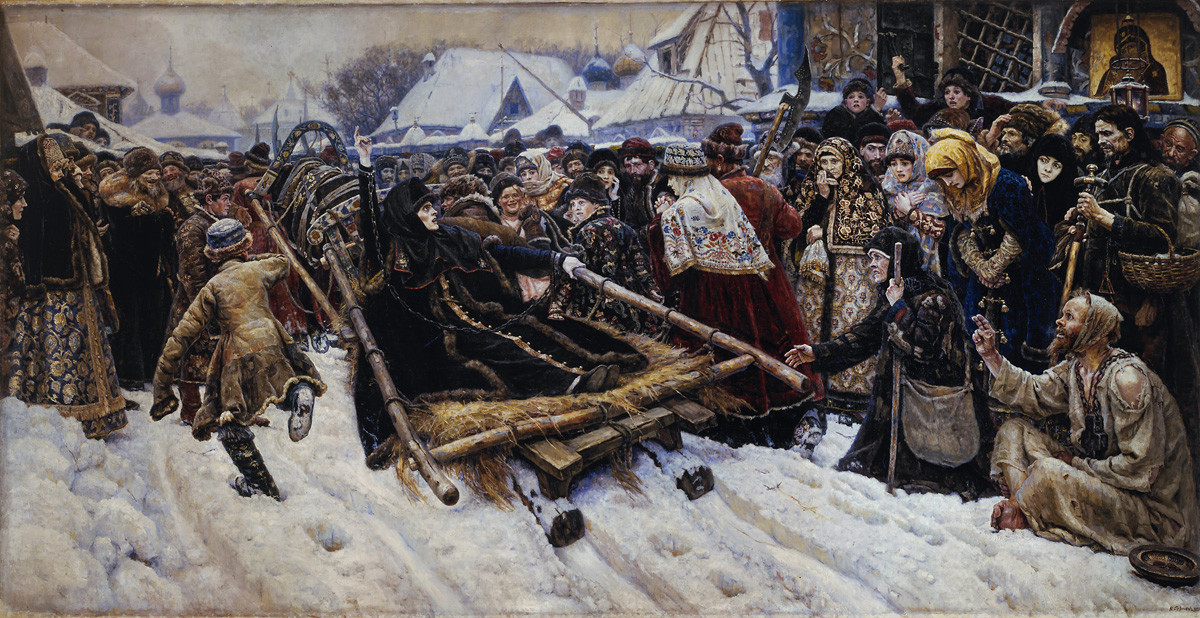
'Boyarina Morozova', 1884-1887
Tretyakov gallery
88. Vladimir Tatlin

Although the Monument to the 3rd International, or Tatlin'southward Belfry, was never built, information technology became the artist'southward most emblematic brainchild and the authentication of constructivism all over the earth. Tatlin designed his tower as a symbol of the 1917 revolution to be erected in Petrograd (at present St. Petersburg).
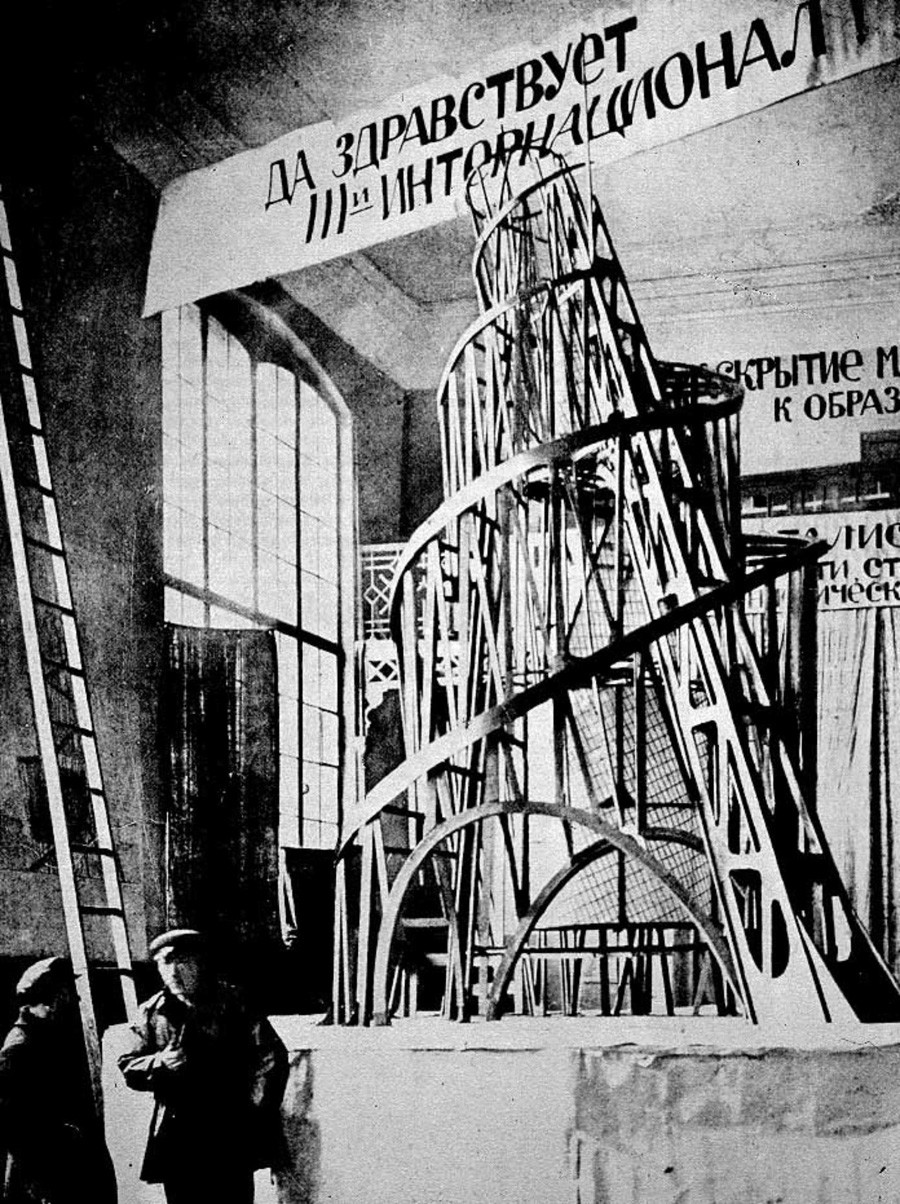
'Tatlin's Tower', 1919
Archive photograph
However, by the tardily 1920s, the Soviet leadership lost involvement in advanced artists and stopped engaging with them, and then the tower was never built.
89. Oleg Tselkov

Cultural Foundation "EKATERINA"
Throughout his life, this nonconformist artist has been painting practically one and the aforementioned character - a deformed human image, a mutant. "This is non a portrait of a specific sitter, merely a universal portrait... and a terribly familiar 1 at that," explained Tselkov. "I accidentally managed to rip the mask off humanity."
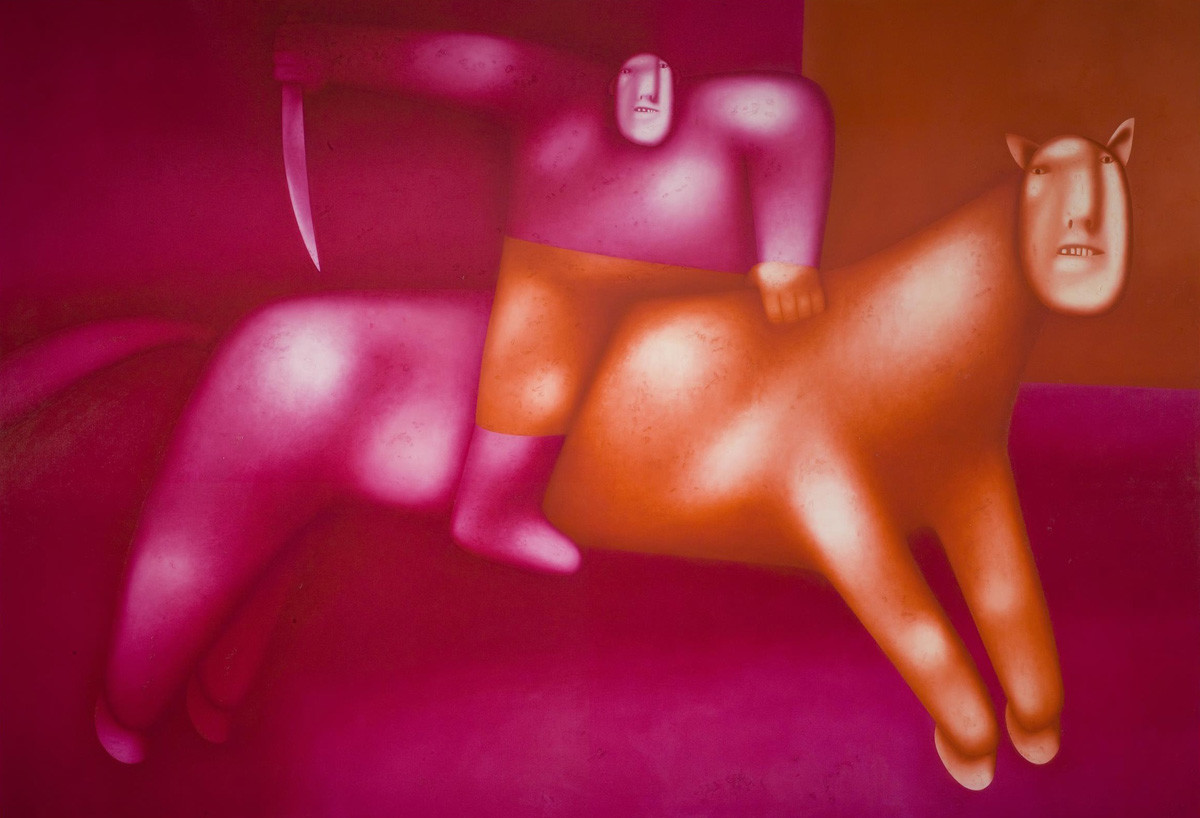
The Soviet leadership were not particularly fond of this "flip side of a homo personality". In 1977, Tselkov was asked to leave the country, and he went to France. It was only in 2015 that he became a Russian denizen again.
xc. Pavel Tchelitchew

This patriarch of mystical surrealism was built-in in Russian federation, but spent most of his life in Europe and America, where he developed the technique of his famous anthropomorphic landscapes. Because of the similarity in style, he is often described equally "the Russian Dali", except that Tchelitchew was the offset to display elements of mystical surrealism in his works: they say, 9 years earlier, Salvador Dali did the same.
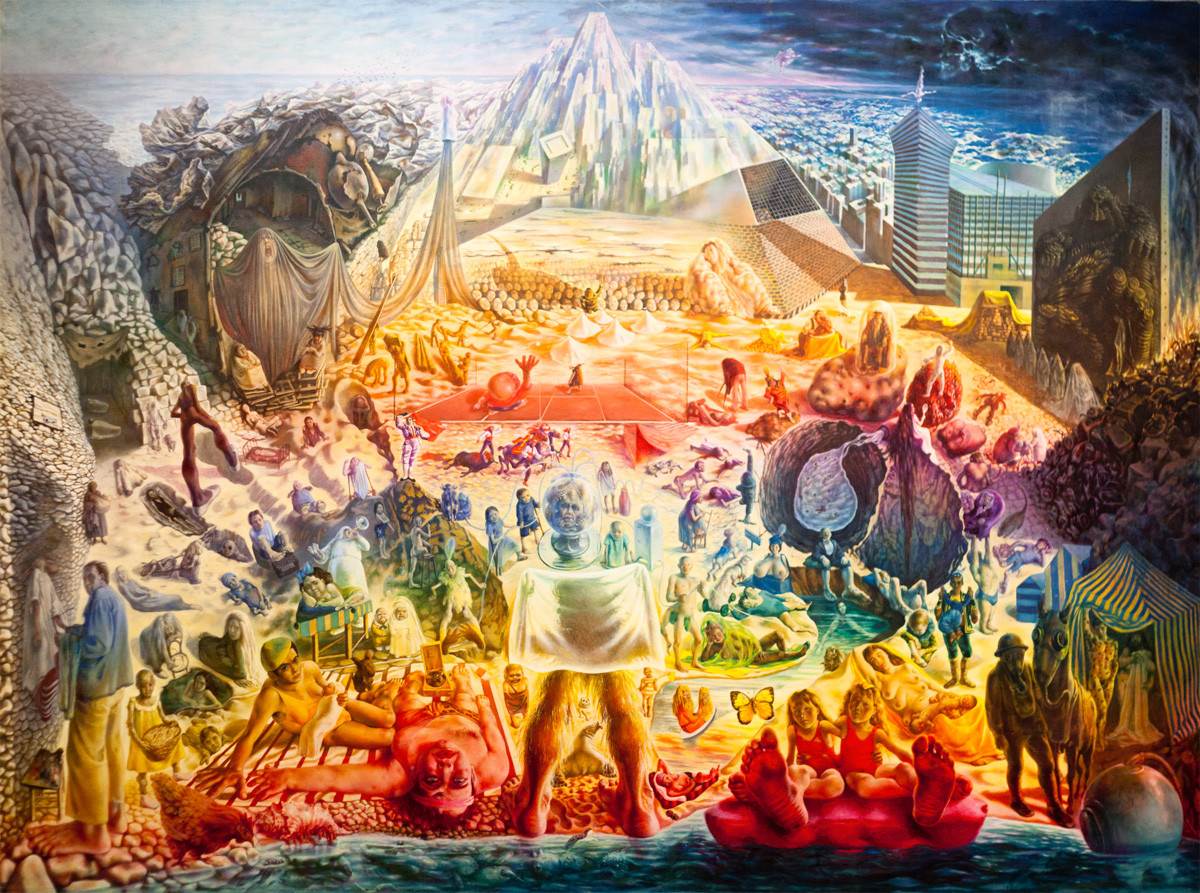
'Phenomena', 1936-1938
Tretyakov gallery
These days, his works can be found in major European museums and collections, whereas in Russian federation, only the Tretyakov Gallery has a unmarried Tchelitchew. 'Phenomena' was secretly brought to Russia by a friend of Tchelitchew, choreographer Lincoln Kirstein. He handed information technology to the Tretyakov Gallery, but until the mid-1990s, it remained in the museum's storerooms.
91. Simon Ushakov

The Romanovs took the throne in 1613. The dynasty ruled the country for centuries, but at the very offset, it needed something to confirm its legitimacy. A major office in this was played by the prototype of the royal family lineage created by the icon painter Ushakov. Art critics call it the first and best justification of the merits that the Romanovs were given their power from in a higher place.
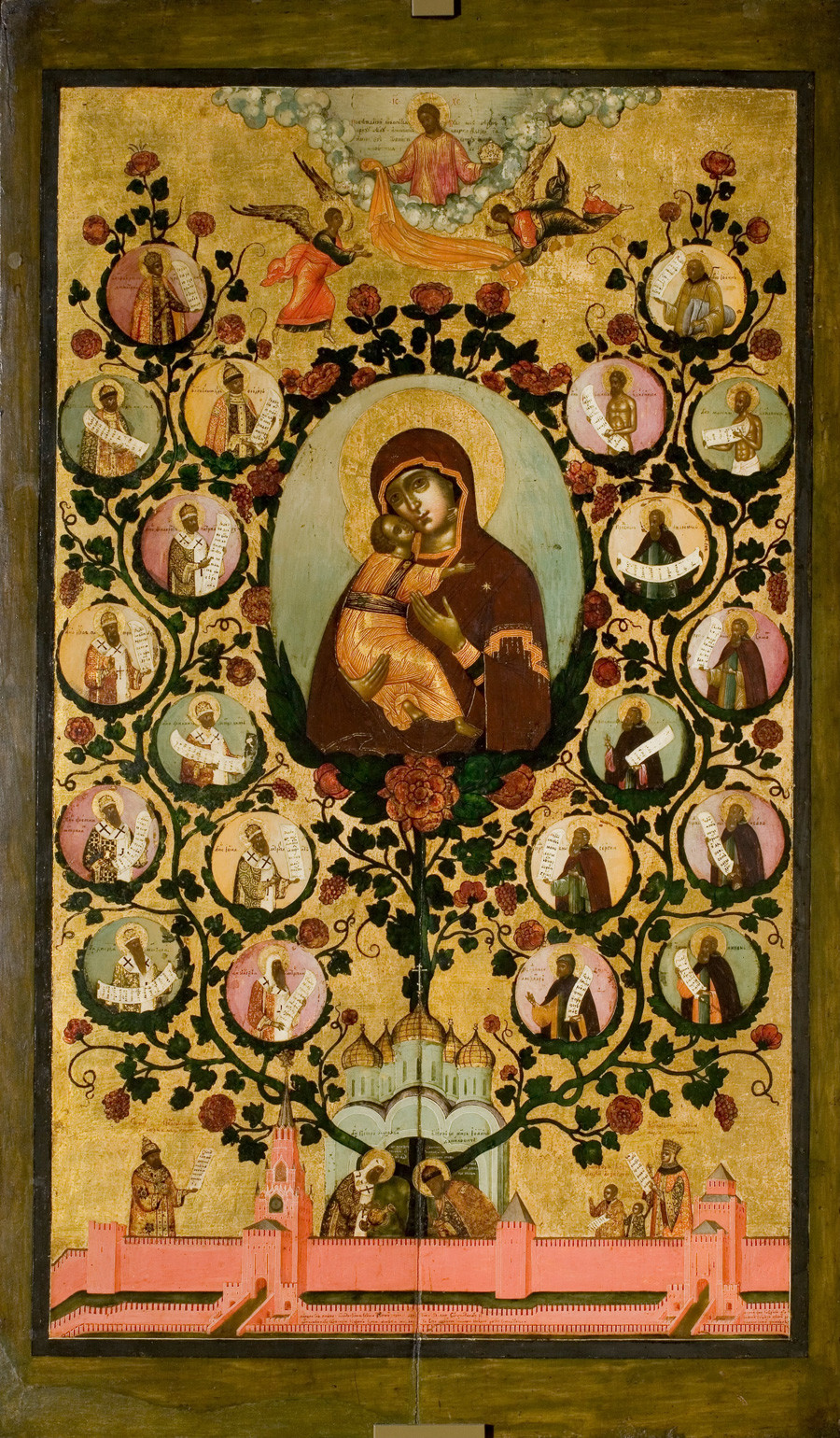
'The Tree of the Muscovite State', 1668
Tretyakov gallery
The Romanovs must have agreed with that cess: they made Ushakov the chief icon painter of the empire and showered him with favors until his death.
92. Viktor Vasnetsov

Vasnetsov tried himself in different styles and types of work, from painting church frescos (like in the Church of the Savior on the Spilled Blood in St. Petersburg) to creating curving art nouveau embellishments. Yet, for most Russians, he is associated exclusively with characters from Russian fairy tales. In popular imagination, these characters look very much the fashion Vasnetsov depicted them.
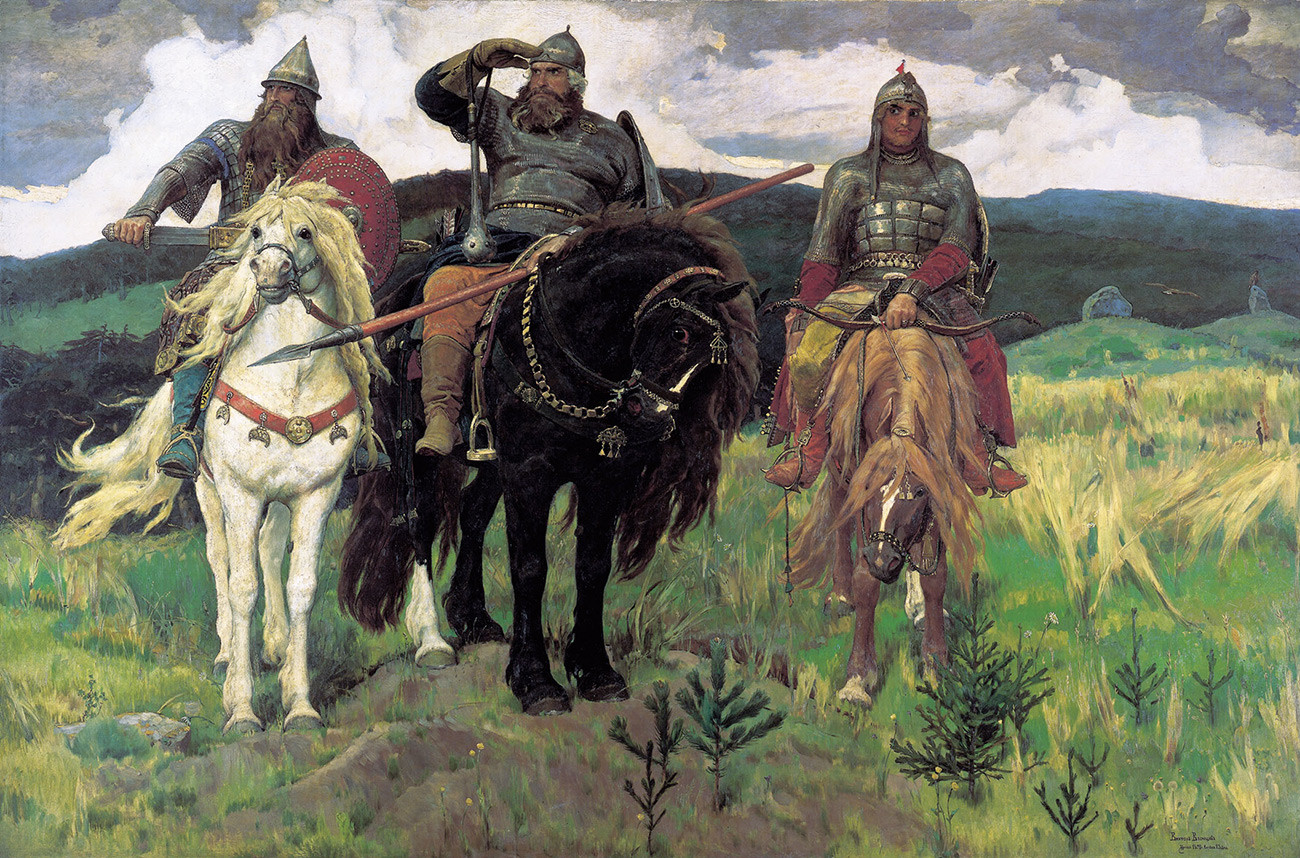
«Bogatyrs», 1881-1898
Viktor Vasnetsov / Tretyakov Gallery
The painting 'Bogatyrs', which depicts popular Slavic superheroes Dobrynya Nikitich, Ilya Muromets and Alyosha Popovich, took him nearly 20 years to complete.
93. Alexey Venetsianov

Sergey Zyryanko / Ivanovo Clan of Historical and Revolutionary Museums
Venetsianov was i of the first artists to depict scenes from the life of common people, making a proper noun for himself in "the peasant genre". At the same time, he was not especially interested in the practicalities of peasants' everyday life.
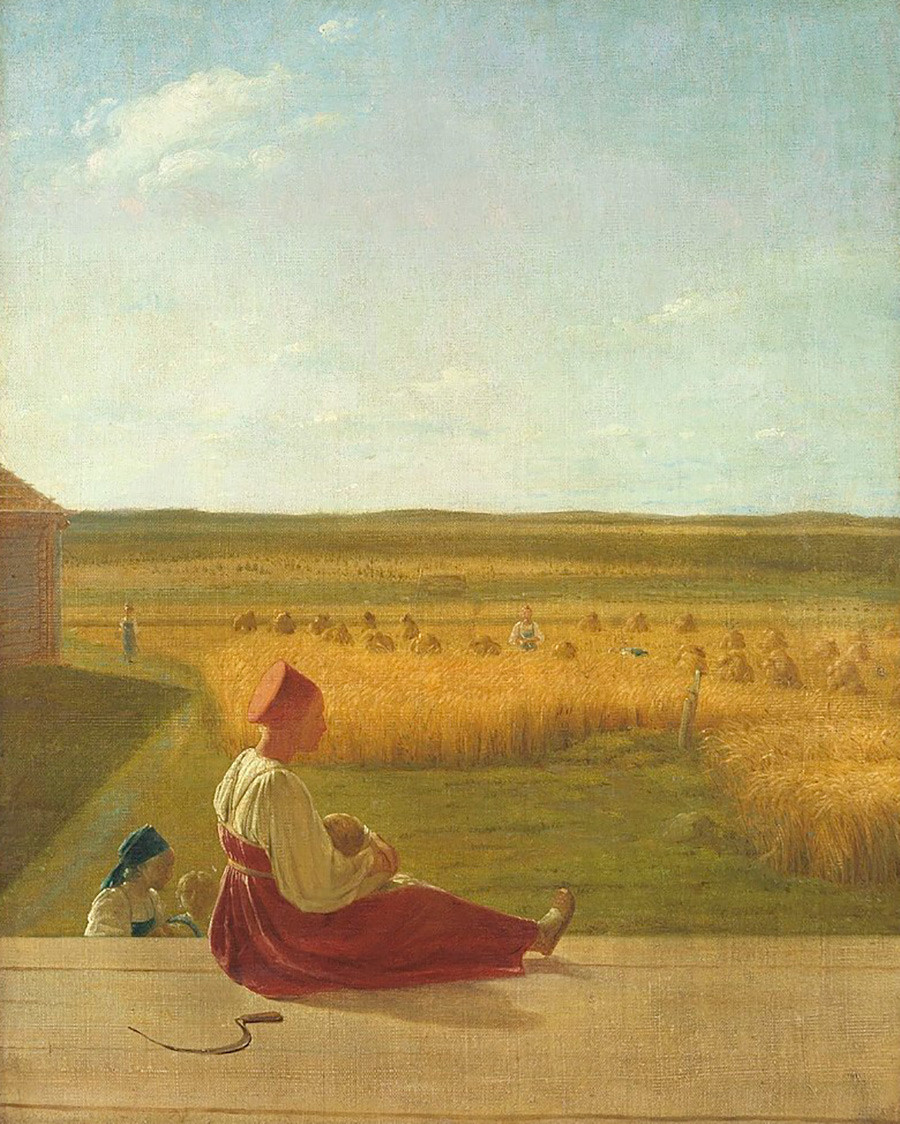
'Summer. Reaping', 1830
Alexey Venetsianov / Tretyakov Gallery
His paintings were more virtually spaciousness, freedom and immensity. Many believe that his 'Reaping' painting epitomizes the true Russian landscape.
94. Vasily Vereshchagin

A painter of battle scenes, Vereshchagin usually painted what he saw with his own eyes. He had been to many wars and had traveled the world from India to Syrian arab republic. He organized his exhibitions in New York and London himself, ofttimes displaying non simply his paintings only also trophies from the battlefield.
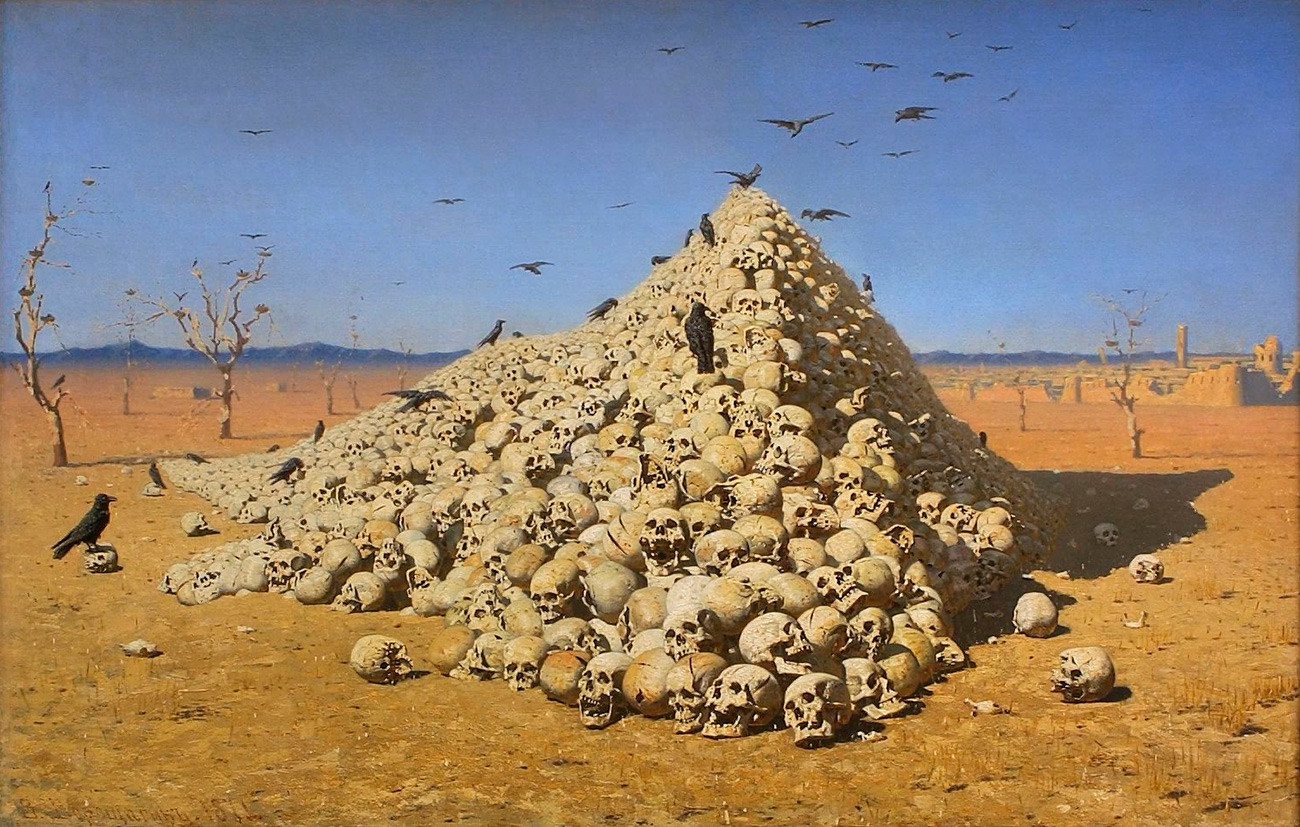
'The Apotheosis of War', 1871
Vasily Vereshchagin / Tretyakov Gallery
However, his 'Apotheosis of War' is an exception, in that he painted it non from life, but from an idea in his caput. On its frame the creative person wrote: "Dedicated to all great conquerors - past, present and future."
95. Mikhail Vrubel

Vrubel is primarily associated with the image of a demon, whom he painted repeatedly and obsessively. The image of a fallen angel suffering from his demonic nature had been inspired by Mikhail Lermontov's poem of the same proper noun. Vrubel made some 30 sketches for this painting.
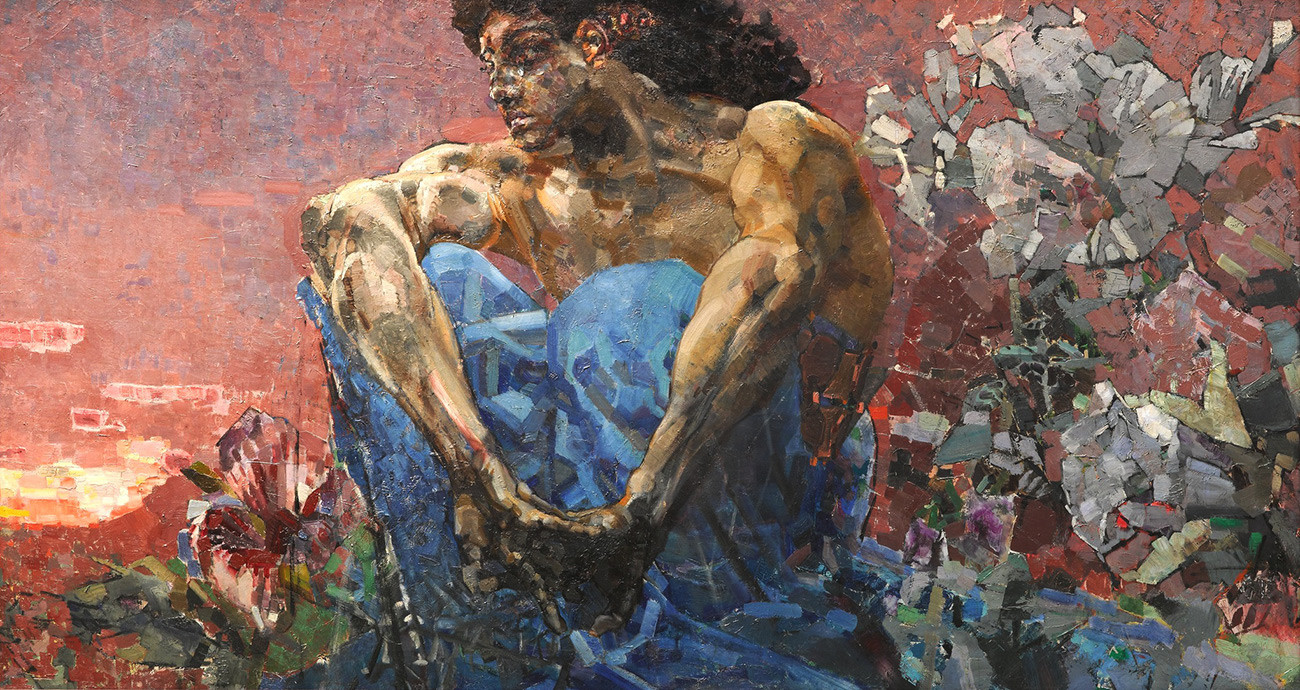
'Demon Seated', 1890
Mikhail Vrubel / Tretyakov Gallery
Vrubel admitted that he had seen a demon in his nightmares likewise. An acute psychosis, which the creative person developed in his later life, combined with his obsession with a unmarried prototype prompted his contemporaries to conclude that Vrubel had been driven mad by his addiction to demonism.
96. Vladimir Weisberg

Igor Palmin / IN ARTIBUS Foundation
Weisberg stands apart in the context of Russian art: he belongs neither to official art, nor to nonconformists. His trademark fashion is so-called "white painting", pictures that appear to take been painted with white paint on a white background. According to Weisberg himself, he tried to attain "invisible art".
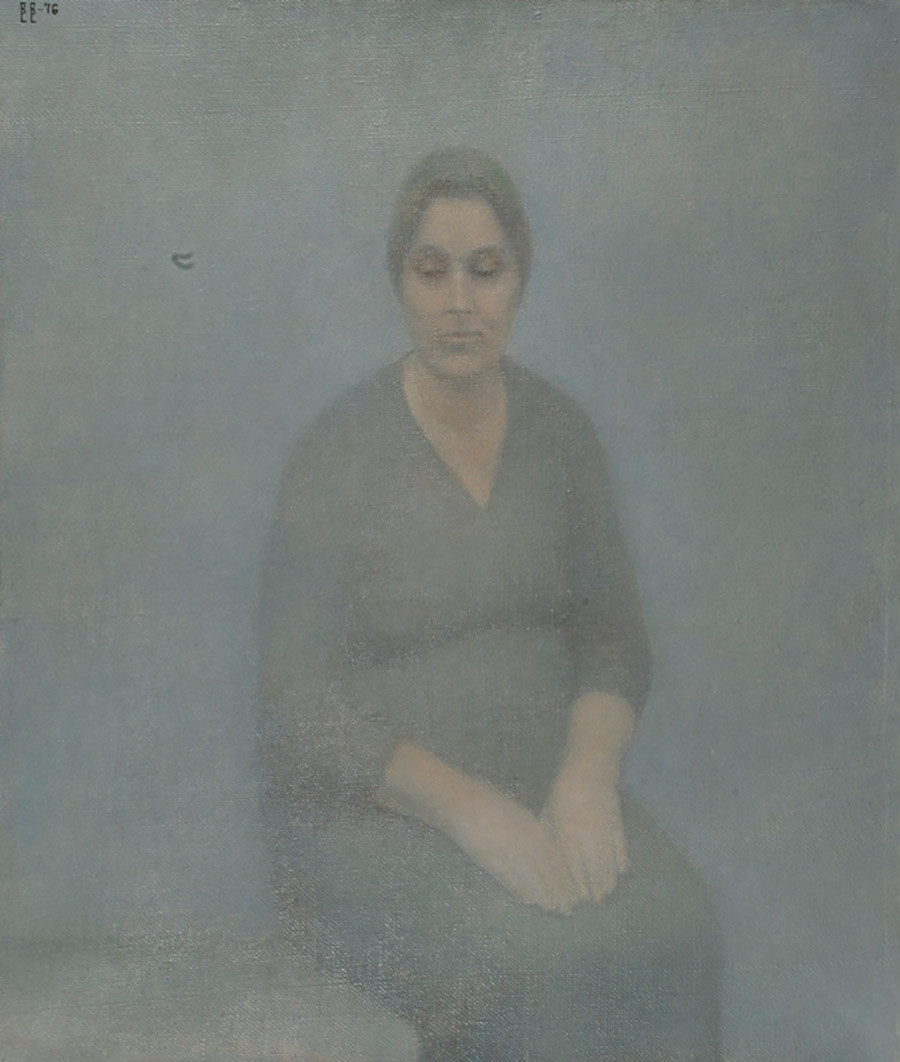
'Portrait of the Artist'southward Wife', 1976
Vladimir Weisberg / Radishchev Art Museum
In bodily fact, he inappreciably ever used white pigment. His paintings are an intricate combination of pocket-sized multi-colored particles. "A picture should turn white if all, literally all, its colors, fit in," he used to say.
97. Vladimir Yankilevsky

A pioneer of the Moscow "unofficial art" and a perennial loner, Yankilevsky did not fit into any artistic association and always was on the sidelines, as it were. Many just did non understand his existential works: all his life he painted a metaphysical "Man opposed to Eternity".
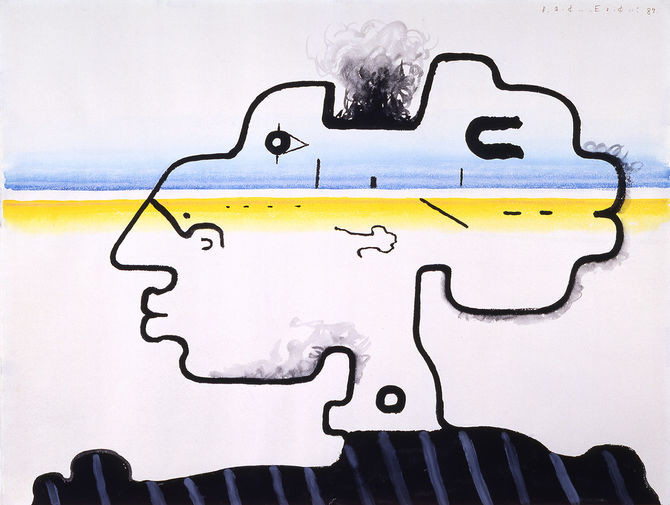
'Loneliness in the Universe', 2013
MAMM
The idea of people in boxes came to him under the influence of existentialism. These "existential boxes" became a metaphor for a person whose aspirations and dreams e'er come against the walls of a social surround. Information technology must be said that life in the USSR was very much conducive to this perception of reality.
98. Vadim Zakharov

In the 1970s, Zakharov joined the circle of Moscow Conceptualists, starting with absurdist deportment and leading to painting. "Betwixt 1985 and 1989, I created a lot of huge paintings, afterwards which I did non paint a single 1 with the exception of just a few fabricated in charcoal, and now to become back to canvas and oil is a torture for me," he said. In 1989, he moved to Cologne, where a new stage in his artistic career began - installations.
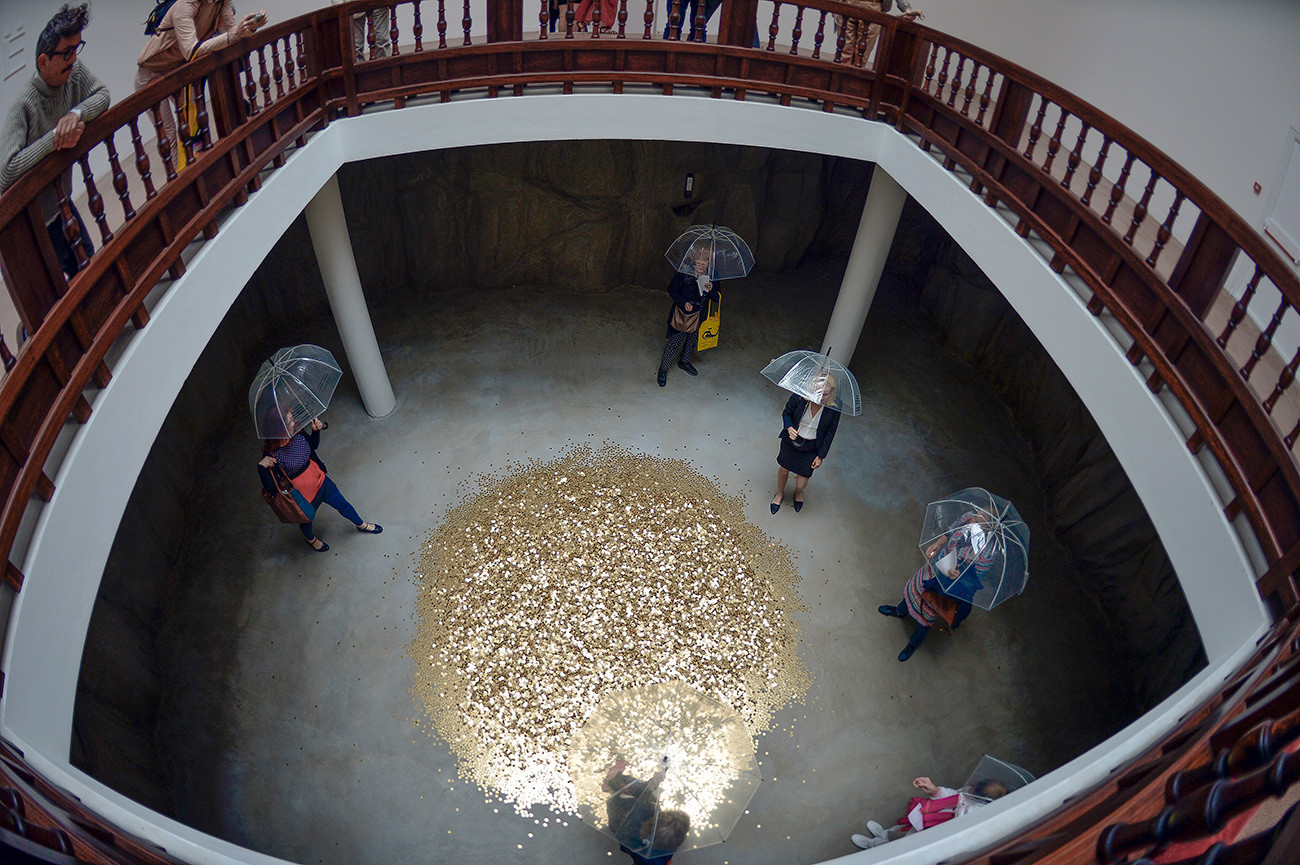
His project "Danae" became a sensation at the Venice Biennale. In the first hour after its opening, a queue lined up to the Russian pavilion to look at the unique process of a famous Ancient Greek myth materializing through a golden shower of coins with the words trust, freedom, love, and unity written on them pouring down from a room where merely male viewers were allowed, to "the womb", where only female viewers were allowed.
99. Konstantin Zvezdochetov

He is the Russian male monarch of kitsch, without whom no major exhibition of contemporary art tin can do. Zvezdochetov belongs to the generation of Soviet artists who were the showtime to enter the international art scene and became known as "contemporary Russian art".
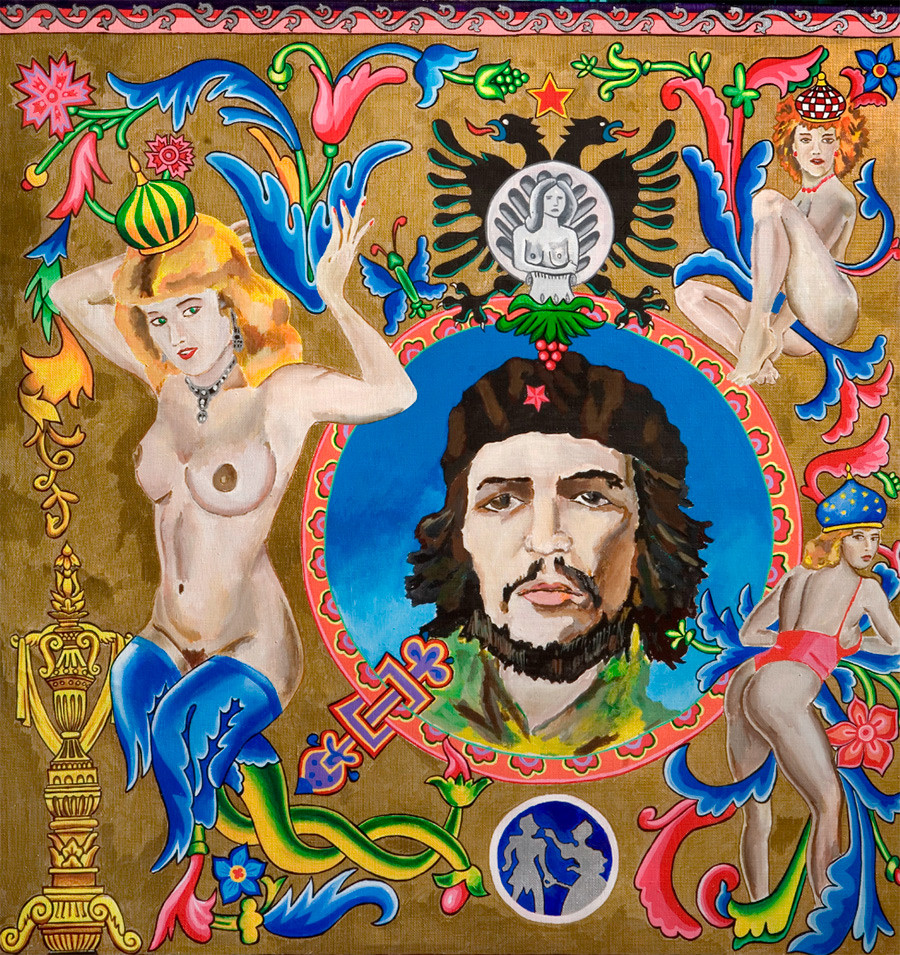
In that location was a time when he was offended to be called an "artist". He said, "I am a person who offers interpretations... All I do are quotations and compilations."
100. Anatoly Zverev

Vladimir Sychev / MAMM/MDF / russiainphoto.ru
He is frequently referred to equally "the Russian Van Gogh". Robert Falk said of him: "Every touch of his brush is priceless", while Picasso himself echoed him. A decorator by trade, Zverev entered the art scene in the late 1950s, and in 1965, his beginning international exhibition was held in Motte in Paris, although he himself never went abroad.
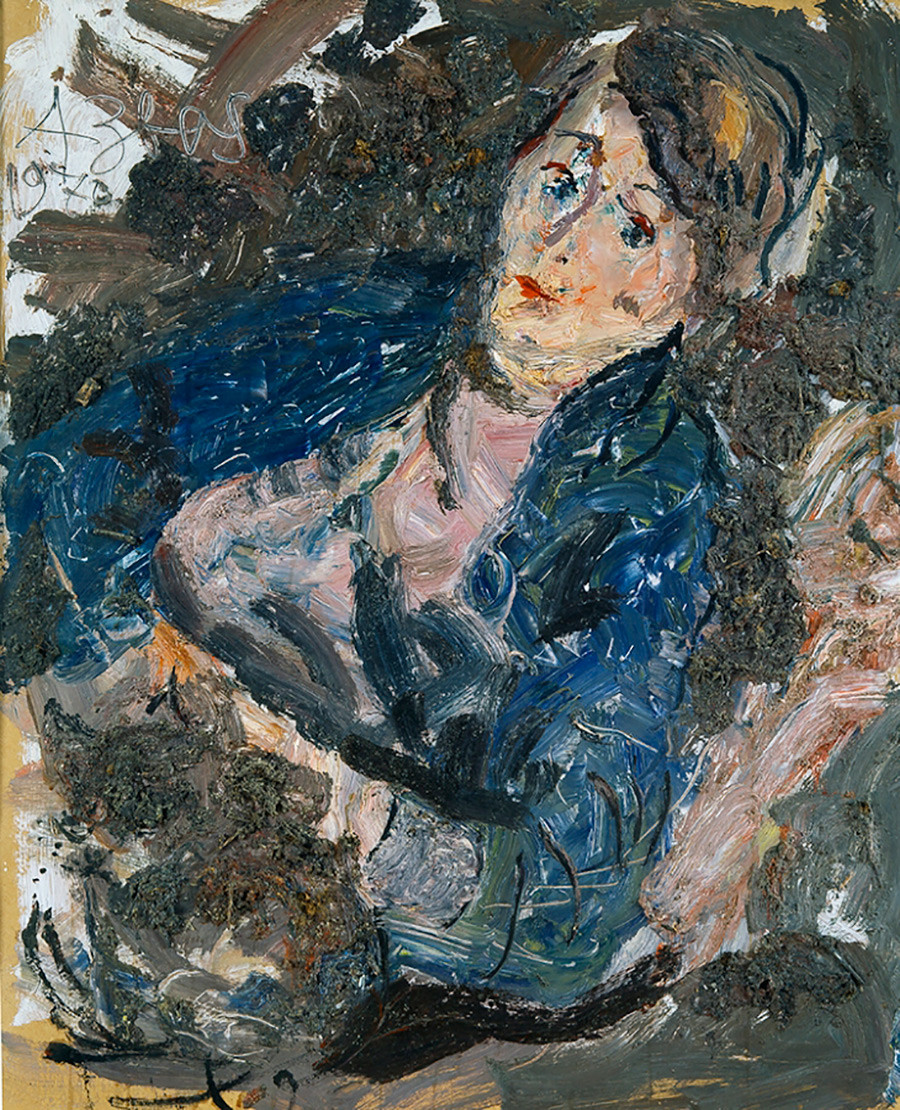
'Portrait of Thou.M. Aseeva', 1969
МОММА
The Soviet system did not similar Zverev. The police were afterwards him to abort him for "parasitism" (which was a crime in the USSR), while he lived solely for his art and for his only dearest and muse, the widow of the poet Nikolai Aseev, Ksenia Aseeva, who was 39 years his senior.
If using any of Russian federation Beyond'due south content, partly or in full, always provide an active hyperlink to the original material.
Get the week'southward all-time stories straight to your inbox
0 Response to "Museum of Theatrical and Musical Arts St Petersburg Russia"
Post a Comment