Michael Edited to Be Black Again
For a figure as enigmatic equally Michael Jackson, one of the more fascinating paradoxes about his career is this: equally he became whiter, he became blacker. Or to put it some other style: as his pare became whiter, his work became blacker.
To elaborate, nosotros must rewind to a crucial turning point: the early on 1990s. In hindsight, information technology represents the best of times and the worst of times for the creative person. In November 1991, Jackson released the first single from his Dangerous album: Black or White, a bright, catchy popular-rock-rap fusion that soared to No 1 on the Billboard Hot 100 and remained at the summit of the charts for half dozen weeks. Information technology was his nearly successful solo single since Crush It.
The chat surrounding Jackson at this point, however, was not about his music. Information technology was about his race. Sure, critics said, he might sing that it "don't thing if you're black or white", merely so why had he turned himself white? Was he bleaching his skin? Was he ashamed of his blackness? Was he trying to appeal to every demographic, transcend every identity category in a vainglorious effort to attain greater commercial heights than Thriller?
To this day, many assume Jackson bleached his pare to go white – that it was a wilful corrective decision because he was ashamed of his race. Notwithstanding in the mid-1980s Jackson was diagnosed with vitiligo, a skin disorder that causes loss of pigmentation in patches on the body. According to those close to him, it was an excruciatingly humiliating personal challenge, one in which he went to great lengths to hide through long-sleeve shirts, hats, gloves, sunglasses and masks. When Jackson died in 2009, his autopsy definitively confirmed he had vitiligo, as did his medical history.
However, in the early 1990s, the public were sceptical to say the to the lowest degree. Jackson starting time publicly revealed he had vitiligo in a widely watched 1993 interview with Oprah Winfrey. "This is the situation," he explained. "I have a skin disorder that destroys the pigmentation of the peel. It is something I cannot help, OK? But when people make up stories that I don't want to be what I am it hurts me … It's a problem for me that I can't control." Jackson did acknowledge having plastic surgery but said he was "horrified" that people concluded that he didn't want to be black. "I am a blackness American," he declared. "I am proud of my race. I am proud of who I am."
For Jackson, so, there was no ambiguity about his racial identity and heritage. His skin had changed but his race had non. In fact, if annihilation his identification as a blackness creative person had grown stronger. The first indication of this came in the video for Black or White. Watched by an unprecedented global audition of 500 million viewers, information technology was Jackson's biggest platform ever; a platform, it should be noted, that he earned by breaking downward racial barriers at MTV with his groundbreaking short films from Thriller.
The offset few minutes of the Black or White video seemed relatively benign and consistent with the utopian calls of previous songs (Can Yous Feel It, We Are the World, Homo in the Mirror). Jackson, adorned in contrasting blackness-and-white apparel, travels across the globe, fluidly adapting his trip the light fantastic toe moves to whatever civilization or state he finds himself in. He acts as a kind of cosmopolitan shaman, performing aslope Africans, Native Americans, Thais, Indians and Russians, attempting, it seems, to instruct the recliner-bound White American Male parent (played past George Wendt) near the beauties of difference and diversity. The main portion of the video culminates with the groundbreaking "morphing sequence," in which ebullient faces of various races seamlessly blend from i to some other. The bulletin seemed to be that nosotros are all role of the human family – distinct merely connected – regardless of corrective variations.
In the age of Trump and the resurgence of white nationalism, even that multicultural message remains vital. But that's not all Jackson had to say. Only when the director (John Landis) yells "Cut!" nosotros encounter a black panther lurking off the soundstage to a back alley. The coda that follows became Jackson's riskiest creative move to this bespeak in his career – specially given the expectations of his "family unit-friendly" audience. In dissimilarity to the upbeat, more often than not optimistic tone of the main portion of the video, Jackson unleashes a flurry of unbridled rage, hurting and assailment. He bashes a car in with a crowbar; he grabs and rubs himself; he grunts and screams; he throws a trash can into a storefront (echoing the controversial climax of Spike Lee's 1989 film, Do the Right Thing), before falling to his knees and tearing off his shirt. The video ends with Homer Simpson, another White American Father, taking the remote from his son, Bart, and turning off the TV. That censorious motion proved prescient.
The and then-called "panther dance" caused an uproar; more than so, ironically, than anything put out that yr by Nirvana or Guns N' Roses. Fox, the U.s. station that originally aired the video, was bombarded with complaints. In a forepart page story, Amusement Weekly described information technology as "Michael Jackson'due south Video Nightmare". Eventually, relenting to pressure, Fox and MTV excised the last four minutes of the video.
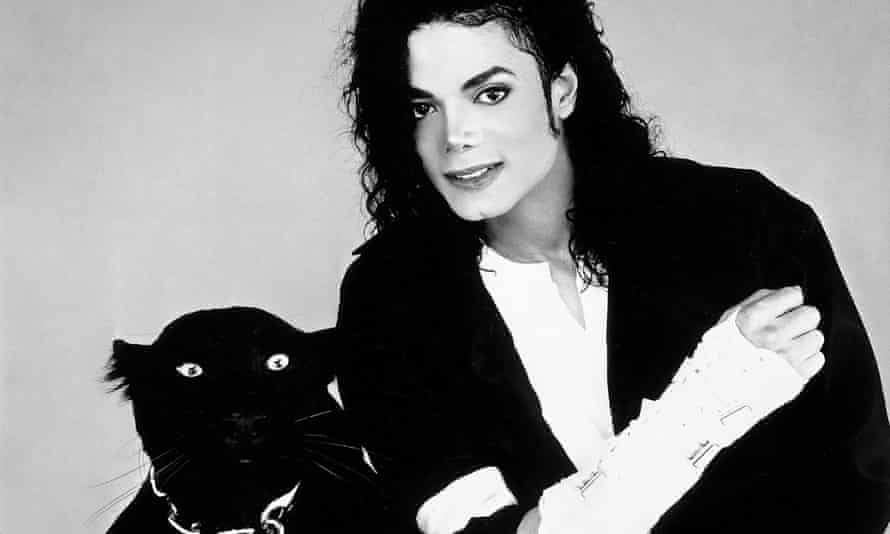
Yet amongst the controversy (nigh in the media simply dismissed information technology as a "publicity stunt"), very few asked the uncomplicated question: what did it mean? Couched in between the Rodney Rex beating and the Los Angeles riots, information technology seems crazy in retrospect not to translate the short moving picture in that context. Racial tensions in the US, in LA in detail, were hot. In this climate, Michael Jackson – the world's well-nigh famous black entertainer – made a curt film in which he escapes the confines of the Hollywood sound stage, transforms into a black panther and channels the pent-up rage and indignation of a nation and moment. Jackson himself later explained that in the coda he wanted "to do a dance number where I [could] let out my frustration nigh injustice and prejudice and racism and bigotry, and inside the dance I became upset and let get."
The Black or White brusque movie was no bibelot in its racial messaging. The Dangerous album, from its songs to its short films, not only highlights black talent, styles and sounds, simply also acts as a kind of tribute to black civilization. Perhaps the most obvious example of this is the video for Remember the Fourth dimension. Featuring some of the era's almost prominent black luminaries – Magic Johnson, Eddie Murphy and Iman – the video is set in ancient Arab republic of egypt. In contrast to Hollywood'south stereotypical representations of African Americans as servants, Jackson presents them here as royalty.
Promised a sizable production budget, Jackson enlisted John Singleton, a young, rising black director coming off the success of Boyz Northward the Hood, for which he received an Oscar nomination. Jackson and Singleton's collaboration resulted in one of the nearly lavish and memorable music videos of his career, highlighted by the intricate, hieroglyphic hip-hop dance sequence (choreographed by Fatima Robinson). Once more, in this video, Jackson appeared whiter than ever, just the video – directed, choreographed by and featuring black talent – was a celebration of black history, art, and beauty.
The song, in fact, was produced and co-written by some other young black ascension star, Teddy Riley, the architect of new jack swing. Prior to Riley, Jackson had reached out to a range of other black artists and producers, including LA Reid, Babyface, Bryan Loren and LL Cool J, searching for someone with whom he could develop a new, post-Quincy Jones sound. He constitute what he was looking for in Riley, whose grooves contained the punch of hip-hop, the swing of jazz and the chords of the blackness church. Remember the Time is perhaps their best-known collaboration, with its warm organ bedrock and tight drum machine beat. It became a huge hitting on black radio, and reached No i on Billboard'due south R&B/hip-hop nautical chart.
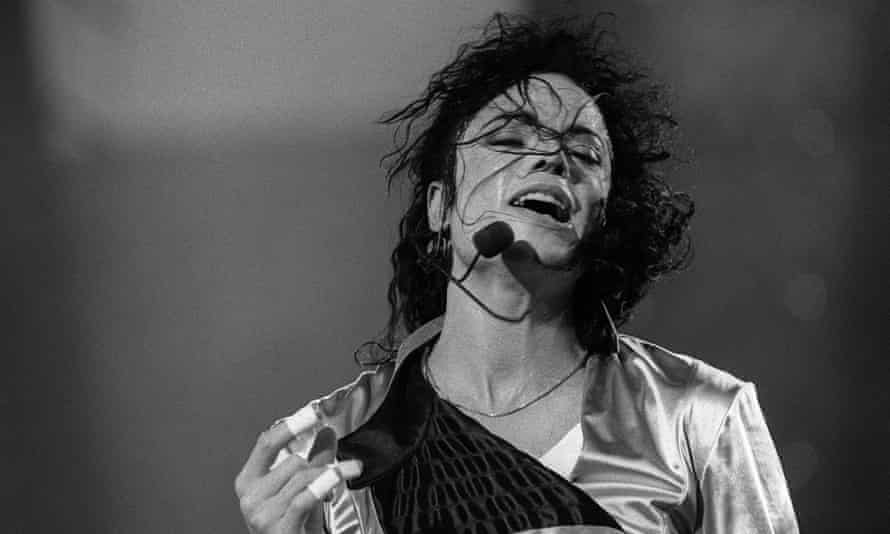
The first six tracks on Dangerous are Jackson-Riley collaborations. They sounded like nix Jackson had washed before, from the glass-shattering, horn-flavoured verve of Jam to the factory-forged, industrial funk of the title rail. In place of Thriller's pristine crossover R&B and Bad's cinematic drama are a sound and bulletin that are more raw, urgent and attuned to the streets. On She Drives Me Wild, the artist builds an unabridged song effectually street sounds: engines; horns; slamming doors and sirens. On several other songs Jackson integrated rap, one of the start pop artists – along with Prince – to do so.
Dangerous went on to become Jackson's best-selling album after Thriller, shifting 7m copies in the United states of america and more than 32m copies worldwide. Withal at the time, many viewed it every bit Jackson's concluding desperate attempt to reclaim his throne. When Nirvana'due south Nevermind replaced Dangerous at the top of the charts in the second week of January 1992, white stone critics gleefully declared the Male monarch of Pop'southward reign over. Information technology's like shooting fish in a barrel to see the symbolism of that moment. Yet Dangerous has anile well. Returning to information technology now, without the hype or biases that accompanied its release in the early 90s, one gets a clearer sense of its significance. Like Nevermind, information technology surveyed the cultural scene – and the internal anguish of its creator – in compelling ways. Moreover, it could be argued that Dangerous was just as significant to the transformation of black music (R&B/new jack swing) as Nevermind was to white music (alternative/grunge). The contemporary music scene is certainly far more than indebted to Dangerous ( ie Finesse, the recent new jack-inflected single from Bruno Mars and Cardi B).
Merely recently, however, have critics begun to reassess the significance of Dangerous. In a 2009 Guardian article, it is referred to every bit Jackson'southward "true career high." In her book on the anthology for Bloomsbury's 33 ⅓ serial, Susan Fast describes Dangerous as the artist's "coming of historic period album". The record, she writes, "offers Jackson on a threshold, finally inhabiting adulthood – isn't this what so many said was missing? – and doing so through an immersion in black music that would merely continue to deepen in his afterwards work."
That immersion continued equally well in his visual work, which, in addition to Blackness or White and Remember the Time, showcased the elegant athleticism of basketball game superstar Michael Jordan in the music video for Jam and the palpable sensuality of Naomi Campbell in the sepia-coloured short motion picture for In the Closet. A few years later, he worked with Fasten Lee on the well-nigh pointed racial salvo of his career, They Don't Care Virtually U.s.a., which has been resurrected equally an anthem for the Black Lives Matter motion. Still, critics, comedians and the public alike continued to suggest Jackson was ashamed of his race. "Only in America," went a common joke, "can a poor blackness boy abound upward to exist a rich white woman."
Yet Jackson demonstrated that race is most more than mere pigmentation or physical features. While his skin became whiter, his work in the 1990s was never more infused with black pride, talent, inspiration and culture.
Source: https://www.theguardian.com/music/2018/mar/17/black-and-white-how-dangerous-kicked-off-michael-jacksons-race-paradox
0 Response to "Michael Edited to Be Black Again"
Post a Comment