Example Html Code Meta Tags Upload Html Code Meta Tags
Understand How Meta Tags Affect Search Engine Crawlers
Nosotros all talk near on-page and off-folio SEO and how useful information technology is for boosting the ranking potential of your site. But today, we're going to dig fifty-fifty deeper—into the nitty-gritty technical aspects of meta tags and their bear upon on your SERP rankings.
There are a lot of unlike meta tags, and each one has a specific purpose, often related to telling search engine crawlers and browsers how to interpret your site. But not all meta tags are created equal—some bear upon how your content appears in the SERP while others tell crawlers and browsers how to interpret your folio.
Whether you lot're building a new page or optimizing an existing one, agreement how to use meta tags and which ones to focus on can have a significant impact on how search engines and website visitors collaborate with your content.
Meta tags are HTML elements in the head department of your website. Search engines use them to acquire specific information about your page, such as the title and description of the content. While these meta tags won't be displayed to readers on your website directly, they are a vital piece of any technical SEO audit.
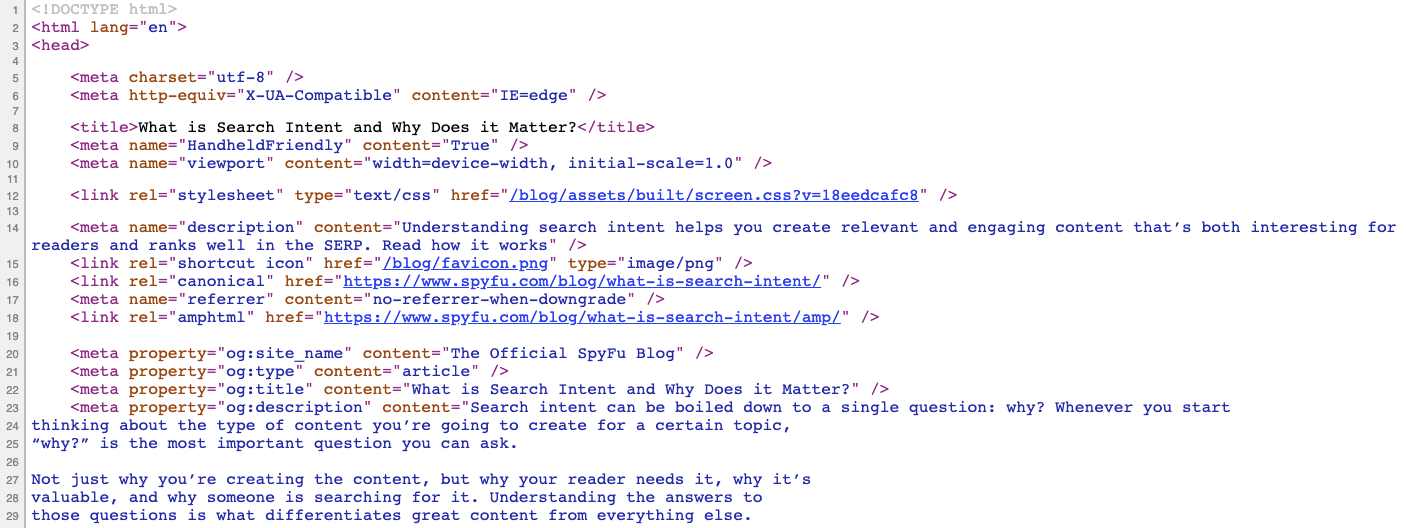
Each of these tags provides an important piece of information well-nigh how spider web crawlers should parse the metadata on your website. Basically, it'due south a way to tell search engines, and sometimes browsers, how to interpret the content you've created.
Let's break downwardly some of the of import meta tags in the screenshot example:
<meta charset="utf-8" />
This defines the grapheme encoding for your website. It tells browsers and search engines how to translate the code/content of your website at the base level. Basically, it's defining the language your website uses. UTF-8, also known as Unicode, is the graphic symbol encoding that covers almost all of the characters and symbols in the world.
<title>What is Search Intent and Why Does it Matter?</title>
The title of the page will appear as the title in the SERP.
<meta name="description" content="Understanding search intent helps you lot create relevant and engaging content that'due south both interesting for readers and ranks well in the SERP. Read how it works" />
This tag summarizes your page'due south content and will display below the championship in the SERP and volition tell searchers whether or not the folio will help respond their query. Just keep in heed that Google can also pull content from your folio directly for various unlike search features.
The title and meta description are probably the nearly important tags you define on a folio-by-page ground, every bit they're going to be unique to the content that'due south displayed. In the screenshot, nosotros also see the following meta tags:
<meta http-equiv="X-UA-Uniform" content="IE=edge" />
<meta proper name="HandheldFriendly" content="Truthful" />
<meta name="viewport" content="width=device-width, initial-calibration=1.0" />
All three of these impact how your entire page volition be displayed on unlike browsers or mobile devices.
- X-UA-Compatible tells Microsoft Edge to display the page in the highest mode possible.
- HandheldFriendly tells browsers and spider web crawlers that your site uses mobile markup—significant that the page is optimized for mobile browsers.
- Viewport tells browsers how to control the folio'southward dimensions and scaling when your site is viewed on unlike devices (desktop, phone, tablet, etc.).
And the list goes on. At that place are a lot more meta tags that tell browsers and crawlers how to interpret your website, which we'll dig into in the next section.
The Departure between SEO Meta Tags and Open Graph Meta Tags
There are tags in our screenshot that include OG in the property designation:
<meta property="og:site_name" content="The Official SpyFu Blog" />
<meta belongings="og:type" content="article" />
<meta holding="og:title" content="What is Search Intent and Why Does it Matter?" />
It's important to include these tags in your weblog content to ensure that sharing it is a seamless experience for readers. If y'all don't, when a reader shares your content their post volition merely include the URL for your commodity itself, no championship, image, or description volition appear.
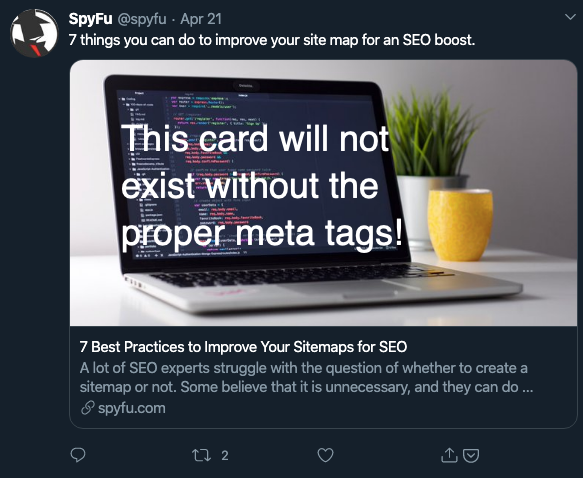
Including these tags tin drive traffic dorsum to your site and promote your make.
Call up of meta tags equally a kind of roadmap for search engine crawlers. Whenever a bot lands on your website, its goal is to larn as much as possible and bring that information dorsum to its respective search engine for indexing. Proper meta tag usage ensures that you're telling these bots the right data in a fashion that's like shooting fish in a barrel for them to parse.
We can interruption downward the different meta tags based on what they tell crawlers almost your website. There are meta tags that:
- tell crawlers how to interact with your website
- tell search engines how to display information in the SERP
- tell browsers and devices how to display your site when it's accessed
Meta Tags That Impact How Crawlers Interact With Your Website
Every bit shortly as a crawler lands on your site, the bot needs to understand how to interact with it. If you lot're not defining certain meta tags in the <head> section of your website, it's incommunicable for web crawlers to understand the data they're meant to read. Some of these elements volition be defined at the site level, like charset and hreflang, but others will define how specific pages should be crawled.
Charset Meta Tag
<meta charset="utf-8" />
We referenced this earlier, but this meta tag is one of the first things a crawler needs to know when they access your website. That's why information technology'southward the first meta tag you'll see in the <head> section of your website. Without it, both crawlers and browsers won't be able to render your site.
Hreflang Meta Tag
There are basically 2 ways to ascertain the linguistic communication that'due south beingness used on your website. The offset is a universal HTML tag that appears at the top of your website'south source lawmaking:

This is a simple way to define the content of a website that is static across the entirety of the content you produce. The other way is through the utilize of an hreflang meta tag, which is more oftentimes used for indexing a multi-lingual website.
<link rel="alternating" href="http://instance.com/" hreflang="en" />
<link rel="alternating" href="http://example.fr/" hreflang="fr" />
This example includes a website that has both an English language and a French version. Past defining which linguistic communication is used for each site, you're telling Google to index each individually. That ensures that the English variant will appear in English search results and the French variant in French results.
While this may not be pertinent for every website, information technology'southward of import to understand how linguistic communication and land origin impact the indexing (and therefore rankability) of a given website. If you're using the hreflang tag, merely make sure to follow all Google guidelines for designating the correct country. The more countries you're translating content for, the more complicated it volition get.
Now, allow'southward motion on to the tags that define how your website should exist crawled.
Robots Meta Tag
<meta proper name="robots" content="noindex" />
Sometimes you may need to tell crawlers to featherbed certain pages of your website for indexing. Whether those pages contain sensitive data or are but not built to bear witness up in the SERP, applying a robots meta tag with the noindex designation volition make any crawlers ignore that page.
Merely make sure you lot're not using this on a page that you want people to be able to notice through search. This meta tag will remove the page from a search engine's index entirely.
Keywords Meta Tag
<meta name="keywords" content="SEO,Competitor Analysis, SpyFu">
The keywords meta tag was originally created to define a fix of relevant keywords for specific pages of your website. We say "was" because information technology'southward an outdated method of SEO optimization that dates back to 1995 when search engines weren't nearly as powerful as they are today.
We don't recommend you use this meta tag on your website considering, ultimately, it serves no purpose. Google et al. will crawl your site content direct and make a conclusion nearly what keywords are relevant to the page itself. Only it is still something you lot might see in older websites that have been around since the early 2000s. Information technology helps to be familiar with what you need also equally what you don't need.
Canonical Meta Tag
<link rel="canonical" href="https://www.spyfu.com/weblog/what-is-search-intent/" />
This meta tag tells search engines which folio is the primary copy of any given page. It'due south used to cutting downwardly on the potential for duplicate content and tells the search engine which version of your page should be displayed in the SERP. You should define this on every folio of your blog, even when syndicating content to other publications like LinkedIn or Medium, so you don't end upwardly cannibalizing your rankings with multiple versions of the same page.
Using this tag as well helps you cutting downward on the time it takes for crawlers to read your entire site, which mitigates any negative impact on site speed while they motion through every page.
Site Verification Meta Tag
<meta name="google-site-verification" content="your verification string">
Site verification is a process where you claim ownership over a given folio of your website. The site verification meta tag is not the only way to verify your site with Google and is therefore used more than as a fill-in verification method.
If you're worried most verifying your ownership of the site, you lot'll be able to receive a specific verification string from Google to plug into the lawmaking directly. It volition ensure that the content is linked to the correct Google account of your choosing.
Meta Tags That Impact How Your Website Appears in the SERP
Whenever someone searches for a particular question or keyword, search engines have to determine what results are the best friction match to respond that question. Once they've ranked the results, they then need to brandish them on the SERP. That's where your title, clarification, and URL meta tags come into play. Past defining these elements in the <head> section of your website, you're telling the search engine exactly what information you lot want to be displayed.

This will look familiar to everyone, but it wouldn't be possible without defining the proper meta tags for each folio of your website.
Meta Tags That Define How Your Website is Rendered
These meta tags volition assistance you manage how your website appears in the unlike browsers and devices that searchers use. Many volition be ready directly at the website level, but you all the same need to understand how they work to ensure your technical SEO is the best it can exist.
Viewport Meta Tag
<meta name="viewport" content="width=device-width, initial-scale=i.0" />
The viewport tag is one of the core components of mobile responsiveness. This meta tag gives browsers the information they need to return your site correctly across multiple dissimilar devices.
It'due south of import to define information technology properly. Failing to do and so can create a poor experience when people browse your website, which tin negatively impact your rankings in the SERP. It's 1 of the best tools y'all have for ensuring a seamless experience regardless of how a user interacts with your website.
Refresh Meta Tag
<meta http-equiv="refresh" content="Ten">
This meta tag is a method for telling a given page to refresh every X number of seconds. Spam websites often utilise this tactic to increase the amount of ad acquirement they can gain from a given page past updating the ads that are displayed a number of times per each site visit.
The only applied example of using a refresh like this would be for interstitial pages, similar those that say "This page volition redirect automatically after xv seconds," which are unremarkably used in the mail service-purchase experience.
We don't recommend using this as a redirect method for your website because information technology can negatively impact your rankings if crawlers meet a number of pages refreshing in this way. There are also a lot of other methods to refresh that are much better for SEO.
Now that you understand a bit more about how these different meta tags impact the SEO of your website, we'll interruption down some best practices for how to use them effectively across the lath.
Meta tags dictate much of how spider web crawlers interact with your website, and so you need to get them right. If you're not using the correct syntax or ignoring character limits, you lot run the risk of negatively impacting your rankings and confusing searchers at the same time.
While most CMS platforms will have born functionality to help you define these meta tags, at least at the website level, it'due south important to bank check each folio of your website earlier information technology'southward published or after it's updated. Doing and so volition ensure that, even with your careful consideration of these meta tags, you lot don't run into any problems.
There are also plugins like Yoast for WordPress that make the process of updating meta tags easier. These kinds of third-party plugins are a great choice if you're not comfortable interacting with code directly on your website. In some cases they guide y'all toward best practices for SEO.
Equally with any HTML, the syntax you employ is ready. Utilise resources similar W3 to double-check how to write these meta tags earlier going alive with any updates.
Character limits are also important, especially for your meta title and clarification. If you're not careful, yous'll cease upward truncating important information, so searchers can't notice it. Information technology is by and large accustomed that a meta championship should exist no more than sixty characters, and a meta description should exist no more than 158 characters. Take this example, where the 2nd sentence of the meta clarification is cut off abruptly without providing any information.

That said, on mobile, search engines will truncate your meta descriptions, so y'all'll want to aim for less than 120 characters.As long as you're post-obit these best practices, you should have no problem giving web crawlers the information they need to properly alphabetize your site. That, in turn, volition requite searchers a better overall experience interacting with your website in the SERP.
When y'all use the right meta tags in the right way on your website, they tell search engines everything they demand to know about your website. Having that information readily bachelor makes it piece of cake for crawlers to parse the data and bring it dorsum to be indexed.
Optimizing your meta tags can, therefore, positively bear on your ranking ability and provide searchers with a better overall SERP feel. Don't let misplaced or poorly constructed meta tags cause trouble for the SEO of your website.
Source: https://www.spyfu.com/blog/how-seo-meta-tags-work/
0 Response to "Example Html Code Meta Tags Upload Html Code Meta Tags"
Post a Comment